Darktrace and Cybereason: The Intelligence Front Companies Seeking to Subjugate the World with the A.I. Singularity
Darktrace and Cybereason: The Intelligence Front Companies Seeking to Subjugate the World with the A.I. Singularity
Meet two powerful cybersecurity companies riddled with American, British, and Israeli intelligence agents who plan on using AI technology to target foreign populations as well as their own.
Johnny Vedmore
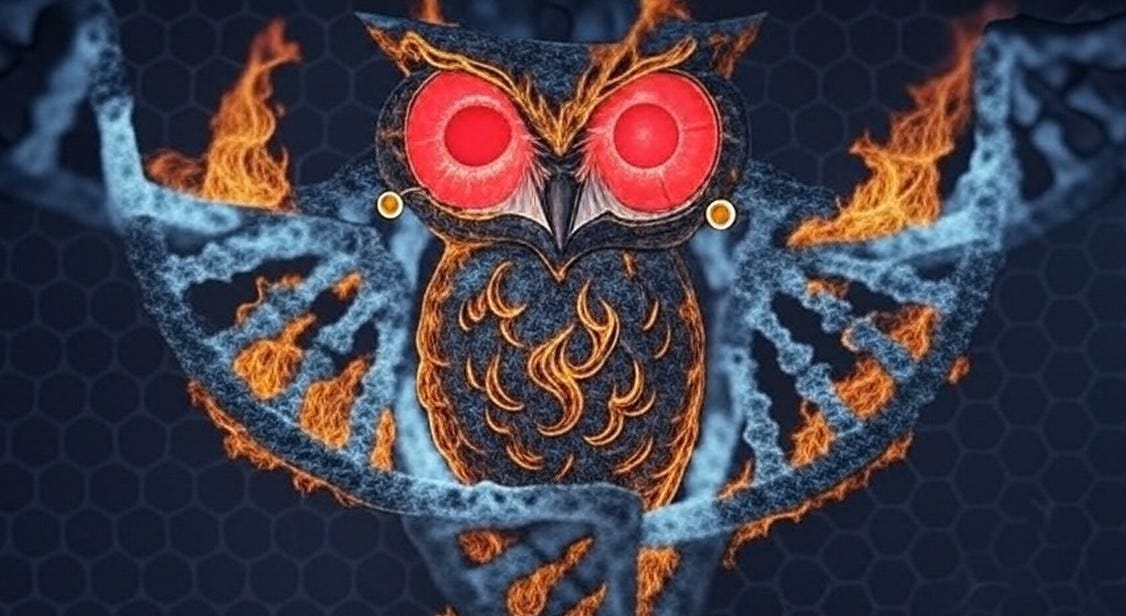
We have all been dreaming, a dream where you can float or glide across your dreamscape effortlessly. This leads to a feeling of trepidation, as if you can let go, and if you do, you’ll either soar or fall.
We’re now at a point in history where either the coming events will be studied for thousands of years, or they will be remembered as the point where we lost our humanity completely. Artificial Intelligence (A.I.) technology has entered a new phase over the past several years, where instead of the A.I. algorithms learning from humans, they are now teaching themselves, changing their own algorithms as they learn. We are on the cusp of letting go of control entirely, so early on, because of a few small companies that have quietly been given free rein under the guise of “protecting” our digital lives, all within a tech sector that is moving so fast that we can no longer see what’s just around the bend.
The entire free-thinking population of Earth would love a little more time to discuss such epochal change. However, the technocrats and scientists, supported by venture capitalists, are already implementing the future before the masses have a chance even to consider discussing its consequences. With very little legislation governing A.I. technologies on the books, our governments are eager to get every tech pioneer inventing, whilst there is no accountability for any resulting harm. We’re not talking major societal disruption, we’re talking about a potential extinction-level event of our own creation. Where we should be taking cautious baby steps, instead, we’re expecting to fly just by letting go.
We are on the cusp of a monumental technological shift, beginning with “next-generation” cybersecurity that will then rapidly advance into uncharted territory. Unsupervised AI, now running on critical networks worldwide as a “cybersecurity” product, is evolving its own algorithm without human involvement. Meanwhile, the wealthy patrons funding this cutting-edge future tech are out in force, working to propel our societies into this new, unexplored and dystopian technological frontier.
But who are the companies that these eager, wealthy venture capitalists are funding to create an autonomous, AI-powered cyber defence system like never before? Are they even companies at all when we consider their deep and direct ties to intelligence agencies? Should these firms instead be reclassified as simply extensions of state intelligence apparatus acting without the restrictions of public accountability?
Each of these companies has been built by teams of former intelligence operatives, some of whom have sat in the highest echelons of the intelligence apparatus of their respective countries. MI5 and CIA both carry considerable weight in these sinister-sounding enterprises. Still, it is Israel’s Unit 8200 that is the main group capitalising on this advance into the world-altering realm of unsupervised Artificial Intelligence algorithms.
Yet, these very companies are selling a defence against a potential apocalypse that they themselves may be responsible for. They have the solutions to everyone’s cyber-woes, or at least that’s the image they wish to portray. Let me introduce you to the most dangerous intelligence operations masquerading as cybersecurity companies on planet Earth.
Darktrace – The Unsupervised Machine Learning A.I. Cybersecurity Solution
The members of Darktrace are open about their aims. They discuss publicly held data as if they already have the right to sell it to anyone worldwide. Data is the fuel of the Fourth Industrial Revolution, and Darktrace has made almost $2 billion in the data business during its relatively short history, reaching Unicorn status with great ease. When Darktrace first launched its website in 2013, its description of the company’s vision was entitled, “The New Normal: Learn Human and Machine Behavior to Reduce Cyber Security Risks.” Back then, we were less familiar with the term “the new normal,” but now it surrounds us. Darktrace is already active within the NHS, the U.K. power grid, and many other significant parts of Britain’s critical infrastructure, and they are rapidly expanding around the globe.
Dave Palmer was an MI5 anti-terror agent working on the 2012 London Olympics when he and some of his colleagues first bashed out the initial idea for what would become Darktrace. They aimed to develop an AI cybersecurity system modelled after the human immune system, offering a departure from traditional, reactive antivirus software approaches. This system identifies abnormalities in a computer network’s processes, targeting a broader range of sophisticated cyber issues.
Palmer had spent 14 years working for MI5 and GCHQ, creating secure networks for British spies to communicate. He would eventually approach two mathematicians from Cambridge University to help make his dreams a reality at the tail end of 2012. These mathematicians were working on projects related to using unsupervised machine learning to teach a computer to have a sense of self, a step that would bring such technology dangerously close to the so-called singularity. At that point, as critics and proponents of self-aware A.I. alike have warned, machine intelligence will not only surpass human intelligence, but advance at an incomprehensible rate, which has major and world-altering implications.
In a 2016 TechCrunch talk, Poppy Gustafsson, the newly appointed co-CEO of Darktrace, was caught misleading the audience about the company’s origins. She uses the TechCrunch stage to claim that the “spark” for the creation of Darktrace originally came from the mathematicians at Cambridge and downplays the involvement of intelligence agencies like MI5, GCHQ, and the CIA. The TechCrunch moderator, Natasha Lomas, displayed some fine journalistic integrity on this occasion and asked for clarification.
“So did the maths research come first, and then you got together with the spies. Which way round was it?”
asked the intrepid Lomas. Gustafsson squirms a little before saying:
“It was exactly that. First, the machine learning discussion focused on how to critique a computer to help it understand itself. And then it was the, um, experts from the government intelligence agencies who thought ‘ooh, this could be applied to the problem of cybersecurity.’”
But that statement was an outright lie, and Gustafsson isn’t the most skilled deceiver.
Gustafsson, who was initially CFO and COO for the fledgling Darktrace, runs the company alongside the other co-CEO, Nicole Eagen, an alumnus of Oracle. This major tech company also has its origins in intelligence. Both parts of Darktrace’s female power duo were brought over from Invoke Capital by Darktrace’s initial angel investor and advisory board member, UK billionaire Dr Mike Lynch OBE. Describing himself as the “UK’s answer to Bill Gates“, Dr Mike Lynch is lauded as one of the most influential investors in the tech sector. His previous successful endeavours had been with Autonomy, a tech firm that had Lynch caught up in a legal wrangle with HP over the fraudulent inflation of its valuation, and Blinkx, a video search company where Lynch was later forced to step down from the board.

Dr Mike Lynch’s problems with Hewlett-Packard are not to be understated, as was made clear in a Telegraph article that described it as “the trial of the century.” However, before that spectacle can take place, Mike Lynch must first be extradited. His protracted court battle to resist extradition has led to uncertainty surrounding Darktrace’s future while Lynch remains active within the company. It was also recently reported in the mainstream media that the Wall Street bank Goldman Sachs had declined to take a role in the initial public offering (IPO) of Darktrace due to Mike Lynch’s ongoing extradition battle.
Yet, Darktrace is not just one man working alone. The company boasts that over 4000 organisations worldwide now rely on Darktrace’s AI technologies. With headquarters in San Francisco, US, and Cambridge, UK, Darktrace has over 1300 employees spread across 44 countries, and its workforce is growing. And although the connections to the state intelligence agencies are clear and unmistakable, Darktrace is officially a completely private enterprise with big investors including KKR, Summit Partners, Vitruvian Partners, Samsung Ventures, TenEleven Ventures, Hoxton Ventures, Talis Capital, Invoke Capital and Insight Venture Partners. Sitting alongside the controversial Dr Mike Lynch OBE on the advisory board for Darktrace are some seriously influential people deeply connected to US and UK intelligence agencies.
One of the first members appointed to Darktrace’s advisory board was Jonathan Evans, also referred to as Baron Evans of Weardale. Evans was previously the Director General of MI5, taking over from Dame Eliza Manningham-Buller in 2007 and staying in the most senior intelligence role that the UK has to offer until 2013. After his time as head of MI5, Evans initially joined HSBC Holdings as a non-executive Director, a role he also took up at Ark, a highly secure UK data centre.
If you were to walk into the advisory boardroom at Darktrace, you could be forgiven for thinking that you were actually attending a U.K. Home Office meeting from the past. The former Home Secretary under Prime Minister Theresa May, Amber Rudd, joined Darktrace after her time in government ended in 2019. She is also on the advisory team of Teneo, a consulting firm co-founded and led by Doug Band, the former advisor to Bill Clinton and close friend of the infamous Jeffrey Epstein. As always, when investigating the murky world of intelligence, many connections to Epstein and his partner Ghislaine Maxwell are revealed.
With that being said, yet another member of Darktrace’s advisory board also has Epstein/Maxwell links. The CIA stalwart, Alan Wade, is one of the most interesting members of the Darktrace advisory team. He was announced as joining their growing advisory board on 10 May 2016, having previously served as the Chief Information Officer of the Central Intelligence Agency. His thirty-five-year career at the top echelons of the CIA ended in 2006, and afterwards, he dedicated his time to assisting companies with CIA links from the private sector.
While he had been at one of the top posts in the entire U.S. intelligence community, Wade co-founded Chiliad alongside Ghislaine Maxwell’s sister, Christine Maxwell. As Unlimited Hangout reported earlier this year, Christine Maxwell was personally involved in leading the operations of the front company used by Robert Maxwell to market the PROMIS software, which had a backdoor for Israeli intelligence, to both the U.S. public and private sectors. Given this history, it is certainly telling that Wade would choose to co-found a major software company with Christine Maxwell of all people.
When it was still active as a company, Chiliad described itself as “the leader in data analysis across clouds, agencies, departments and other stovepipes”, and it ran on the computers and databases of nearly every major national security system in the U.S. government. But nowadays, its defunct website gives us just the standard error message.
Rounding out the Darktrace advisory board is their token academic, Professor Nick Jennings CB FREng, who serves as the Vice-Provost for Research and Enterprise at Imperial College London. Yet, Jennings has also been the U.K. Government’s Chief Scientific Advisor for National Security and is currently a member of the U.K. government’s AI council. This position aligns well with Darktrace’s ambitions.
The leadership and board of Darktrace are poised to offer a solution to all our cybersecurity-related problems. You can install a box and let Darktrace care for your network, placing your trust in an A.I. approaching self-awareness that is managed by intelligence-linked individuals with questionable pasts, all for peace of mind and “convenience.” But what will they be fighting?
Cybereason – From Offensive, State-Sponsored Hackers to A.I. Cybersecurity
As we have experienced at other memorable moments in history, coincidental simulations before or during any intelligence agency-led manipulated event are commonplace. On this occasion, Cybereason is here to provide us with a short glimpse of our impending fears. In multiple simulations Cybereason has run over the last few years, they have been gaming out how potential cyberattacks could cause an unthinkable disaster for the U.S. 2020 election.
Cybereason’s CEO and co-founder is an enigmatic former Israeli Intelligence agent, Lior Div-Cohen, often referred to as Lior Div. Div, an IDF Medal of Honor recipient and former Israeli Unit 8200 member, co-founded Cybereason in 2012 alongside Yossi Naar and Yonatan Striem-Amit, who are also fellow veterans of Israel’s military cybersecurity corps. A scholar from the Academic College of Tel-Aviv, Lior Div, subsequently worked as a software engineer for Xacct, a network service provider, before joining the notorious firm Amdocs, which was accused of eavesdropping on American government officials on behalf of Israel. In between Amdocs and Cybereason, Lior Div was the CEO and co-founder of Israeli cybersecurity firm AlfaTech, which is described in its national media as “a cybersecurity services company for Israeli government agencies.”
Cybereason, in a bizarre advert promoting a fictional product they called Cyberblast, described themselves as:
“The leader in endpoint protection, offering endpoint detection and response, next-generation antivirus, and managed monitoring services powered by paradigm-shifting, military-grade technology leveraging artificial intelligence and machine learning.”
The marketers at Cybereason have gone all out to present themselves as a Silicon Valley-style start-up, where they spend their days cooking, drinking, dancing, and doing barely any work. Still, in reality, it is a company partially owned by such defence giants as Lockheed Martin, which have very close ties to the Israeli intelligence apparatus. Through their partnership with Lockheed Martin, Cybereason now his its A.I.-driven cybersecurity software running on some of the U.S. government’s most classified networks, including numerous critical U.S. military systems.
Yet, it’s not only primary weapons developers like Lockheed Martin who have invested in this hi-tech cybersecurity platform. Reuters reported in August 2019 that Japanese firm Softbank had invested previously in the company, along with venture capital firms CRV and Spark Capital. Spark Capital’s investment portfolio includes Twitter, Oculus, Wayfair, Coinbase, Plaid, among many other big players. CRV’s investments include Dropbox, Patreon, as well as A.I. and machine learning related enterprises such as Standard Cognition and Dyno Therapeutics.
Similar to Darktrace, Cybereason offers a next-generation antivirus technology that, instead of responding to attacks when detected, uses AI and machine learning to identify abnormalities in a network’s usual processes in real time.
Some of the simulations that Cybereason have hosted over the past two years have led us to election day. In a video entitled ”2018 -10 Hacking the Vote” from a scenario and simulation titled “Blackout: Protect the Vote,” the simulation examines which parts of the election day processes were vulnerable to hackers. They make clear from the start that it won’t be all about voting machines themselves.
Operation Blackout
Nolandia, the fictional city which was ground zero during Operation Blackout, was based on an average American city nestled within a crucial swing state on election day. Here in Nolandia, three teams of cyber-fighters would battle with each other over control of the town.
These would be the three teams, each with succinct roles in the polling day pretence, as told to us by Cybereason’s Ross Rustici and Sam Curry:
Red Team AKA Broken Eagle Task Force: The basic aim of the Broken Eagle Task Force was to disrupt the election processes in real time. The Red’s approach evolved throughout the simulation from causing as much harm as they could to making the result of the election as uncertain and politically biased as possible. They attempted to control the narrative that the system was broken and that the elections could not be trusted.
Blue Team AKA Nolandia Event Task Force: The Blues were fundamentally reactive during the simulation and were constantly on the back foot. The Blues, responding to a reported gas leak at a Nolandia polling station early in the scenario, contacted the Secretary of State’s office to ask whether they needed to close the polling station. Luckily, the real State Department had two advisors sitting in on the simulation who were able to offer alternative contingency plans that existed in real-world America. By the end of the simulation, the Blues were all aware that they had largely failed the exercise.
White Team AKA White Control Team: This team acted as support to give advice or permission to either team, in a role very much like the Dungeon Master in a D&D game. The White’s main task was to balance the realism of the scenario and create problems for either team that they’d experience in the real world.
In November 2019, Cybereason re-ran their election day attack simulation at an event in Washington, D.C. and has run multiple simulations over the last year. The last imagined American city was called Adversaria. As the election day creeps ever closer, Cybereason have been releasing its more well-produced promo videos online. If you’re paying very close attention, then you will have noticed that Cybereason have spent all of October 2020 marketing heavily as their big day approaches. Representatives of Cybereason are being quoted in nearly every mainstream scare story.
Vice News released an article on 7 October entitled: “Hospitals Have Become ‘Prime Targets’ for Crippling Ransomware Attacks,” where they quote Israel Barak, Cybereason’s Chief Information Security Officer. The article states that Barak is “a cyber warfare expert at Cybereason, who spent nine years in the Israel Defence Forces specialising in cyber defence systems.” And when Computer Weekly’s Adam Scroxton reported on the conviction of the six supposed Russian hackers in the famous NotPetya attack on 20 October, Cybereason rolled out its CSO, Sam Curry, to give a statement.
In a 5-minute video released by the channel Freethink on 21 October 2020, entitled “Hackers Simulate Election Day Blackout,” Sam Curry, Cybereason’s Chief Security Officer, speaks openly about the possibilities of election day interference happening in the coming Presidential showdown.
“No one has seen an election like we expect the 2020 Presidential Election to be,” says Curry, “the stakes are high for 2020. Frankly, this is the game to win.”
In a Wired article on 22 October titled: 12 Cyber Threats That Could Wreak Havoc on the Election, Wired explains:
“The security firm Cybereason last year ran a series of tabletop exercises specifically looking at how real-world attacks might impact Election Day. One exercise focused on a hacktivist group—known in the exercise as “Kill Organized Systems (K-OS),” pun intended—that disrupted traffic lights and brought the election to a standstill by paralyzing the city’s transportation system.”
The media appearances for Cybereason have never come so thick and fast as they have this past October. One could even assume that these appearances are part of a media campaign leading up to a significant event.
And then, on 26 October 2020, Cybereason released a new promo video entitled: “We are the Defenders. The first to your fight.” In the two-minute piece, a Hollywood-esque movie intro narrator is accompanied by a CGI killer robot owl, with knives for wings and evil glowing eyes. They’re obviously looking to project their image as one of the wise, old protectors of cyberspace, or maybe something much worse. Regardless of the reason for the killer robot owls, Cybereason are sinister enough without them.
The Usual Suspects
Cybereason also has links to one of the usual suspects, Brigadier Pinchas Buchris. The former Deputy Commander of an elite IDF operations unit and former Commander of the IDF 8200 Cyber Intelligence Unit, he was also Director General of the Israeli Ministry of Defense, CEO of Oil Refineries Ltd and serves as an AIPAC board member. This high-flying Israeli intelligence operative joined the board of Cybereason shortly after his time spent at Carbyne911. Carbyne, an Israeli 911 call platform that received initial investment from Jeffrey Epstein, Nicole Junkermann, and Peter Thiel, was founded by Ehud Barak and other former Israeli intelligence officials.
Carbyne911 is an excellent example of how Israeli intelligence companies are trying to subvert and infiltrate our current systems. And since my initial article exposing their sinister team of ex-Unit 8200 members in 2019, Carbyne has had to change nearly every member of their advisory board. Now, the members chosen to be on their board are almost all ex-American intelligence and state representatives, with barely a Unit 8200 member anywhere in sight. This was an obvious attempt to distance the company from Israeli intelligence and steamroll on towards their aim to be in control of the private data of every American. Carbyne911 have been pushing to be involved in the Covid-19 track and trace apps, as well as continuing to try to take over the American emergency services communication infrastructure. The people now occupying these positions at Carbyne911 will be examined in greater detail on another day.

Darktrace, Cybereason and Carbyne911 aren’t simply pioneers in a fast-moving tech sector. Instead, they are intrinsically linked to the same old intelligence agencies who are attempting to reinvent themselves under a different, more acceptable guise. They are creating the infrastructure designed to subvert our current systems. An unsupervised A.I. behemoth that will require as much data as possible to power, and our governments have already agreed to give away everything they can.
All of these technologies must be considered not only in relation to an election day cyber-attack or a terrorist event, but also within their original and broader context. The Cambridge mathematicians behind Darktrace’s creation weren’t originally looking to prevent a cyberattack on Election Day 2020. These high-flying math geniuses were trying to create the singularity, the creation of self learning AI. This advancing technology will soon be fed with more data sets than the human brain can imagine. In a move to take self-learning A.I. online, the cyber threat to the elections will serve as a smoke screen to avoid the larger, more pertinent public policy questions concerning the safety and ethics of unsupervised self-learning A.I., and more importantly, the significant risks attached to these unknown systems.
The companies holding this all-powerful future tech no longer bother to hide their associations and allegiances. Their various companies are riddled with American, British, and Israeli intelligence agents who plan on using this kind of technology to target their own populations. It is no coincidence, then, that some of these same nations have been covertly working on developing an AI that would replace human hackers, thereby automating the very threat that companies like Darktrace and Cybereason claim to be guarding us against.
Source: Johnny Vedmore's Substack


Comments
Post a Comment