‘Expresso Vaccines’ and Lessons from the American Chestnut Tree
‘Expresso Vaccines’ and Lessons from the American Chestnut Tree
Why a vaccine designed in two days faced less regulatory scrutiny than a venerable nut tree that sustained life for centuries
Dr. Mathew Maavak
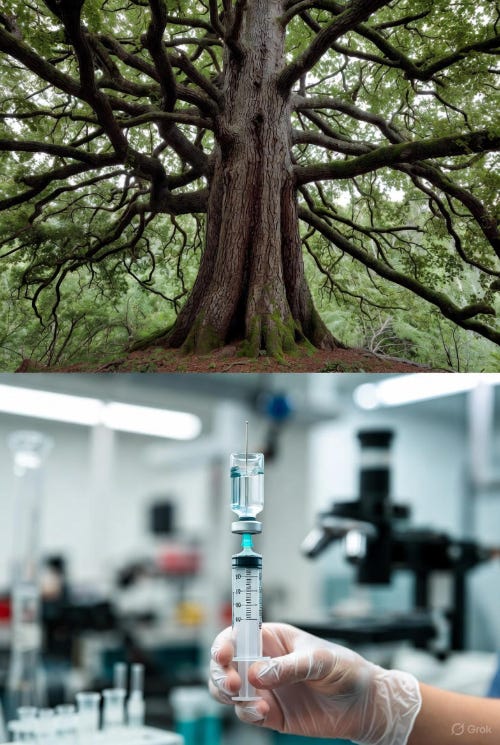
A tree that once fed multitudes now faces a decade of federal red tape before a single seed can touch wild soil, while a brand-new genetic vaccine, cooked up in 48 hours and injected into billions, sailed through approval in under a year.
One restores a vanished forest, the other rewrote human cells on a planetary scale. Both are genetic modifications, yet one is treated as a potential ecological threat while the other is hailed as a modern miracle. Welcome to the “expresso lane” of modern biotechnology, where speed, risk, and scrutiny depend entirely on whose veins are on the line.
Reign of the Chestnut King
In the ancient forests of Appalachia, the American Chestnut (Castanea dentata) once towered as the unmatched monarch. Stretching from the southern ridges to southern Canada, over four billion of these giants once dominated the forested landscape, comprising a quarter of all trees and nearly every one on untouched slopes. Soaring up to 130 feet high with trunks 14 feet thick, they could live for up to 800 years. This was no mere tree as it was the backbone of a thriving wilderness, stabilizing soils with deep roots and nourishing a web of life from squirrels to songbirds.
For Native American tribes, the chestnut was sacred. It was called the “grandfather of the forest.” They cultivated these groves through controlled burns, harvesting nuts to grind into nutrient-rich flour for breads and porridges, while leaves and bark were brewed into remedies for ailments from fevers to wounds. Tools, dyes, and even ceremonial artifacts sprang from its versatile wood.
When European pioneers arrived, they found existential deliverance in the New World’s chestnut tree. Its rot-resistant timber built enduring cabins, barns, split-rail fences, sturdy bridges, and fuelled the region’s iron forges with high-grade charcoal. Nuts became the “poor man’s food,” roasted as street fare in cities or fattening hogs in mountain hollows. The trees’ barks were used to tan hides into leather while its leaves soothed settlers’ coughs.
Old Appalachian Christmas stories were incomplete without referencing this tree. It provided nearly everything that sustained life in the wild frontiers — for flora, fauna and humans alike. Then came the “greatest ecological disaster in history.”
The Great Blight and Cascade Effect
Tragedy struck in the late 19th century, imported unwittingly from Asia. In 1876, ornamental Chinese chestnuts arrived at the Bronx Zoo, harbouring a deadly fungal pathogen (Cryphonectria parasitica) to which native trees had no defense. By 1904, the first American casualties wilted in New York, their bark cankering as the fungus girdled trunks, starving crowns above. The blight spread like wildfire through trade routes and wind, devouring billions in a relentless wave. Within decades, it engulfed Appalachia’s heartland. By 1950, the catastrophe claimed nearly all four billion trees.
The near-extinction of the American chestnut — and the abrupt loss of its nutrient-rich mast — triggered a cascading collapse that rippled through the entire eastern forest ecosystem, wiping some species from existence and pushing many others to the brink. Seven specialist moths vanished in near-silence, erased when their only host tree disappeared. The passenger pigeon, already collapsing from industrial hunting, lost one of its last dependable food sources and was extinct by 1914. Across the Appalachians, wildlife numbers plummeted: deer, black bears, and wild turkeys fell to half their former populations as one of their most reliable winter calorie sources disappeared. The environmental fallout deepened as eroded, destabilized soils washed into streams, clouding waterways and starving fish, mussels, and amphibians of oxygen and habitat.
The human and economic costs of the American chestnut blight are surprisingly under-studied, especially given the tree’s extraordinary versatility and central role in Appalachian life. Long known as the “cradle-to-grave tree,” every part of the chestnut served a purpose: its wood built homes, its nuts fed families and livestock, its bark provided medicine, and its tannins fueled one of the region’s largest industries.
Before the blight, the chestnut-powered tannin trade dominated Appalachia, supplying more than half of the nation’s tannic acid for leather production and supporting thousands of jobs in remote mountain towns. Its loss was felt not only in factories and forests but in the very texture of the land. Early settlers described Appalachian slopes in June as looking “snow-covered,” not from frost but from the chestnut’s creamy blossoms glowing beneath the summer sun. When the blight arrived, that spectacle vanished almost overnight, taking with it the factories, livelihoods, and cultural rhythms built around the Chestnut King. Economists estimate that, in today’s terms, tens of billions of dollars in timber value alone were erased by the blight’s rampage.
American chestnuts were high in vitamin C (rare for a nut), high in potassium and were an excellent source of manganese, copper, and folate. Its complex starches digested slowly, thereby providing a steady supply of energy. For winter survival, these qualities were extremely important. Nutritionally, they could serve the role of a starchy staple like wheat, corn, or potatoes while remaining naturally sweet and richer in micronutrients.
By the 1950s, the American chestnut survived only as persistent root sprouts clinging to life in the acidic soils of Appalachia. Though the ancient root systems continue to send up new shoots, each is doomed to the same fate: within a few years, the blight returns, girdling the young stems and cutting them down before they can reach maturity. What remains today is a vast ghost forest living underground — a tree determined to rise, and a fungus equally relentless in forcing it back into the earth.
More importantly — in the context of this article — scientists have spent nearly a century trying to restore the American chestnut, yet progress has been painfully slow.
Why is this important in the context of COVID-19? When the blight is transposed into a human biological context, the cascading effects of the American chestnut blight illustrate what a real pandemic would look like.
Myriad Challenges
For decades, the main approach to tackling the blight was backcross breeding. The goal was to cross the American chestnut with the naturally resistant Chinese chestnut and then repeatedly “backcross” the hybrids with American chestnuts to recover the American growth form and characteristics, while retaining the blight resistance genes.
The genes for blight resistance are however linked to those for “Chinese-like” characteristics (e.g., slower growth, bushier form). It has been incredibly difficult to break these linkages and get a tree that is both highly resistant and truly an American chestnut in every other way.
Furthermore, blight resistance isn’t controlled by a single gene; it is a complex trait involving many genes (polygenic). This makes it much harder to reliably breed into a population. Trees take 3-10 years to reach reproductive maturity. Each breeding cycle involves a commitment of many years, making progress painstakingly slow.
Even if the blight were solved tomorrow, other problems have emerged. The Phytophthora Root Rot (”Ink Disease”) is another extraneous soil-borne pathogen that kills young chestnuts, especially in the warmer, southern part of its range. A tree resistant to the blight can still be killed by this disease. The forests of today are different from those a century ago. The land has been fragmented, and other tree species have filled the niche left by the chestnut.
The genetic diversity of the species is a fraction of what it once was, making it more vulnerable to new threats.
New Hope and Regulatory Impediments
In recent decades, a breakthrough has emerged through the American Chestnut Research & Restoration Project at the State University of New York College of Environmental Science and Forestry (SUNY ESF).
Scientists introduced a single gene from wheat — oxalate oxidase (OxO) — into the American chestnut, giving it the ability to neutralize the oxalic acid the blight fungus uses to kill tree tissue. This single, strategic enhancement, found naturally in many plants, does not otherwise alter the chestnut’s genetic identity. The resulting “Darling 58” tree is the first American chestnut variant capable of withstanding the blight without sacrificing its native traits.
Yet the path forward is tangled in regulatory and societal hurdles. As the first transgenic tree ever proposed for release into the wild, Darling 58 faces intense debate over the ethics and ecological risks of GMOs in natural forests. Public trust remains a major barrier.
Before restoration plantings can begin, the American chestnut must clear an unusually demanding regulatory hurdle: review by all three major U.S. agencies — United States Department of Agriculture (USDA), Environmental Protection Agency (EPA), and the Food and Drug Administration (FDA) — because its nuts are considered a human food as well as wildlife feed.
This makes it only the second genetically-modified tree (after the virus-resistant HoneySweet plum) ever to require the full triple-agency process. Dozens of other food crops and fish — including Arctic® apples, Innate® potatoes, pink pineapple, AquAdvantage® salmon, soybean, maize, canola, sugar beet, and Bt brinjal — have gone through the same three-agency scrutiny, but no other tree has.
And here is where the process gets interesting. The full journey from initial lab development of a genetically modified (GM) crop or tree to regulatory approval and commercial release (or “mass consumption” as food/feed) typically spans 10–15 years on average in the U.S.
Wait a minute, that is exactly the same timeline needed for vaccine development and deployment!
‘Expressso’ Double Standards
That 10–15-year gauntlet for GM crops and trees however evaporates when the target shifts from forests to human bodies.
After Chinese researchers released the SARS-CoV-2 genome on January 10–11, 2020, Moderna — leveraging AI-driven machine learning on Amazon Web Services (AWS) for sequence optimization — finalized its mRNA design just two days later, by January 13.
This sparked the first clinical batch and Phase 1 trials by March 16. All in all, it was a blistering 25 days from design, or 66 days from the genome drop. The FDA turbocharged it with Fast Track designation in May, paving the way for Emergency Use Authorization that December — bypassing the usual decade-plus slog under Operation Warp Speed’s glare.
As for the specter of “GMOs in wild ecosystems,” it barely slows Big Food’s march: titans like Monsanto (now Bayer) flood fields with climate- and pest-resistant soy, corn, and cotton, representing 95% of U.S. acreage. GM elements in these crops routinely seep into soils and waterways with scant wild-release scrutiny, while processed aisles brim with their derivatives, no consent required.
At the same time, the Bill & Melinda Gates Foundation has poured tens of millions into GM mosquitoes for “disease prevention,” with at least 2.6 to 3 billion released globally via partners like Oxitec. The technique involves genetically-modified self-limiting males that slash populations by at least 80% in trials from Florida to Brazil. But will they halt at mere suppression?
Gates’ track record include a 2008 grant to kickstart “flying vaccinators” — mosquitoes engineered to secrete malaria antigens in saliva, sparking antibodies in lab mice — and a recent $1.5 million grant to Leiden UMC to develop mosquito-delivered attenuated parasites as live vaccines. These experiments are officially confined to bites-as-inoculation trials. But who knows what is really happening behind the scenes?
What are the odds that these aerial syringes win regulatory wings before a blight-hardy American chestnut, mired in years of ecosystem audits, gets the nod for wild reintroduction?
Near-extinct yet unbowed, the mighty American chestnut stands as an eternal sentinel against the double standards and sheer madness of “expresso vaccines.”
Source: The Eye Opener


Comments
Post a Comment