The Sweden Syndrome

While riding a municipal bus in Uppsala, I had the opportunity to observe a group of high school students. In one seat were a few Swedish boys, of the bespectacled, well-behaved, and soft-spoken variety typical of Sweden’s intermediate professional classes. In the seat next to them was a small group of Swedish girls. Behind the girls were some Arab boys, who were engaged in pulling the girls’ hair and otherwise tormenting and teasing them, much to the girls’ displeasure. In other circumstances this might have been an innocent, even light-hearted scene, and there was a part of me that was amused by the Arab boys’ antics and the girls’ protests, but the rigid posture of the Swedish lads, the way they carefully looked anywhere but at the Arab boys, gave the scene a tense, dark aura.
Here in microcosm was a holographic fragment of Sweden’s peculiar sociological madness. The Swedish boys were clearly deeply uncomfortable with the way the Arab kids were treating what they could not but instinctively think of as their women; whether their discomfort was due to the Arab boys’ discourteous behaviour, or due to displeasure at these foreigners getting the attention of girls the way boys have always done, the fact of their discontent was obvious. The lads radiated a desire to intervene, but their inaction turned their anger into a futile and pathetic thing.
These boys had been raised to be good feminists and anti-racists. Whether they personally bought into these ideologies was immaterial, for they certainly understood the consequences of transgressing them. As good feminists, the girls were meant to be able to take care of themselves. If they wanted help, they’d ask for it; moreover, they certainly weren’t anyone’s tribal property, so the Swedish boys had no standing to protect their women from foreigners. As to the Arabs, the Swedish boys were trapped in the double-bind of anti-racist multiculturalism, in which they must simultaneously ignore race and be acutely conscious of it: they must not think of the Arabs as members of a foreign and hostile tribe, but simply as Swedes just like themselves; yet at the same time, should they assert themselves against the Arab boys, they would certainly be harshly punished for this expression of racism.
For the girls’ part, I had no doubt that they would have much preferred the Arab kids to stop. Their body language was not of the sort that teenage girls use when they’re being teased by boys whose attention they are pleased to have. Yet they too were trapped by the antiracist imperative to avoid offending New Swedes by any means necessary, while also being prevented from asking for the help of the Swedish boys because, after all, they had been raised to be strong, independent women. Possibly some part of them felt angry at the Swedish boys for not standing up for them.
As for the Arabs, neither the strictures of feminism nor those of anti-racism applied to them one bit, and they knew this quite well. Thus they felt no compunctions about taking liberties with the girls. Doubtless any attempt to stop them would have been met with unabashed racial verbal abuse and quite possibly physical violence. From the point of view of the Arab boys, the Swedish girls were nothing but whores, and as for the Swedish boys – who were required by feminism to defer to the girls – well, they were obviously even lower than whores, contemptuous creatures of no account.
It is a particularly sick society that binds the hands of its own men in this fashion, that its women may be offered up in the name of sexual liberation and gender equality to foreign invaders whom that same society refuses to hold to the same standard, because to do so would be culturally insensitive.
Over my time in Sweden I made several similar observations: broken glass on bus stops, which would be repaired only to be shattered the very next day; gangs of young Afghan men prowling the downtown, staring at the populace with a frankly predatory gaze; female friends who would whisper to me, under their breath and with the door closed, that they didn’t dare go out at night unaccompanied; other girlfriends who stated forthrightly that they’d stopped wearing makeup and started deliberately dressing down in order to dissuade the attention of these immigrants; stories of racial bullying in the schools escalated to such a level that the parents had no choice but to transfer their white sons and daughters; ubiquitous gypsy women begging outside grocery stores or shoving their cups under your face when you sat on the terrace (the gypsies were a recent arrival, having flooded into the country when Romania joined the EU, and having quickly identified the gullible, good-hearted Swedes as easy marks).
The pace of Sweden’s demographic change has been rapid. This was brought home to me somewhat viscerally when a landlord from whom I’d been renting a room returned home one evening, shock written on his face. He was something of a recluse and a misanthrope, a retired engineer who lived at the edge of Uppsala but spent most of his time in his rural cabin. We’d had a few good conversations, as unlike most Swedes he had no illusions about the ill effects of immigration. Nevertheless, it was all somewhat abstract to him. When he returned to the apartment that night he had just gone to the city centre for the first time in several years. He told me that he thought I’d been exaggerating, but now knew that I had not exaggerated one bit: the city was completely changed, there were Africans and Middle-Easterners and Afghans everywhere.
Meanwhile, the good Swedes I met at work or in social settings were resolutely blind to all of this, convinced that there was nothing to worry about, that there were no problems, and that anyone who said anything to the contrary was a sexist, a racist, an Islamophobe, and probably a Nazi. When I tentatively raised the subject with one, he proclaimed confidently that such thoughts were the short path to Auschwitz. Another conversation that stuck with me was with a colleague who had spent a year or so as a conscript in the Swedish military, an experience to which I could relate, having served a few years in the Canadian militia myself. The subject of bar brawls came up: for myself, I’d always enjoyed the sense that the boys from my platoon had my back and vice versa, and that any civilian who threw hands was starting a fight with all of us; he’d been in similar situations, but found the unreflective tribalism of it horrifying. I pointed out that there were good reasons of evolutionary psychology for this sort of pack instinct, and that tribes which lacked it tended to go extinct; he responded by saying that we’d evolved past such things. Later, he explained to me that he did not care at all whether there were no ethnic Swedes left in Sweden by the end of the twenty-first century, so long as the people living in Sweden continued to practice Swedish values of tolerance and so on.
How does a country come, in such a short period of time, to embrace its own annihilation with such enthusiastic abandon? In other European countries, you might point to a bad conscience over the legacy of slavery or empire, but the only people the Swedes ever conquered and enslaved were other Europeans. With the exception of the Saami in the far north, Sweden had been perfectly ethnically homogeneous, with no oppressed minorities because there were no minorities to oppress. Some Swedes would tell me that Sweden had to make amends for its neutrality in the Second World War, as though tiny Sweden declaring war on Nazi Germany would have made a lick of difference. Others, bizarrely, pointed to the possibility that a certain amount of Swedish iron might have been used to forge chains and manacles for Trans-Atlantic slave ships, based on nothing more than the fact that those were made of iron, and that iron was a fungible commodity, and it was therefore plausible that a certain fraction of Swedish iron was put to this use.
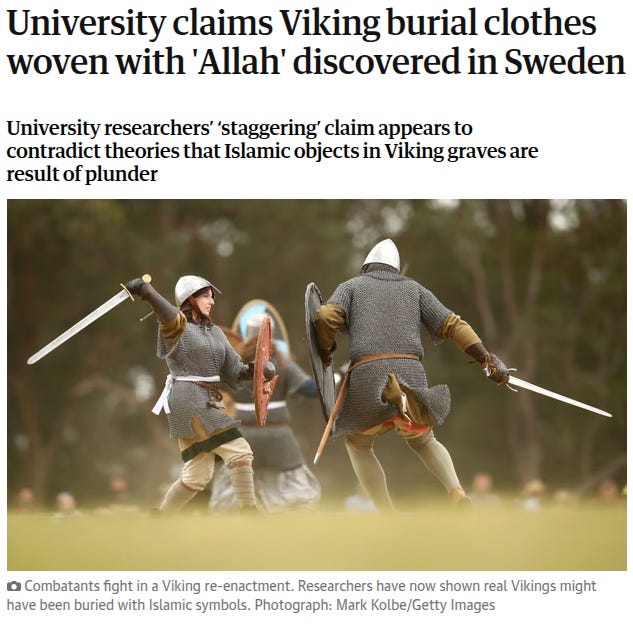
Such justifications seem like ex post facto attempts to rationalize the phenomenon, to me. To the contrary, I suspect much of Sweden’s ostentatious self-harm is explained by Sweden’s somewhat inflated sense of its importance on the international stage, a belief encapsulated by the Swedish government’s characterization of Sweden as a ‘humanitarian superpower’. Swedes are fashion-conscious people, with an aristocratic assumption that others are looking to them and taking their cues from them. Thus, for instance, when it comes to Net Zero policies, Swedes will happily agree that even if Sweden became completely carbon-neutral it would not make any difference to the global anthropogenic carbon budget, which is dominated by countries such as China or India who could not possibly care less about ‘climate change’. Nevertheless, they assume that the whole world is watching what Sweden does, and that therefore Sweden must set an example. The actual truth is that much of the world is only vaguely aware that Sweden exists: your average American has a hard time remembering the difference between Sweden and Switzerland, for instance, to say nothing of the Chinese, who assuredly do not give Sweden a moment’s thought in their daily lives. An uncharitable interpretation of Sweden’s self-description as a ‘humanitarian superpower’ is that they are jumping in front of a parade in order to pretend to lead it.
Another important factor is that Sweden is a consensus society. Swedes are much more reluctant to violate social consensus than assertive Americans, eccentric Anglos, or the argumentative French. Say the wrong thing on the wrong subject, and be quietly ostracized. Sweden’s elites astutely use the educational system and the media to manage the social consensus on race, immigration, feminism, and so on, with the result that Swedes feel an intense emotional pressure to conform to these ideologies. To speak against them too strongly is to endanger not just one’s social life but one’s career.
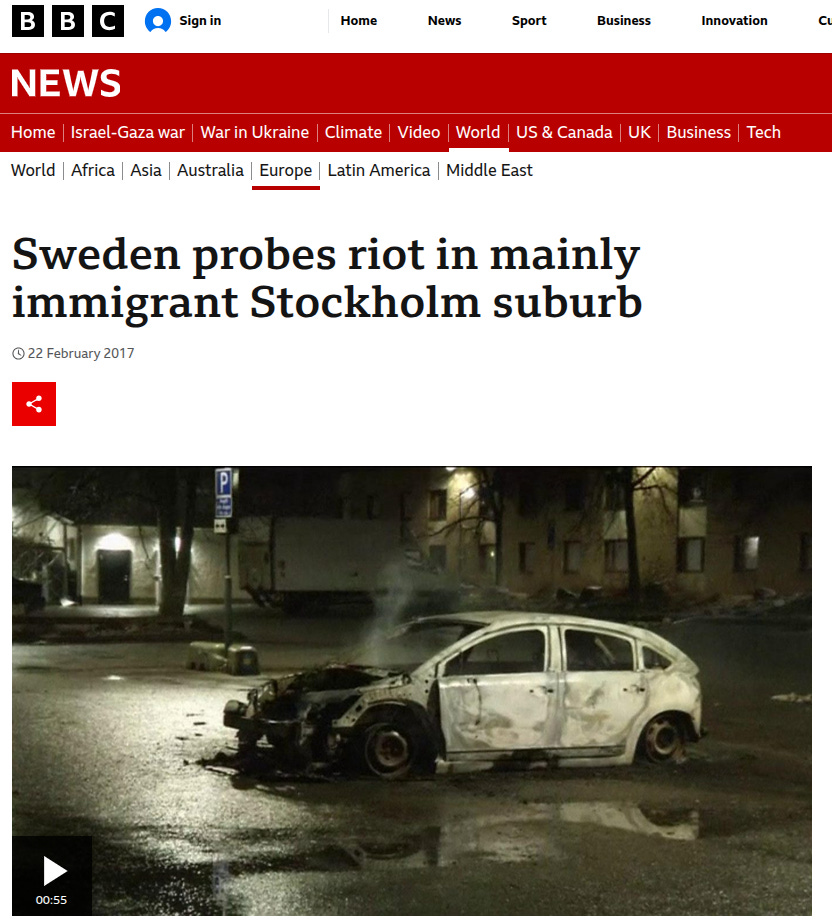
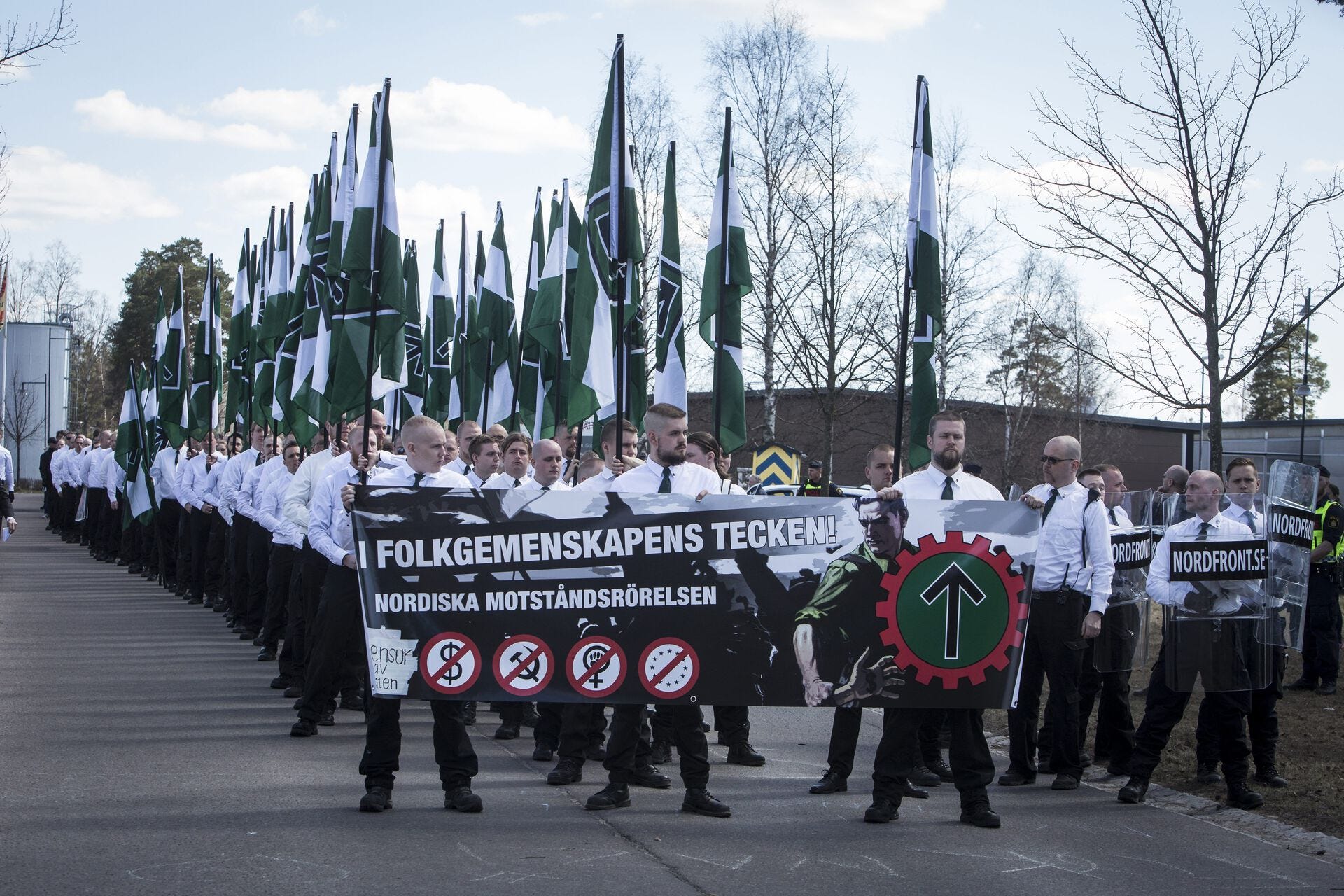
That isn’t to say that every Swede agrees with all of this suicidal insanity. Far from it. There’s a vibrant political underground in Sweden: large and well-organized nationalist groups; a robust and highly critical commentary sphere of anonymous online dissidents; and a large and influential nationalist party in the form of the Sweden Democrats. Many Swedish men, in private, will admit that they revile the self-destructive left-liberal tyranny. For now, the establishment has been successful in keeping such men from power, but I do not know that this will remain the case indefinitely. In a consensus society there is always a quiet conversation taking place underneath the public conversation, consisting of whispered private remarks and things that are said by being left unsaid, the purpose of which is to continually test the consensus. When a consensus is reached that the consensus has changed, the new consensus rapidly displaces the old, bringing abrupt changes in governance, law, public policy, and social norms. In Sweden, that quiet conversation under the public conversation has been proceeding furiously, both in pace and in tenor, for many years now. Moreover, it can’t be ignored that the wider Western world is quickly souring on multiculturalism, replacement migration, feminism, and the rest of the intersectional left-liberal ideology. Left-liberalism is no longer hegemonic, and ordinary Swedes will certainly be taking notice of that. As open-borders globalism becomes unfashionable, political elites who cling to it look ridiculous and out-of-touch, rather than trendy and chic.
Perhaps that prediction of eruptive political change in Sweden will be borne out in the near future; perhaps, though, things will simply continue to decay, and it will strike the reader of a decade or two hence as obscenely wrong. Time will tell. For now, Sweden remains in the grips of this madness. The present work by Karl-Olov Arnstberg is a thorough, clinical description of the symptoms and etiology of what the author calls ‘the Sweden Syndrome’. Arnstberg summarizes the Sweden Syndrome’s characteristics as a combination of oikophobia, hierarchical inversion (i.e. preferring the worse to the better, the lower-performing to the higher, and so on), reality denial (the postmodern superstition that objective reality does not exist, and that subjective morality can be treated as objective: as he puts it, ‘pathos replaces logos’), and the collapse of distinctions and boundaries (e.g. men/women, self/other, us/them, etc.)
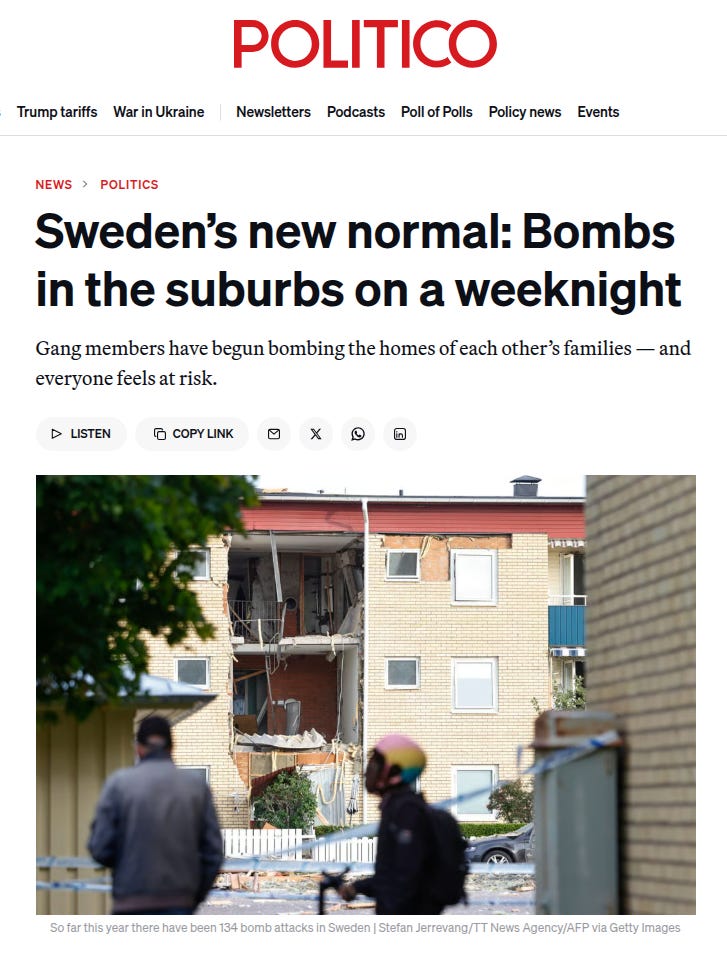
Arnstberg traces the historical process that converted Sweden from a nationalistic Folkhemmet which treated the country like a family, to a multicultural administrative zone that perversely prides itself on privileging the foreigner over the native. He shows how these beliefs were introduced into Sweden’s elite and propagated through the key educational, academic, legislative, judicial, and media sectors. He shows in gut-wrenching detail the consequences for ordinary Swedes: vicious gang-rapes; teenage boys forced to submit to having their mouths urinated in after being robbed; legal persecution, public defamation, and career destruction for complaining about it. He demonstrates how the legal system has been twisted to harshly punish native Swedes, while letting migrants off with a slap on the wrist. He explores the deleterious consequences for Sweden’s institutions of feminization following capture by ideological feminists, and how the imposition of feminist dogma turns Sweden’s men and women against one another, and against their own natures. He demonstrates how the disease expresses itself even at the level of national symbols, for instance with the castration of the Swedish military’s heraldic lion.

For Arnstberg, the Sweden Syndrome is not a mere academic exercise, but something that he has lived through. He was personally acquainted with some of the principals who drove the early debate on multiculturalism. As a professor of ethnology at Stockholm University, he had both a front-row seat to the deepening psychosis of academia, alongside mastery of the conceptual toolset necessary to document and analyze the degenerative process. Finally, as an outspoken critic of the government’s immigration policies, Arnstberg has personally experienced the regime’s tactics of cancellation and defamation face-on.

The book is called ‘The Sweden Syndrome’, but the broad stokes of the disease that Arnstberg describes can be seen in practically every Western country. Sweden is not unique in this regard. However, Sweden presents an exemplary case study, due to the rapidity with which it succumbed, and the thoroughness with which the symptoms presented themselves. No matter what country you live in, you’ll likely recognize the symptoms Arnstberg describes.
Arnstberg’s concise analysis of this complex mass psychosis is a service not only to the present, but to future generations. While, as Arnstberg notes, we do not yet have either a vaccine or a cure, the first step to treating an illness is recognizing and describing it.
There are reasons to be hopeful that the fever is breaking. Since this book was written in 2022, the Sweden Democrats have become the second-largest party in the Riksdag and therefore too big to ignore, thus they have finally broken through the long-standing cordon sanitaire with which they were isolated from any meaningful policy influence, entering into the government as part of the so-called Tidö Agreement coalition with the other right-leaning parties (the Moderate Party, the Christian Democrat Party, and the Liberal Party). Meanwhile, the Swedish government has started experimenting with offers of lump-sum financial compensation to induce migrants to leave the country. These are small, tentative steps towards sanity. The Tidö coalition is an awkward one, particularly for the Liberals, and the centre-right parties have faced furious condemnation from both domestic media and their European counterparts abroad; while the Sweden Democrats are the largest party in the coalition (and the second-largest in the Riksdag), neither the prime minister nor any senior government ministers are drawn from the party. As to the remigration efforts, these have been completely unsuccessful, with only a few hundred accepting the government’s bribe to leave, as compared to the million-plus who ultimately need to be removed. Nevertheless, these are small steps in the right direction, and mark the first reversals of left-liberal multicultural globalism in decades.
SourceL Postcards From Barsoom


Comments
Post a Comment