The Strategic Dilemma At the Heart of Iran's Struggle
The Strategic Dilemma At the Heart of Iran's Struggle
Simplicius
Contradictory bouts of news and rumor continue to pour in surrounding Trump’s ‘imminent’ attack on Iran. The buildup is said to be the largest since the Iraq war, with various figures like ex-CIA operative John Kiriakou giving their renditions of ‘insider intel’ that Trump has already sealed the fated decision and is ready to roll heavy within the next 48 hours. Iranian officials, on the other hand, appear to signal that talks will continue into next weekend, and there are varied reports about deals gaining traction.
It’s clear that Trump has been wavering due to major second thoughts about a prolonged conflict. Multiple reports have indicated he may be leaning towards a “compromise” of limited strikes in order to coerce Iran into a deal, rather than risking an all out conflict which could end in humiliation.
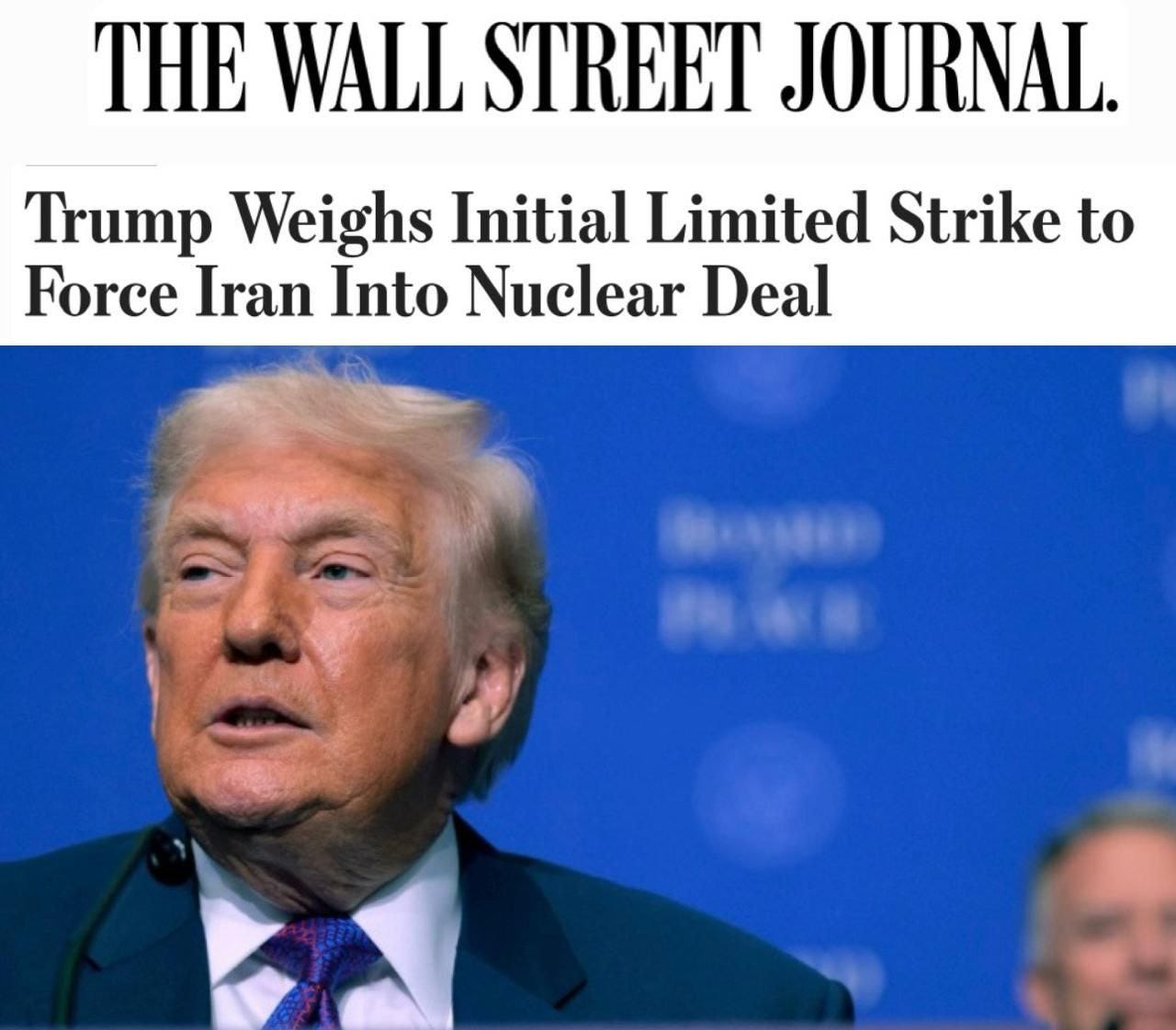
U.S. President Donald J. Trump has told advisers that he is leaning toward conducting an initial strike on Iran in coming days intended to demonstrate that they must be willing to agree to give up the ability to make a nuclear weapon, and that if diplomacy or any initial targeted attack does not lead Iran to give in to his demands to give up its nuclear program, he will consider a much bigger attack later in the year intended to drive Iranian Supreme Leader Ali Khamenei and other leaders from power, senior advisors have told The New York Times.
Before we get into the nitty-gritty, one thing should be said. Most people tend to always jump immediately into extremes when making predictions: either Iran will completely humiliate and destroy the US forces, sinking every aircraft carrier; or the US will totally level Iran, slaughter the entire leadership, and establish an Iraq-like dominion over the entire country.
In reality, when we analyze historical precedent we can see that neither often happens. Most commonly the case is that neither side commits fully, and a lot of messy, ambiguous damage is done from which both sides emerge as self-proclaimed victors. Trump prefers things “easy” and is likely to pull out of any kinetic conflict as soon as he’s able to grab that one shiny PR motif that gets him his victory laurels. For instance, should he succeed in taking out the Ayatollah or other senior leadership, he could immediately declare a win and wind down hostilities.
This is likely the main reason behind Trump’s refusal to even name objectives for the brewing conflict: there are no real pre-determined objectives, he’s intent on achieving anything at all that has the cachet of success so he can retroactively label it as the objective he had all along. This allows him to again annoint himself a “genius” for having achieved what he wanted. Should Iran’s leadership prove too difficult to root out, Trump may simply wait until the US hits some other juicy military targets which can be glamorously emphasized on TV, then declare those as having been the objectives all along, again touting victory and that “Iran’s nuclear potential has been destroyed”.
We know that Trump’s real motivation for the Iran strikes is not US’s own intelligence regarding some nonexistent Iranian potential, but rather the pressure from Israel. That means for Trump the main operative goal is to somehow satisfy his Israeli superiors and relieve the pressure, rather than achieving any one particular military objective. As long as he can give them a good “college try” and prove his loyalty with a thrashing of Iran, he may deem his debt paid and pull the plug. Israel, of course, will never be fully satisfied until Iran is entirely destroyed, but this is simply how the game works: Trump relieves pressure by striking Iran even if it doesn’t entirely satisfy Netanyahu. After some kinetic fanfare, Israel is left with less credible leverage of its own, particularly when Trump is able to twist headlines to “prove” how far his “devastating” strikes were able to set Iran back, which Israel would then be unable to credibly gainsay without directly challenging his narrative.
It should also be noted that some are convinced Tucker Carlson has just single-handedly saved Iran from destruction by outing Israel’s true plans in his interview with ultra-Zionist Mike Huckabee, US’s ambassador to Israel. Recall that Carlson was detained in Israel in quite unfriendly fashion as he’s been internally deemed a kind of enemy of the state for exposing Israel’s propaganda:
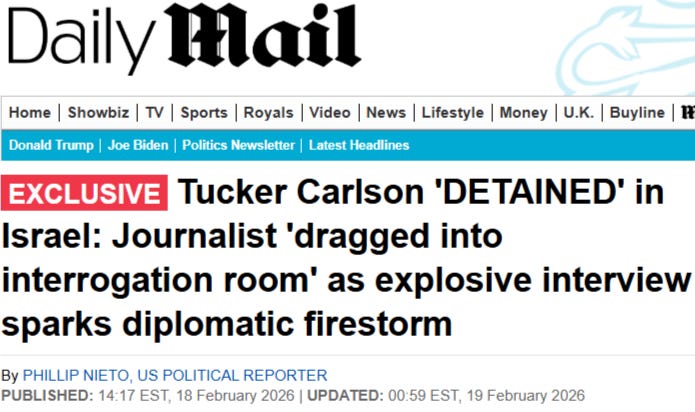
In the interview, Huckabee implied to Carlson his belief that Israel is entitled to conquer the entire Middle East, as per its biblically chosen stature.

This sent a firestorm of outrage throughout the Middle East, with the ministries of every major country writing an ‘open letter’ of protest:
#Statement
The Ministries of Foreign Affairs of Saudi Arabia, Egypt, Jordan, UAE, Indonesia, Pakistan, Türkiye, Qatar, Kuwait, Oman, Bahrain, Lebanon, Syria, and Palestine, together with the Organization of Islamic Cooperation (OIC), the League of Arab States (LAS), and the Gulf Cooperation Council (GCC) express their strong condemnation and profound concern regarding the statements made by the United States Ambassador to Israel, in which he indicated that it would be acceptable for Israel to exercise control over territories belonging to Arab states, including the occupied West Bank.
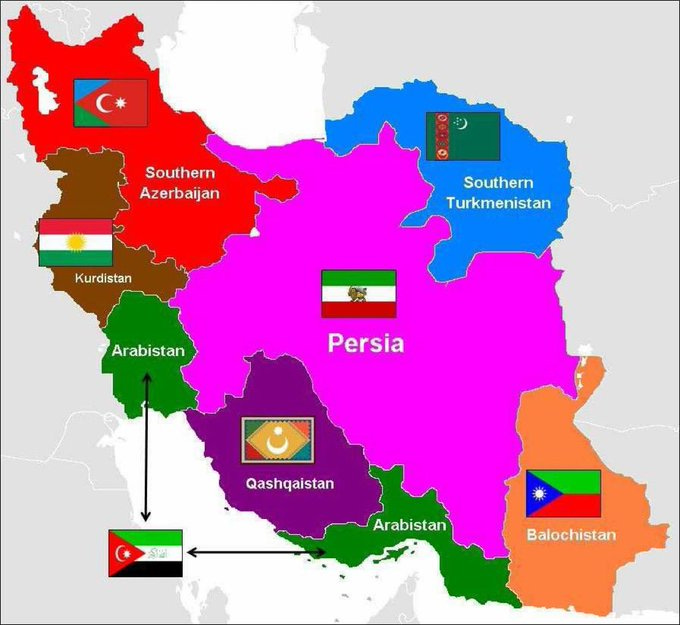
This outrage, many now believe, could have led to Trump rethinking a long-term military campaign against Iran—a longshot, sure, but a fairly rational thought, given that Carlson has now ‘shone a light’ on the true intentions behind Israel-US’s anti-Iranian campaign, with the endgame being the establishment of Greater Israel. Recall that think tanks have been pushing Iran’s total balkanization into smaller statelets after the Ayatollah’s defeat:
Also recall my long-standing contention that this potential coming attack amounts to Israel’s last chance against Iran, because after midterms wherein Trump could lose control of all Congress, he may never again regain the political capital to engage in such large-scale unilateral actions. This has now been confirmed by the regime’s most rabid psychopaths who openly admit that it’s their last chance to get Iran:
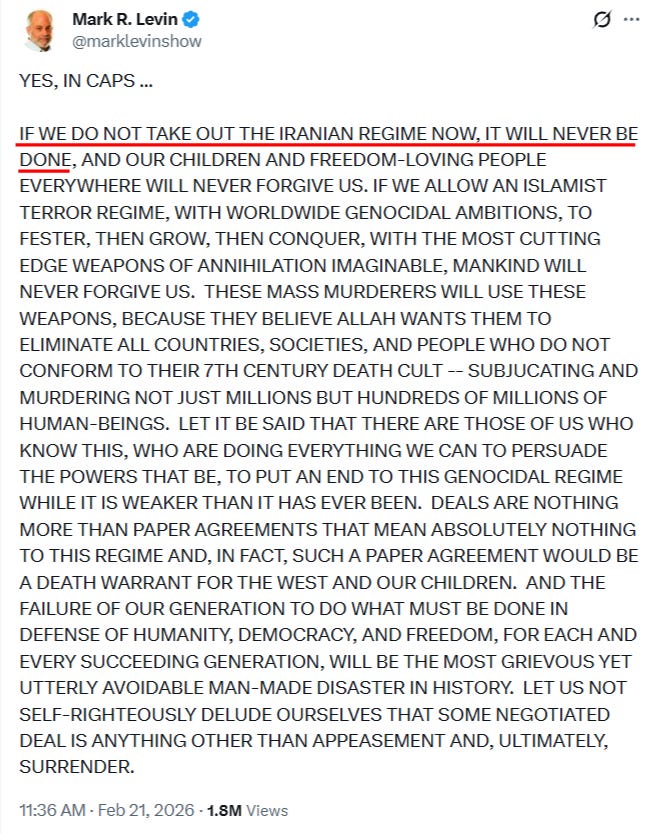
Some have credibly maintained that it would make no difference: Trump acts unilaterally with or without Congress, so why would it matter if Democrats control it after midterms? There’s no one exact mechanism that Democrats would “suddenly” be empowered to wield to stop Trump, per se. It’s simply that the mass amount of political pressure and leverage they would employ against him from that point forward could completely cripple his presidency, relegating him to a lame duck forced to fight exclusively off the back foot; this of course includes potential impeachment, and many other things. The simple critical mass of pressure against him would preclude any such major unilateral actions from being easily carried out ever again.
The Strategic Dilemma
There is a phenomenon that has been witnessed since the dawn of time. You’ve seen it yourself: an armed militant marches a line of captives condemned to die toward their execution. If all of them were to resist in unison, they would have a chance at overpowering the gunman. But instead they march on in docile submission to their deaths. There is something psychologically that paralyzes humans from acting in such circumstances despite the fact that inaction would bring even more certain death, while taking action stands at least some small chance of success.
Related to this phenomenon, there are many known game-theoretic dilemmas that lead people to make safe choices when hedging between risk and cooperative uncertainties, even if those safe choices open the possibility for far greater risks down the line. Those that may be familiar with the sci-fi novel The Traitor Baru Cormorant might remember the “Traitor’s Dilemma”. It describes a group of governors who want to overthrow a despotic autocracy which rules over them, but are unable to act because they are faced with this strategic paradox: if they all act in coordination, they can easily overthrow the ‘empire’, but if any one of them jumps the gun alone while expecting others to join him, they risk being the only one that took action, which would result in their being labeled a traitor with the ensuing consequences. It’s a strategic dilemma that results in paralysis because you can never be certain that others will join you.
Many Global South countries are afflicted with similar dilemmas when faced with the Empire’s ceaseless aggression. In the case of Russia, many have long complained about how Putin “cucks out” and “plays it safe” due to his belief that not upsetting the apple cart too much will maintain the status quo and lead to eventual victory, whereas taking far more decisive yet riskier action up front could regain total initiative from the aggressor. The safer choice leads to a kind of perceived slow strangulation of Russia that is game-theoretically deemed a safer play than an explosively decisive action that could potentially win the game outright, but just as quickly invite devastating consequences. The best example being the idea of Russia directly striking US aerial assets—like surveillance drones in the Black Sea, etc.—as a final “red line” delineation. This could lead to the US backing off all its ISR assets, giving Russia a much easier free ride to victory henceforth; or it could lead to a flashpoint where the US chooses to respond kinetically against a weakened, vulnerable Russia with its hands full. The choice to “play it safe” and allow US’s ISR assets to give Ukraine eyes and ears seems cautiously pragmatic, but invites great long-term risks for Russia, which include a gradual ‘mission creep’ of US military brazenness that will grow to test Russian boundaries and limits in increasingly dangerous ways.
Faced with uncertainty of consequences, global leaders tend to resign themselves to the safest available action despite it inviting a progressively degrading long-term outlook. Recall this tweet:
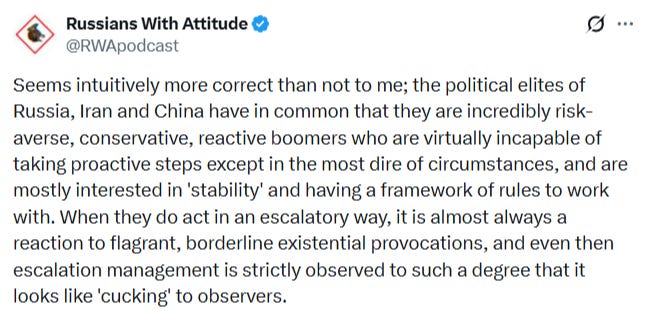
We even saw this recently in the war games carried out by Welt magazine with many Western experts standing-in for wartime leaders of both “red team” (Russia) and “blue team” (Germany). In the games, German “leaders” were paralyzed by the threat of taking immediate military action against Russia, and consistently chose safer de-escalatory actions so as not to spark a flashpoint, which allowed Russia to steam-roll through the Suwalki gap and essentially capture lower Lithuania.
This brings us to Iran and the major strategic dilemma it faces: Iran is forced to watch as the US assembles one of its largest strike packages ever. If Iran was absolutely certain that US has chosen to truly wipe it off the map, it would obviously be in Iran’s existential interests to strike first and hard, to take as much wind out of the aggressor’s sails as possible right off the bat.

The longer that Iran equivocates, the more the US is able to “set its feet” in a perfect strike posture to inflict maximum damage. Iran is forced to make a huge, risky bet on the possibilities that either: 1. some kind of deal is reached and the US calls off the attack, or 2. the US chooses a very ‘limited’ attack to ‘blow off some steam’ as periodically seems necessary for the US MIC.
The same goes for US naval assets: the second US carrier group—that of the USS Gerald R. Ford—is still in transit, with only one carrier—the USS Lincoln—currently in theater by Iran. Iran could go all out and attack the single vulnerable carrier group without its backup nearby, but risk inviting a massive full-scale American war that would potentially destroy Iran. Conversely, Iran could play it “safe” and wait for the second carrier to arrive while betting its hopes on negotiations working out, but this obviously risks the US later having its full combined naval assets safely in place to attack Iran with.
In the eyes of many, Iran’s choice to allow the second carrier to slowly transit into position is no different than a group of hostages allowing the lone gunman to march them toward their execution without fighting back. In both cases, the risk is death, but there is something in human psychology that privileges the more distant death even if it is no less certain, likely because humans are hopeful creatures, and would rather imagine some ‘divine intervention’ at the last moment saving them instead of putting their fate into their own hands in the moment.
But this discussion over strategic dilemmas is not to assert that Iran’s decision—or that of Russia’s in the previous example—is definitively wrong. There is no real right or wrong in such systems with uncertain outcomes and multitudes of variables. There are only game-theoretic models and conjectured opinions on what may or may not be the optimal course of action.
Most people—particularly anonymous online commentators—are driven by pure knee-jerk emotion and will always loudly favor the immediate risky reaction. But if they were ever put in the position themselves, where everything—including their lives—was on the line, they would likely find themselves hard-pressed to “pull the trigger”. They too would likely become docile in the face of their captors, and allow themselves to be quietly marched toward the gallows without resistance—because for humans it’s always easier to hope for more time rather than face the uncertain consequences of one’s own direct actions.
In the case of Iran, there are many other variables that make it presumptuous to declare Iran’s “passivity” as cowardly or misguided. For instance, we don’t know the scope and tenor of the various backdoor negotiations that could be giving Iran unique insight into the US’s true intentions, which we are not privy to. Iran could be basing its decision on the hints of secret deals that most internet commentator’s simply wouldn’t have in their risk-reward equations.
On the other hand, many Global South countries which have been victims of the Empire’s aggression often do adopt a mentality of righteous victimhood, a sort of turn-the-other-cheek do-gooder foil to the Empire’s perceived “villain” role. This causes them to embody the “good guy” archetype, internalizing the perceived attributes associated with this, such as the idea that striking an aggressor is only permitted in pure self-defense, because that is the ‘moral’ thing to do. Similarly, Iran may feel that striking first is simply contrary to its own curated global image of the ‘morally just’ nation.
We may learn soon which of the choices for this game-theoretic model would have been optimal, but I still personally lean toward Iran making the right decision simply because there are signs of buckling in Trump’s knees, and I remain skeptical about the US’s “maximalist” intentions, much less its capabilities. And we might also say that a civilization that has survived thousands of years should probably be given the benefit of the doubt on its decision-making. But I could be proven wrong.
Share your thoughts, is Iran failing to play its strategic dilemma accordingly? Or is the “strike first” doctrine of gung-ho internet commandos a dangerously misguided strategy?
Source: Simplicius The Thinker


Comments
Post a Comment