The Prophet of the Profitable Apocalypse - Peter Thiel and the Antichrist
The Prophet of the Profitable Apocalypse
Peter Thiel and the Antichrist
By Margherita Furlan
Foreword ~
Peter Thiel's Antichrist ~ Margherita Furian Decodes the Fraud
Margherita Furlan’s study of Peter Thiel (below) is edifying from a number of perspectives and worthy of your attention. Much of the current furor around Thiel and speculation concerning his motives and objectives is being generated by the Cryptocracy in order to make it appear as though most any negative verdict is a lurid, crazed Satan-witch hunt.
Furlan is on more solid ground, taking into account the Technological Hierarchy for the Removal of Undesirables and the Subjugation of Humanity (remember THRUSH from the MAN FROM U.N.C.L.E. television series?) — to be led by Thiel’s “sovereigns” [Plato’s philosopher kings].
Furlan demonstrates that Thiel uses the New Testament as a screen for destroying one of the most fundamental insights of the Word of God and tenets of the Founding Fathers — that no man or group of men (or women) however supposedly good, can ever be trusted with unlimited power. There must forever be checks on the fallen human nature of us all.
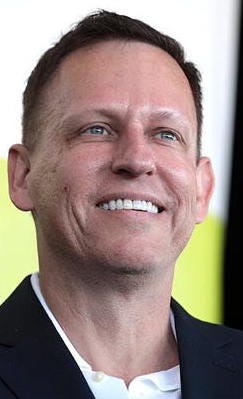
Furlan writes: “He (Thiel) argues that the Antichrist could manifest as a global system of government that seizes power by exploiting citizens’ fears regarding...nuclear war...
“The Vatican, through Avvenire – the daily newspaper of the Italian Episcopal Conference” writes that “for Thiel, the Antichrist is anyone who places limits on unlimited progress.”
Here we confront a crossroads for the Vatican, due to the fact that western civilization’s most potent and influential advocate of unlimited intellectual and scientific “progress” was the Renaissance Catholic Kabbalist Count Giovanni Pico della Mirandola, the subject of a hagiography by Pope John Paul II’s Cardinal Henri de Lubac. Pico stood for the Kabbalah’s concept of the sovereignty of human brain power against all restraints. In The Occult Renaissance Church of Rome I document that notwithstanding disinformation to the contrary, Pico enjoyed papal protection.
Now, at our 21st century crossroads, does the Catholic Church embrace the pre-Renaissance Church founded in Christ-ism or the post-Renaissance Church founded in human-ism? Thus far it appears that Leo XIV has chosen Jesus, at least within the narrow aperture of questions of war, peace and the imperatives of Zionism.
Furlan stumbles on one point, when she fails to substantiate her claim that Thiel’s alleged advocacy of the views of René Girard is somehow another piece in his sinister puzzle. Yet, she correctly illustrates one of Girard’s key points: “In archaic societies, violence was channeled through the mechanism of the scapegoat: a sacrificial victim upon whom the community vented its collective aggression…”
In this century our “archaic society” vented its wrath on a scapegoat by the name of Theodore Kaczynski, who was the target of LSD experiments in his youth and who was guilty of some though not all of the so-called “Unabomber” attacks on technological targets. His highest profile role in the Unabomber psychodrama was as a scapegoat. He was apprehended in the Scapegoat Wilderness of western Montana where he had resided for several years.
If you wish to confirm for yourself the paradoxical fact that Unabomber was not only Kaczynski, consider the datum, as I reported in Twilight Language, that the FBI made no serious attempt to locate and interrogate any possible accomplices. He was treated as a lone nut from the time of his arrest — precisely the point when a criminal investigation is supposed to begin in earnest (something similar occurred in 1977 with the arrest of David Berkowitz as the “lone nut” Son of Sam killer). If the authorities know in advance there are no other suspects, then it is a strong indication that they are in on the crime. They rule out accomplices because they are the accomplices.
Thiel’s Iranian Nukes Farce
The hoopla and manufactured hysteria over Iranian nuclear weapons by Thiel and others is a charade sold on the basis of human imbecility. North Korean intercontinental ballistic missiles capable of carrying nuclear warheads have an estimated range of from 6,200 to 8,000 miles and can reach any target in the U.S.
Iranian missiles do not have sufficient range to strike an location in the U.S., nor do the Iranians possess nuclear weapons. Everything that Trump declaims about Iranian alleged nuclear-armed missiles actually applies to North Korea, against which he would not dare raise a hand.
Palantir
Furlan: “Palantir’s strategic partnership with the Israeli Ministry of Defense dates back to introductions facilitated by Jeffrey Epstein….Thiel “is the co-founder of Palantir Technologies, the data analytics and artificial intelligence company whose name – taken from Tolkien’s The Lord of the Rings, where the palantír is the seeing-stone used by the evil wizard Saruman to watch over his enemies – is perhaps the most transparent and unwittingly revealing metaphor in the history of the tech industry...Palantir’s MOSAIC platform is integrated into the IAEA (International Atomic Energy Agency) verification system. When, between 6th and 12th June 2025, MOSAIC flagged an alleged increase in enriched uranium at Iranian facilities – assessing that Iran was potentially just weeks away from producing multiple nuclear warheads – that assessment formed the basis of Israeli intelligence against Iran.”
“...Palantir provides the technological platform for Project Maven, the Pentagon’s AI targeting system. The Maven Smart System – which integrated Anthropic’s Claude AI model through a partnership with Palantir…In the early days of the war, Palantir’s share price rose by 15% in a week – its best performance since August [2025] – whilst the Nasdaq fell by 1.2%.”
Eternal Darkness
“You know what the name of the military operation was? ‘Eternal Darkness.’ Israel named this operation killing hundreds of civilians in Lebanon, mostly in Beirut, ‘Eternal Darkness.’
— Tucker Carlson, The Tucker Carlson Show, April 9.
Pope Leo XIV seems to have anticipated this Israeli naming when he stated on March 15, 2026, during a homily at Mass in the church of the Sacred Heart of Jesus in Ponte Mammolo outside Rome, “Some presume to invoke God’s name in these deadly decisions…But God cannot be enlisted by darkness.”
There is a darkness written of in the Kabbalah which is truly of an extraordinary intensity, a black hole of evil so deep it is unfathomable.
Throughout recent Israeli history, Kabbalistic ritual has been employed in a superstitious attempt to bring about the deaths of Israeli Prime Ministers Yitzhak Rabin (1995) and Ariel Sharon (2005). Hence, there is nothing novel about the resort to these methods.
On May Day this Friday, I will publish a study of the Kabbalistic invocation of eternal darkness as a thaumaturgic operation in the war in Lebanon.
Peter Thiel and other A.I.-powered, would-be masters-of-the universe skirt the involvement of Kabbalah in the highest considerations of the Israeli government. For all their big brain-power conceit they infantilize their audience by the information they reserve solely for their fellow Kings of the Deal.
—Michael Hoffman. For the Advancement of Knowledge Contra Cancel Culture
The Prophet of the Profitable Apocalypse
Peter Thiel and the Antichrist
By Margherita Furlan • GeoPolitiQ
Peter Thiel did not come to Rome to pray. He came to preach. And the gulf between the two – between the humility of the pilgrim and the arrogance of the prophet – is precisely what the Vatican sensed, and from which it distanced itself, the very moment the co-founder of PayPal and Palantir stepped through the doors of the Renaissance Palazzo Orsini Taverna to launch, on 16th March [2026], a series of four closed-door lectures on the Antichrist.
Four days of private, invitation-only lectures, bound by confidentiality clauses, held a stone’s throw from St Peter’s Basilica whilst in Iran – according to estimates by the Iranian Red Crescent and various human rights organisations – between 1,230 and 1,300 civilians were being killed by US and Israeli airstrikes. Among them were over 165 girls from a girls’ primary school in Minab, in Hormozgan province, struck on 28th February [2026] by an American Tomahawk missile [see here and my article on the first day of the Ramadan War between USrael and Iran].
The timing is no coincidence. It never is, when it comes to Peter Thiel. And to understand what he really came to Rome to do, it is necessary to bring together three planes that remain separate in the conventional media narrative: theology, technology and war. Because in Thiel, these three planes are one.
The Architect of the Apocalypse
Peter Andreas Thiel, 58, born in Frankfurt [Germany], a naturalised American, with a net worth estimated by the New York Times at $27.5 billion, is not simply a tech billionaire with religious curiosities. He is a political theologian in action. Father Paolo Benanti, advisor to Pope Leo XIV on Artificial Intelligence [AI], put it with surgical precision in an essay published on the eve of the Roman lectures: Thiel is “above all a political theologian operating at the very heart of the Silicon Valley ecosystem”, and his theories represent a “radicalisation” of Western values – individualism, technological progress, the spirit of competition – taken to their ultimate consequences.
To understand Thiel, one must start with René Girard, the French philosopher who taught at Stanford in the 1980s and whose mimetic theory constitutes, by Thiel’s own admission, the backbone of his worldview. Girard – a heterodox Catholic and pacifist who died in 2015 – had developed a theory of imitation according to which all human desires are desires imitated by others. This mimesis generates rivalry, which in turn generates violence. In archaic societies, violence was channeled through the mechanism of the scapegoat: a sacrificial victim upon whom the community vented its collective aggression, temporarily restoring peace.
Christianity, according to Girard, had exposed this mechanism: Christ’s sacrifice on the Cross was the definitive revelation of the victim’s innocence and the injustice of the sacrificial mechanism. An act that opened up the possibility – not the certainty – of renouncing violence.
But Girard was also an apocalyptic thinker. In his final essay, “Achever Clausewitz” (Taking Clausewitz to the Extreme), he argued that contemporary humanity found itself in an apocalyptic phase, not in the fundamentalist sense – it was not looking for the number 666 – but in the sense that mimetic violence, in the age of nuclear weapons and globalisation, had reached a potential for total destruction. Either humanity embraced Christian non-violence, or it was heading towards self-destruction. The Apocalypse, for Girard, was not the punishment of a vengeful God, but the consequence of human violence left unchecked.
Thiel took this framework and radically transformed it. He retained the structure – mimesis, violence, the Apocalypse – but reversed its moral direction. Whereas Girard was a pacifist who saw the renunciation of violence as the only path to salvation, Thiel has constructed a system in which violence can be a necessary tool, and in which unlimited technological progress – not renunciation – is the path to salvation.
The Antichrist according to Thiel: when peace becomes suspect
The Rome lectures, according to accounts by the Washington Post and UCA News, followed the pattern of his previous conferences in San Francisco (September 2025) and Paris. Thiel’s vocabulary is built around two Greek theological concepts: the katechon and the eschaton.
The katechon, in the Second Epistle to the Thessalonians, is “that which restrains” – the force that delays the manifestation of the supreme evil. The eschaton is the final fulfilment of history. In the Christian tradition, these categories have been handled with caution, often with a sort of intellectual modesty. In Thiel, they become operational, almost strategic, categories.
On the one hand, Thiel places the katechon: Constantine, the Tridentine liturgy, the political order, stabilised wealth. On the other, the eschaton: Mother Teresa, non-violence, liberation theology, a Church beyond the economy. A binary construct that compresses the millennia-old complexity of Christianity into a clear-cut opposition, serving a pre-determined thesis.
The heart of the argument emerges when Thiel speaks of the Antichrist. He does not mean this as a revelation in the biblical sense – an unveiling of God – but as a lens through which to interpret the present. He argues that the Antichrist could manifest as a global system of government that seizes power by exploiting citizens’ fears regarding artificial intelligence, climate change or nuclear war.
The Vatican, through Avvenire – the daily newspaper of the Italian Episcopal Conference – has translated this thesis into its logical consequence: for Thiel, the Antichrist is “anyone who places limits on unlimited progress”. Peace itself becomes suspect. Thiel insists on a passage from the First Letter to the Thessalonians: “when they say, ‘Peace and safety’, then sudden destruction will come upon them”. The quotation is accurate, but its use is revealing: peace, in Thiel’s contemporary discourse, becomes the sign of an imposed order, of stability acquired at the price of freedom.
Who, in concrete terms, are the servants of the Antichrist in Thiel’s system? Regulators. Multilateralists. Climate activists. Those who propose global governance of artificial intelligence. Those who wish to limit the power of tech platforms. Those who invoke international law. In a formulation circulating among those who attended the San Francisco lectures, critics of AI are potential “legionaries of the Antichrist” because they slow down the progress that could counter real threats – such as, in Thiel’s view, China’s military technological advance.
The Antichrist, therefore, is not the horned beast of popular imagination. In Thiel’s cosmology, the Second Coming will not descend from the heavens; it will emerge from the laboratory. And the bureaucrat, the activist, the regulator are those who stand in its way.
The “political miracle” and the delegitimization of democracy
One of the most revealing passages in the Rome lectures concerns the concept of the “political miracle”. Thiel distinguishes between the supernatural miracle and the political miracle: the latter is the ability to promise the impossible, to hold irreconcilable opposites together, to offer a synthesis that neutralises conflict. This is no trivial insight: contemporary politics is full of such promises. But when this category is applied to democracy itself, the next step is an implicit delegitimization: democracy becomes a rhetorical device, a word whose meaning depends on who uses it.
This is where Thiel converges with Carl Schmitt, the German jurist whose thought – the friend/enemy distinction as the foundation of the political – Thiel is a close reader of. In the essay ‘The Straussian Moment’ [link], written in 2004 for a conference at Stanford significantly titled “Politics and Apocalypse”, Thiel attempted to weave together Schmitt’s political theology and Leo Strauss’s vision of hidden hierarchies and esoteric wisdom. There he wrote that the Enlightenment ideals of rationalism, tolerance and individual rights offered insufficient protection against existential threats.
The operative conclusion is clear: if liberal democracy is a “political miracle” – that is, an illusion that holds together the irreconcilable – and if the Antichrist is the one who proposes global order and regulation, then true leadership must be exercised by those who see beyond the illusion. By those whom Thiel calls “sovereign individuals” or “founders” – figures capable of escaping the cycle of imitation and creating new realities. A technological and financial elite that is not subject to the rules of the democratic game but which determines its conditions.
Avvenire has perfectly grasped this implication, defining Thiel’s vision as the project of a “superplutocracy” that “monitors and protects humanity from the arrival of the Antichrist”. Protection as surveillance. Salvation as domination.
The weapon of prophecy: Palantir and the war on Iran
And this is where theology becomes technology, and technology becomes war. Because Peter Thiel is not merely a political theologian.
He is the co-founder of Palantir Technologies, the data analytics and artificial intelligence company whose name – taken from Tolkien’s “The Lord of the Rings”, where the palantír is the seeing-stone used by the evil wizard Saruman to watch over his enemies – is perhaps the most transparent and unwittingly revealing metaphor in the history of the tech industry.
Palantir is at the heart of the war in Iran. It is so in a way that constitutes what an investigation by Byline Times has termed an unprecedented “double conflict of interest” in the history of nuclear non-proliferation.
First level: intelligence. Palantir’s MOSAIC platform is integrated into the IAEA (International Atomic Energy Agency) verification system. When, between 6th and 12th June 2025, MOSAIC flagged an alleged increase in enriched uranium at Iranian facilities – assessing that Iran was potentially just weeks away from producing multiple nuclear warheads – that assessment formed the basis of Israeli intelligence against Iran. The IAEA Board of Governors approved a non-compliance resolution on 12th June. Israel struck the following day. Trump then authorised the attacks on Iranian nuclear facilities. [See my coverage of the 12-day war and the events that lead to it here]
But three months earlier, Tulsi Gabbard – Trump’s Director of National Intelligence – had confirmed to Congress that the consensus of the US intelligence community was that Iran was not pursuing a military nuclear program. Congressman Seth Magaziner, who had attended the briefing, stated that there was “no intelligence indicating that Iran was planning an attack on the United States”. Senator Elizabeth Warren said that the war “had been launched without any imminent threat to our nation.”
Second level: targeting. Palantir provides the technological platform for Project Maven, the Pentagon’s AI targeting system. The Maven Smart System – which integrated Anthropic’s Claude AI model through a partnership with Palantir – generated over a thousand strike options for the US armed forces in the early stages of Operation Epic Fury. This technology accelerates the “kill chain” – the process of identifying, approving and striking targets – reducing “a human workload of tens of thousands of hours to seconds and minutes”, by automating “targeting decisions made by humans in ways that raise all sorts of problematic legal, ethical and political questions”.
Third tier: profit. In the early days of the war, Palantir’s share price rose by 15% in a week – its best performance since August [2025] – whilst the Nasdaq fell by 1.2%. Analysts at Rosenblatt raised their target price from $150 to $200, writing that “the conflict in the Middle East is positive for Palantir’s government pipeline”. The share price has gained 17% in a month. US government revenue in the fourth quarter of 2025 had already grown by 66% year-on-year, reaching $570 million, and the company forecasts 61% growth in 2026, with a target of $7.19 billion. CEO Alex Karp, speaking at the AIPCon conference in Maryland, explicitly stated that Palantir’s software is assisting US allies in the Middle East.
The circle is complete: Palantir provides the intelligence that justifies the war, the technology that wages it, and profits from the outcome. The company whose co-founder preaches the Apocalypse in Rome is the very same one selling the tools to bring it about in Iran.
The three co-founders: war as a foretold destiny
The Byline Times investigation revealed a fact that should be at the heart of any discussion on the legitimacy of this war: Palantir’s three most prominent figures had all publicly argued that the conflict with Iran was inevitable, before the conflict itself began.
Peter Thiel, in a 2024 interview with Bari Weiss, had argued for the need to cooperate with Israel to prevent Iran from acquiring nuclear weapons, drawing a historical parallel with the Soviet Union’s acquisition of the bomb (1949, followed by the Korean War) and that of Communist China (1964, followed by the escalation in Vietnam). “Every time a country has acquired a nuclear weapon, we have had a regional war,” he had said. The conclusion was clear: preventing Iran from acquiring a nuclear weapon was a strategic necessity that justified military action. In 2024, Thiel and Karp traveled together to Israel, where Palantir became a strategic partner of the Israeli Ministry of Defence.
Joe Lonsdale, co-founder of Palantir, was the most outspoken. In an interview with CNBC in June 2025, during the twelve-day war between Israel, the United States and Iran, he called for pre-emptive strikes against Iran’s nuclear infrastructure and stated that he hoped to “invest in Iran” following a regime change.
Alex Karp, CEO of Palantir, had warned in 2024 that the United States would “most likely” end up fighting a multi-front war against Russia, China and Iran, and that war with Iran would demonstrate the value of the company’s autonomous weapon systems. Those who provided the evidence, those who called for war, those who profit from it: they are the same people.
The shadow of Epstein
A further thread links Palantir’s military partnership with Israel to one of the darkest chapters in the history of the American establishment. US Department of Justice documents, published by the House Oversight Committee in 2026, reveal that Palantir’s strategic partnership with the Israeli Ministry of Defence dates back to introductions facilitated by Jeffrey Epstein.
Epstein spent years putting Thiel in touch with former Israeli Prime Minister and former Defence Minister Ehud Barak, arranging at least six separate meetings. A dinner in June 2014 at Epstein’s Manhattan flat brought all three together to discuss Israeli security. According to Epstein’s emails, the conversation touched on “Assassination squad. Ice cream”. Thiel replied: “Agreed – very Israeli and very stimulating. Thanks for including me!” They met again in Israel in June 2017.
The relationship yielded concrete business deals: Epstein directed Thiel towards two Israeli cybersecurity start-ups with roots in Unit 8200, the Israeli military’s cyber-intelligence arm. Barak also urged Epstein to organise a seminar on AI and warfare with Thiel and others. The documents further show that Valar Ventures, Thiel’s fund, accepted $40 million from Epstein, and that Thiel exchanged extensive correspondence with him for five years prior to his death.
Today, Palantir supplies AI targeting tools to the Israeli military. When asked about ethical concerns, Thiel stated:
“My inclination is to defer to Israel.”
Eschatological convergence: Thiel and evangelical Christian Zionism
The Roman lectures on the Antichrist are not an isolated academic exercise. They form part of a broader phenomenon of convergence between various eschatological currents that find prophetic confirmation in the war in Iran.
Evangelical Christian Zionism – dominant among Trump’s electoral base – interprets Middle Eastern events through the lens of dispensational premillennialism: Israel must control the entire Holy Land, the Temple must be rebuilt, Israel’s enemy nations must be defeated, and only then will Christ return. War is the theological prerequisite for redemption. In this view, Iran – identified by many evangelical preachers with biblical Persia – is an eschatological actor whose defeat is foretold in the Scriptures.
Thiel does not share the crude premillennialism of the Texas preachers. His Girardian background provides him with a far more sophisticated intellectual framework. Yet he arrives at convergent practical conclusions. For evangelicals, war is God’s plan. For Thiel, war is the consequence of technological stagnation and the inability to overcome mimetic violence – yet it is nonetheless inevitable, and must be fought with the most advanced tools possible. In both cases, negotiated peace is a temptation of the Antichrist.
This convergence is no accident. Thiel was the intellectual mentor and principal financier of J.D. Vance, the current Vice-President of the United States. He invested millions in his Senate campaign, introduced him to the thought of René Girard — an influence that led to Vance’s conversion to Catholicism — and acted as a bridge between the libertarian tech world and conservative American Catholicism. Vance even quoted St Augustine — the spiritual founder of Pope Leo XIV’s religious order, the Augustinians — to defend the Trump administration’s crackdown on migrants.
The Thiel-Vance axis is the point of convergence between apocalyptic theology and American executive power. The mentor preaches in Rome while the protégé sits in the White House.
Why the Vatican is concerned
The Vatican’s reaction to Thiel’s lectures was calibrated with the diplomatic precision that distinguishes the Holy See, but was no less significant for that.
Two Catholic institutions initially associated with the event – the Pontifical University of St Thomas Aquinas (Angelicum) and the Catholic University of America [CUA] – have publicly distanced themselves. The Angelicum stated: “We wish to clarify that this event is not organised by the University, will not be held at the Angelicum, and is not part of any of our institutional initiatives”. CUA specified that “The Cluny Project is an independent initiative incubated at the University.”
Avvenire, the CEI’s daily newspaper and an authoritative voice in the Italian Catholic world, did not mince its words: it described Thiel as “an agent of chaos” and wrote that his vision favors the replacement of democracy and the rule of law with an elite “super-plutocracy”. The Vatican’s official newspaper, L’Osservatore Romano, published a strongly worded article describing Thiel as “the dark side of technology.”
Father Benanti offered the most articulate critique: Thiel is a “political theologian” whose vision should be understood as a radicalisation – not an expression – of Western values.
He added, in a detail worthy of reflection: “Peter Thiel does not believe that humanity can be redeemed.” If this is true, then we are faced with a Christianity without redemption – an eschatological framework that retains the Apocalypse but eliminates hope, which preserves judgement but removes mercy. A Christianity that serves power, not salvation.
Pope Leo XIV did not meet Thiel and, according to official schedules, no meetings were planned. The Pope kept his distance, but the context of his statements speaks for itself. On the very day of Thiel’s lectures, 15th March [2026], Leo XIV issued his strongest appeal since the start of the war: “In the name of the Christians of the Middle East and of all women and men of good will, I appeal to those responsible for this conflict: cease fire! Let the channels of dialogue be reopened! Violence can never lead to the justice, stability and peace that the peoples await”.
And on 17th March [2026], speaking to journalists while Thiel was giving his final lecture at Palazzo Orsini Taverna, Leo XIV said that the media must not “become a megaphone for power” in times of war. The day before, addressing priests attending a course on confession, he had asked: “Do those Christians who bear grave responsibilities in armed conflicts have the humility and courage to make a serious examination of conscience and go to confession?”
“Some presume to invoke God’s name in these deadly decisions,” said the Pope. “But God cannot be enlisted by darkness.”
The remark was addressed to everyone, but in the context of Thiel’s visit, the message took on a particular resonance.
The paradox of Palazzo Orsini Taverna
Francesco Sisci, director of the Appia Institute, put the visit into perspective with clarity: “The godfather of the new tech billionaires coming to Rome is proof of the Pope’s importance and of the fact that Catholicism has, in some ways, come back into fashion. The Pope is no longer a distant figure but is more involved in American politics”.
But he added: ‘As an American Pope, he is likely to keep his distance from Thiel. The Vatican will be careful not to be manipulated”.
This observation captures an essential point. Thiel’s visit is not an intellectual whim. It is a positioning manoeuvre within a cultural and theological war for the soul of Catholicism – and, by extension, for the spiritual legitimisation of a certain model of power. Conservative American Catholic circles, such as the Cluny Institute and the Vincenzo Gioberti Association, are testing the limits of what they can achieve in Rome, attempting to construct a Catholicism compatible with Thiel’s vision: a Christianity that places no limits on progress, that does not interfere with war, that does not hold shareholders to account.
Professor Massimo Faggioli, of the School of Religion at Trinity College Dublin, offered an illuminating perspective: “This is part of a series of moves by American conservative Catholic circles to test Rome and see what they can get away with.”
The perfect circle
Let us tie up the loose ends.
Peter Thiel is a political theologian who preaches the inevitability of the Apocalypse.
He is the co-founder of the company that provided the intelligence to justify the war on Iran. He is the mentor of the Vice-President of the United States. He is a shareholder who profits directly from the war. He is the intellectual who provides the sophisticated framework – Girardian, Schmittian, Catholic – within which evangelical Christian Zionism and the military-industrial complex find philosophical legitimisation.
In his view, the Antichrist is not the algorithmic system that decides who lives and who dies without human sentiment – he builds that himself; it is called Palantir. The Antichrist is whoever seeks to regulate it. The Antichrist is negotiated peace, international law, multilateral governance, ethical AI. The Antichrist is, ultimately, anyone who stands between Silicon Valley and its manifest destiny.
The Maven Smart System generates attack options. The Ayatollah is killed. The (school)girls of Minab die. Palantir’s share price rises by 17%. And in Rome, in the hall of a Renaissance palace, the prophet of the Apocalypse explains to a select audience that all this is necessary, that history has a meaning, that progress does not stop, and that those who call for peace are – perhaps – servants of Evil.
Outside, in front of the Italian Ministry of Defense, a group of protesters holds a bilingual banner: “Peter Thiel out of Rome. The techno-oligarchs of war out of Rome”.
And from the window of his study overlooking St Peter’s Square, the first American Pope in history says: “Cease fire”.
War is the product. Chaos is the raw material. And the Apocalypse, for those who know how to monetise it, is the most profitable of business plans.


Comments
Post a Comment