CDC Finances ‘FLUSTORM’ to Generate Fake AI Influenza Pandemic ‘Threats’ That Do Not Exist
CDC Finances ‘FLUSTORM’ to Generate Fake AI Influenza Pandemic ‘Threats’ That Do Not Exist
Is CDC manufacturing threat justifications for emergency powers by turning computer-generated pandemics into government evidence?
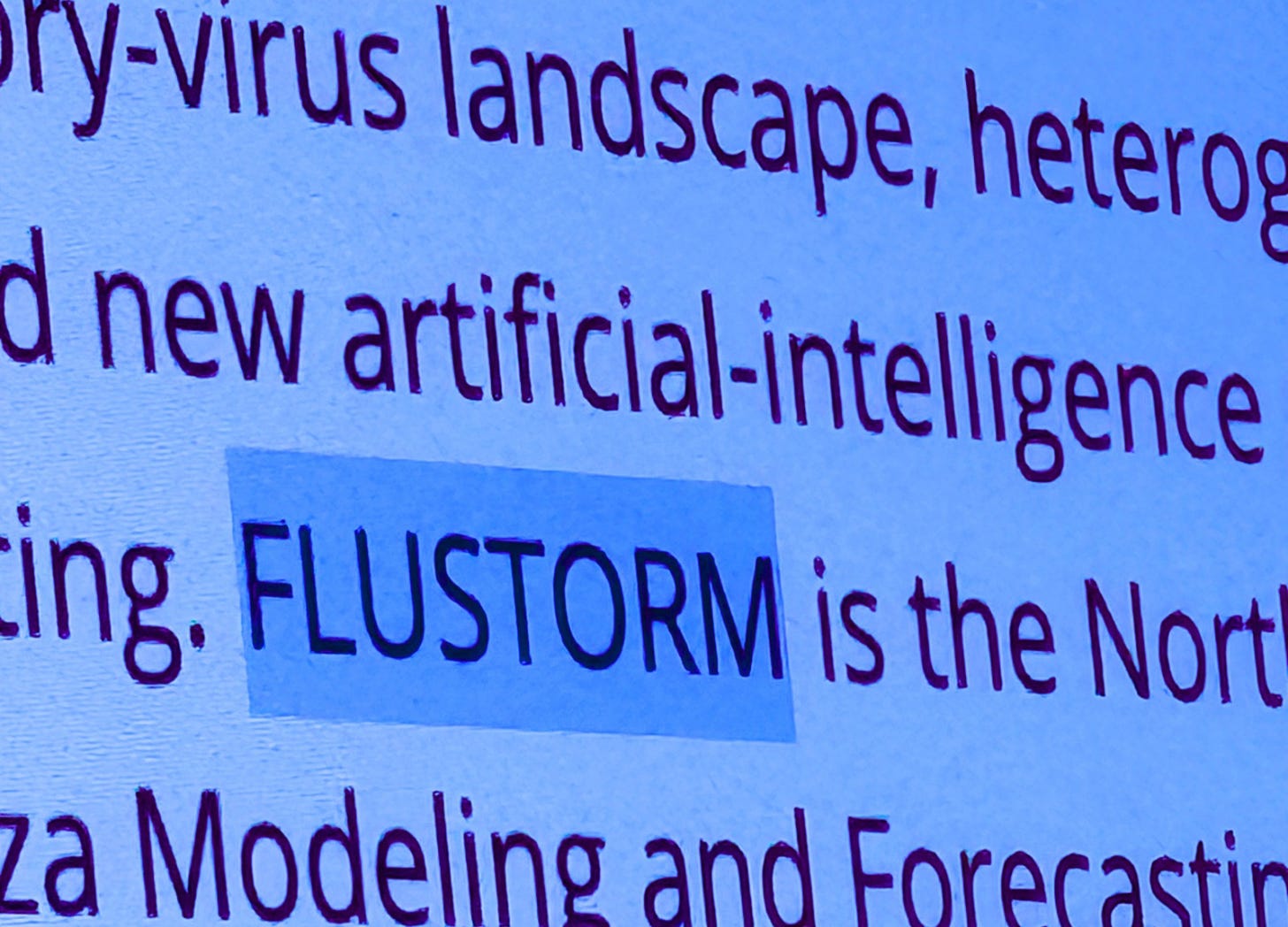
The U.S. Department of Health and Human Services’ September 15, 2026, award record reveals that the Centers for Disease Control and Prevention (CDC) awarded $473,342 to Northeastern University in Boston for FLUSTORM, a five-year project integrating artificial intelligence (AI), synthetic influenza pandemic scenarios, and government public-health decision support.
The CDC is funding technology that can generate fake pandemic threats that do not exist as observed outbreaks, calculate their hypothetical consequences, and deliver those projections to government authorities.
The award reads:
“Influenza forecasting and scenario modeling center to inform CDC and public-health partner preparedness, prevention, and response for seasonal and pandemic influenza.”
…
“By combining a long operational forecasting record with new methodological and infrastructure contributions, FLUSTORM will strengthen CDC’s capacity to generate, evaluate, synthesize, and communicate influenza forecasts and scenario projections for seasonal preparedness and pandemic influenza response.”
The award runs from September 30, 2026, through September 29, 2031.
The central watchdog issue is fraudulent threat predication.
Could officials manufacture the appearance of a pandemic emergency by presenting computer-generated scenarios as observed dangers?
Could hypothetical hospitalizations and projected casualties become justification for emergency measures without corresponding real-world evidence?
If government officials knowingly misrepresent simulated threats as verified emergencies, would that constitute fraud?
Who would investigate, and who would be held accountable?
The move comes as NIH scientists recently reported engineering chimeric influenza material with enhanced replication at 104°F, exempting their own experiments from dangerous gain-of-function restrictions, and using the findings to justify expanded pandemic surveillance and preparedness.
The CDC is also reporting alleged H5N1 infections and a death in Washington while withholding the original laboratory evidence needed to independently verify the diagnoses, raising questions about whether unaudited threat claims could justify expanded surveillance and future emergency measures.

1. CDC Funds Pandemics That Exist Only Inside Computers
The federal award explicitly identifies:
“synthetic pandemic-influenza benchmarks with known ground truth”
The project also incorporates:
“a flu-tailored agentic interface over validated modeling engines”
Meaning: FLUSTORM includes artificial pandemic scenarios with predefined underlying conditions and AI-assisted systems for generating and evaluating contrived forecasts.
The particular pandemic represented in such a simulation need never have occurred.
Researchers can establish hypothetical conditions and calculate the consequences that follow from them.
The modeled threat and its projected consequences exist as computer-generated scenarios, not directly observed casualties from that hypothetical emergency.
The decisive question is whether government officials will maintain that distinction when communicating model-generated threats to the public.
2. AI Generates the Projections Government Receives
The award identifies several technologies:
Epydemix: A modeling platform for forecasting and simulated outbreak scenarios.
GLEAM: An established computational disease-spread modeling platform.
Agentic AI: An interface for working with forecasting engines and interpreting their outputs.
Multistrain influenza models: Systems representing multiple influenza classifications and their projected behavior.
The federal award states that FLUSTORM will:
“strengthen CDC’s capacity to generate, evaluate, synthesize, and communicate influenza forecasts and scenario projections”
Meaning: The project is designed to produce, evaluate, and communicate hypothetical emergency scenarios for public-health decision-making.
The resulting projections can influence government planning even when the particular modeled emergency has never been directly observed.
Who verifies that simulated dangers are not presented as independently established threats?
Who audits assumptions selected by model developers, and who examines rejected simulations that produced different outcomes?
3. Government Agencies Receive the Computer-Generated Scenarios
The federal award identifies partnerships with the Council of State and Territorial Epidemiologists (CSTE), Maine CDC, and Boston Public Health Commission.
The award states:
“forecasts, scenarios, and communication products are used”
in state, territorial, and local public-health settings.
Meaning: FLUSTORM is connected to a government network that uses disease forecasts and scenario projections.
The federally funded system therefore has a documented pathway into public-health planning.
The concern is not merely that artificial emergencies can be constructed. It is that their projected consequences can be communicated to government agencies responsible for real-world emergency responses.
What prevents hypothetical threats from becoming official emergency justifications?
If a simulated outbreak produces alarming projections, who determines whether officials may cite those numbers when seeking additional funding, emergency powers, or public compliance?
Can the public independently audit the entire process?
4. The Pandemic-Orchestration Connection
FLUSTORM expands a federal capability relevant to previous investigations of DARPA threat prediction, computational biological modeling, and pandemic-response infrastructure.
The underlying sequence is:
Hypothetical biological threat → synthetic pandemic → projected infections and casualties → government forecasting and emergency planning.
The CDC award documents the generation, evaluation, and communication of synthetic pandemic scenarios.
Government officials can receive numerical predictions about an emergency that has never happened. Those predictions can influence preparations and responses before the modeled threat is directly observed.
If officials knowingly conceal that distinction, simulated threats could be misrepresented as verified dangers.
That is the fraudulent-threat-predication question at the center of the investigation.
5. Who Is Responsible?
The federal award identifies the CDC’s National Center for Immunization and Respiratory Diseases (NCIRD) as the responsible federal organization and Northeastern University as the recipient.
The award also identifies the project’s institutional public-health partners:
Council of State and Territorial Epidemiologists
Maine CDC
Boston Public Health Commission
The award record does not identify FLUSTORM’s individual principal investigator or the CDC officials directly supervising the project.
The responsible institutions can be contacted through their official channels:
CDC: https://www.cdc.gov/cdc-info/
Northeastern University: https://www.northeastern.edu/
CSTE: https://www.cste.org/
The institutions should be asked to release FLUSTORM’s complete synthetic pandemic specifications, original model inputs, validation records, rejected outputs, underlying data, government communications, and rules governing how simulated threats are presented to policymakers.
Who authorizes the assumptions?
Who decides which hypothetical scenarios deserve government attention?
Who prevents government-funded simulations from being misrepresented as independently verified emergencies?
Bottom Line
The CDC awarded Northeastern University $473,342 to expand a five-year AI-assisted influenza forecasting system that includes computer-generated pandemic scenarios and government decision support.
The project can generate projections of hypothetical emergencies without those specific emergencies having been directly observed.
Its partnerships connect the resulting forecasts and scenarios to public-health agencies.
The fundamental watchdog issue is whether government-generated pandemic scenarios can become official threat justifications without independent evidence establishing the particular projected emergency.
If officials knowingly present hypothetical scenarios as verified dangers, the issue becomes potential deception, fraudulent threat predication, and accountability for the government actions that follow.
Source: Jon Fleetwood


Comments
Post a Comment