Did Noam Chomsky really “revolutionize linguistics”?
This is the second installment in a series. The first part can be found here...
Did Noam Chomsky really “revolutionize linguistics”?

I’ve got my work cut out for me today.
My goal today is to convince you that Noam Chomsky has been part of the U.S. propaganda machine for the entirety of his long career.
To do that, I will need to explain that his theories about linguistics are totally wrong, and have been from the beginning.
Today’s episode is the second in a series. If you want to start from the beginning, please check out Chomsky, Epstein and the CIA.
CHOMSKY’S MAIN IDEAS
Most of you have probably heard that Chomsky “revolutionized” linguistics, but I doubt many of you are aware what his brilliant ideas actually are.
I remember learning a bit about Chomsky at university and wondering what in the hell all the hype was about. I figured that there must have been something that I wasn’t understanding, because nothing I was hearing sounded very insightful.
For example, Chomsky is credited with coming up with the brilliant idea that the capacity for language is innate to human beings.
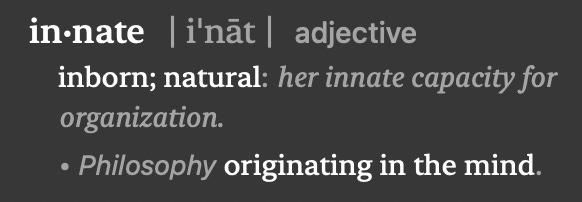
“Who cares?” I remember thinking. Was someone saying that the human capacity for language wasn’t innate?
Another of his ideas was this innate capacity was “hardwired” into human beings by Evolution. We are “genetically programmed” to use language. Fish swim, birds fly, and humans use language.
This seems reasonable, right? After all, all humans use language. Whether we’re talking about African pygmies or igloo-dwelling Inuit, every human society uses speech to communicate. It is most certainly a human universal.
But so what? There’s no way that Chomsky was the first to notice this. What’s so “revolutionary” about the idea that language is “innate”?
Chomsky & Behaviourism
Now, to be fair to Chomsky, he was proposing his theory in response to the behaviourist school of psychology, which explained language through reactions to stimuli. The behaviourists were a bunch of weird creeps who treated humans as big bundles of automatic reactions.
One of the big moments in Chomsky’s ascent to academic super-stardom was a review of B.F. Skinner’s Verbal Behavior in 1959. That review tore Skinner’s work to shreds and pretty much put an end to behaviourism.
Tom Wolfe explains:
Skinner’s radical behaviorism, as he termed it, had effectively turned Freudianism inside out. While Freud endeavored to delve into his patient’s psyche—reminiscent of a voodoo houngan or Gilgamesh—by interpreting dreams and probing unspeakable intimate thoughts using a handful of rather simplistic formulas (e.g., dreams of flying symbolizing orgasms), Skinner dismissed all this as sheer “mentalism.”
He wasn’t concerned with what a patient said or dreamed but focused on observable actions—behavior, including verbal behavior.
Every behaviorist finding began in the laboratory with a rat placed in a small chamber known as a Skinner box—a container about the size of a small carton of paper towels, equipped with a bar on one wall. The rat would eventually learn that pressing the bar resulted in a food pellet dropping onto a tray. Over time, the experimenter could modify the conditions so that the rat received a pellet only after every third press or following a specific sequence, such as walking in a counterclockwise circle before pressing the bar again.
To his great surprise, Skinner found that he could “extend these methods to human behavior,” even verbal behavior, “without serious modification.”
Basically, Skinner was saying that human children learn language through a combination of positive and negative reinforcement – reward and punishment.
I’m no fan of Skinner’s, but it would be hard to deny that children learn language through a conditioning process that involves rewards and punishments.
I mean, isn’t that what school is?
As Chomsky grinds through Skinner’s Verbal Behavior for twenty thousand words, he repeatedly employs expressions such as “empty,” “quite empty,” “quite false,” “completely meaningless,” “perfectly useless,” and similar descriptors. He also uses terms like “vacuous,” “complete retreat to mentalistic psychology,” and “mere paraphrases for the popular vocabulary”—the latter appearing on the same page as “perfectly useless,” “vacuous,” and “likewise empty.” Other phrases include “serious delusion,” “of no conceivable interest,” “play-acting at science,” “This is simply not true,” “no basis in fact,” “very implausible speculation,” and “entirely pointless and empty.”
Empty, empty, empty—until there is scarcely a single point Skinner makes in Verbal Behavior that Chomsky has not exploded into hot air. With this one review, he demolished the book, dug the ground out from under the theory of behaviorism (it never got back on its feet), and consigned B. F. Skinner to history.
No one in academia had ever seen such a show of power.
So that’s how the story goes. It’s kind of a strange story, if you really stop to think about it. Behaviourism was the dominant paradigm psychology, not linguistics. How did Chomsky “revolutionize” linguistics by vanquishing Skinner?
Here’s a question that no one ever seems to ask – what did linguists believe before Noam Chomsky?
A BRIEF HISTORY OF LINGUISTICS
Linguistics as a science isn’t that old. Oh sure, there have been grammarians and philologists since ancient times… but the idea of the scientific study of language only goes back to the mid-1800s.
If you want to understand how modern linguistics really got started, I highly recommend watching a video called The Eureka Moment of Linguistics.

The Eureka Moment of Linguistics happened when scholars figured out that Sanskrit, Greek, and Latin were all descended from one language. Understandably, this caused a massive wave of enthusiasm for the comparative study of different languages.
One of the people who got caught up in this wave of enthusiasm was a Swiss genius named Ferdinand de Saussure. He had a whole bunch of very interesting ideas about language which had apparently never occurred to anyone before.
In 1916, some of Saussure’s students published A Course on General Linguistics, which is widely seen as the founding document of modern linguistics.
Ultimately, Saussure’s vision was for a field of study which went beyond language. He envisioned a science of meaning itself, which he called semiology.
His ideas went on to inspire Structuralism, one of the major philosophical movements of the 20th century.
AMERICAN LINGUISTICS
Around the same time that Saussure was developing his ideas in Europe, an American mathematician and philosopher named C.S. Peirce was working along similar lines. He became one of the founders of the philosophical school known as American Pragmatism, alongside figures like William James and John Dewey.
Peirce’s work on semiotics—the theory of signs—ran parallel to Saussure’s semiology, though with a different framework and a deeper interest in logic and interpretation.
But Peirce was the exception.
In the U.S., linguistics was dominated not by logicians or formal theorists, but by anthropologists, especially those trained by Franz Boas, the so-called Father of American Anthropology.
Boas and his students—people like Edward Sapir—were deeply involved in studying indigenous languages, many of which had never been written down or formally analyzed. They had deep respect for the cultures they were studying, and did not see modern Western civilization as inherently superior to the tribal societies of Turtle Island.
These scholars were, in a very real sense, the countercultural intellectuals of their day. They often sympathized with indigenous peoples and tended toward Romanticism, mysticism, and even anarchism.
Two of the most famous among them were Edward Sapir and Benjamin Whorf, best known for the Sapir-Whorf Hypothesis, which proposes that different languages prime the minds of their speakers to experience reality differently.
CHOMSKY REVOLUTIONIZED LINGUISTICS BY OVERTURNING A PARADIGM THAT NO ONE ACTUALLY BELIEVED IN
So what’s the point of all this?
It’s this: Chomsky didn’t actually overturn the dominant paradigm in American linguistics. He didn’t “revolutionize” linguistics in the way that is so often claimed.
He challenged behaviourism, which was the dominant paradigm in psychology, not in linguistics. In fact, most linguists—especially those in the Boasian tradition—weren’t behaviourists to begin with. If anything, they were the complete opposite of behaviourists.
So, Chomsky basically “overturned” a paradigm that no linguists actually believed in. Isn’t that odd?
Ostensibly, Chomsky wanted to turn linguistics from a squishy social science into a real, hard science by bringing in a new paradigm grounded in formalism and logic, yet he completely ignored the work of C.S. Peirce, who had spent years applying mathematical logic to language.
The official story of the rise of Chomsky makes very little sense. In retrospect, the Chomsky-Skinner beef seems strangely stage-managed.
There’s a reason that we’re talking about a book review that was written over 50 years ago. It marked a changing of the guards. Skinner was out, and Chomsky was in.
And all of a sudden, Chomsky had become the King of American linguists.
THE CHOMSKYAN NOTHINGBURGER
WHAT WERE CHOMSKY’S IDEAS?
One of the bizarre things about Chomsky is that he’s the most famous linguist in the world… but no one can really tell you what his ideas are.
Well, that’s not entirely true – people can usually tell you that one of the oracle’s brilliant teachings is that language is innate, and maybe remember that they had something to do with “deep structure”.
What they can’t do is tell you why these ideas are important.
Tom Wolfe absolutely skewers Chomsky in his brilliant book The Kingdom of Speech, which I really cannot recommend highly enough.
He writes:
Nobody in academia had ever witnessed—or even heard of—a performance like this before. In just five years, 1953–57, a University of Pennsylvania graduate student—a student in his twenties—had taken over an entire field of study, linguistics, and stood it on its head. He hardened it from a spongy so-called social science into a real science—a hard science—and put his name on it: Noam Chomsky.
Officially, on his transcript, Chomsky was enrolled at Penn, where he had completed his graduate school coursework. But at bedtime, and in his heart of hearts, he was living in Boston, as a member of Harvard’s Society of Fellows, and creating a Harvard-level name for himself while he worked on his doctoral dissertation for Penn.*
Even before receiving his PhD, he was invited to lecture at the University of Chicago and Yale, where he introduced a radically new theory of language. Language was not something you learned. You were born with a built-in “language organ.” It is functioning the moment you come into the world, just the way your heart and your kidneys are already pumping, filtering, and excreting.
To Chomsky, it didn’t matter what a child’s first language was. Whatever it was, every child’s language organ could use the “deep structure,” “universal grammar,” and “language acquisition device” (LAD) he was born with to express what he had to say—no matter whether it came out of his mouth in English, Urdu, or Nagamese. That was why—as Chomsky said repeatedly—children started speaking so early in life… and so correctly in terms of grammar. They were born with the language organ in place and the power ON.
By the age of two, usually, they could speak in whole sentences and generate completely original ones. The “organ”… the “deep structure”… the “universal grammar”… the “device”—as Chomsky explained it, the system was physical, empirical, organic, biological. The power of the language organ sent the universal grammar coursing through the deep structure’s lingual ducts to provide nutrition for the LAD, which everybody in the field now knew referred to the “language acquisition device” Chomsky had discovered.
Two years later, in 1957, when he was twenty-eight, Chomsky pulled all this together in a book with the opaque title Syntactic Structures—and was on the way to becoming the biggest name in the 150-year history of linguistics.
IS LANGUAGE SOMETHING YOU LEARN?
Prior to Chomsky, linguists believed that language was something you learned. Thanks to Chomsky, the world discovered that the real reason was because humans are born with a “language organ”.
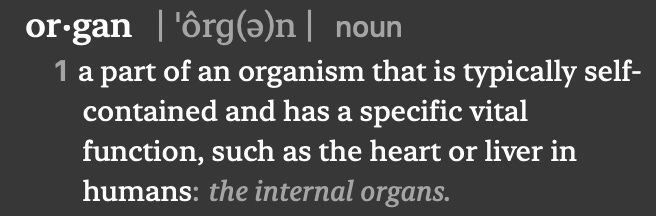
This choice of the word “organ” was weird, given that the word organ has a pretty specific meaning in biology.
Tom Wolfe tells the story with his inimitable wit:
In the one recorded instance of someone confronting him over this business of a language organ, Chomsky finessed his way out of it con brio. The writer John Gliedman asked Chomsky the Question: Was he saying he had discovered a part of human anatomy that all the world’s anatomists, internists, surgeons, and pathologists had never laid eyes on?
It wasn’t a question of laying eyes on it, Chomsky indicated, because the language organ was located inside the brain.
Was he saying that one organ—the language organ—was inside another organ, the brain? But organs are, by definition, discrete entities.
“Is there a special place in the brain and a particular kind of neurological structure that comprises the language organ?” asked Gliedman.
“Little enough is known about cognitive systems and their neurological basis,” said Chomsky. “But it does seem that the representation and use of language involve specific neural structures, though their nature is not well understood.”
It was just a matter of time, he suggested, before empirical research substantiated his analysis. He appeared to be on the verge of the most important anatomical discovery since William Harvey’s discovery of the human circulatory system in 1628.
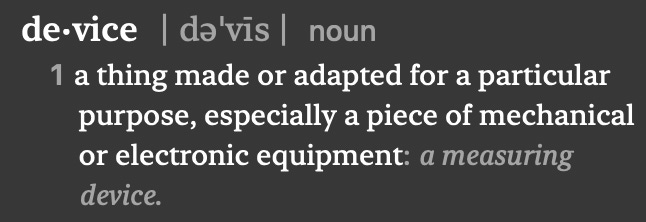
Guess what? No language organ was ever discovered. Not to be deterred, Chomsky renamed his hypothetical language organ a “language acquisition device” and carried right along.
Is device any better than organ? You tell me.
Other than that, Chomsky’s big idea is Universal Grammar, but that is a subject that deserves an article of its own.
So I’ll leave you with that for a cliffhanger, but I’ll include a few closing thought before I let you go.
ACADEMIA IS PART OF THE PROPAGANDA MATRIX
Since COVID, many of us have realized that the Empire’s propaganda machine is much more sophisticated than we had previously realized.
To some, it will seem crazy to suggest that Noam Chomsky, one of the world’s most famous critics of U.S. imperialism, is in fact a propagandist working on behalf of that very same empire.
Why would the U.S. Empire pay someone to criticize it?
Well, it just so happens that Noam Chomsky gives us a very good answer to that question:
“The smart way to keep people passive and obedient is to strictly limit the spectrum of acceptable opinion, but allow very lively debate within that spectrum….”
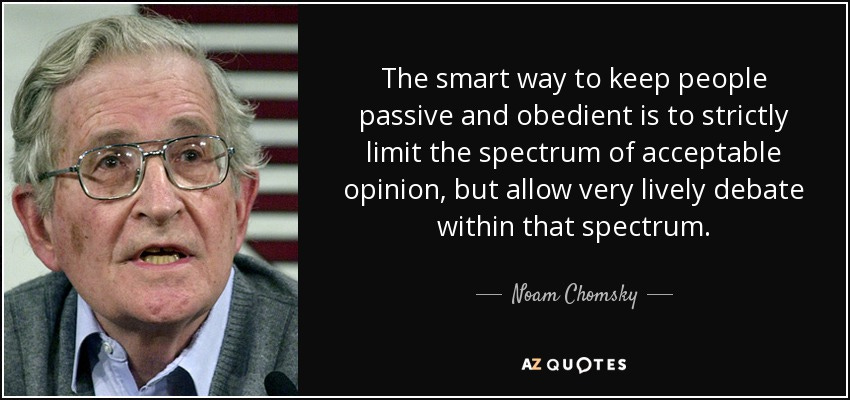
There you have it, folks. Revelation of the Method.
I hope you enjoyed this piece… Stay tuned for my exposé of Universal Grammar!
for the wild,
Crow Qu’appelle
Source: Winter Oak


Comments
Post a Comment