Susan Brownmiller’s Rape Myths
Susan Brownmiller’s Rape Myths
The author has died, but her baseless contentions live on

Radical feminist Susan Brownmiller died last weekend at age 90. As The Washington Post noted in its obituary, Brownmiller’s book Against Our Will: Men, Women, and Rape, published in 1975, “transformed the social and legal understanding of rape as a tool of violence and power.”
It is remarkable that a book so sloppily written, thinly substantiated, and motivated by such obvious derangement could have had such a far-reaching impact, but it did.
No reasonable person will want to read Brownmiller’s repulsive tract, but all should know of its spurious claims.
**
“I wrote this book because I am a woman who changed her mind about rape” (p. 9). So wrote Brownmiller in a Personal Statement placed at the book’s beginning.
In this preface, Brownmiller told of a shattering awakening that occurred when “I finally confronted my own fears, my own past, my own intellectual defenses” (p. 9). Describing the experience as a spiritual rebirth, Brownmiller explained that through listening to her “sisters in feminism,” she had gained a new vision of male-female relations.
Needless to say, it was not a positive one. Against Our Will records in detail her nightmarish revelation.
Brownmiller went from seeing rape as a crime condemned by society and committed by aberrant individuals, to recognizing it as a widely-accepted practice and the ultimate means of patriarchal control: “[Rape] is nothing more or less than a conscious process of intimidation by which all men keep all women in a state of fear” (p. 15).
For Brownmiller, there was nothing deviant about men who commit rape; they were simply acting out the desires and beliefs that most men have (p. 312).
Never providing any proof for such an outrageous assertion, Brownmiller claimed that rape was what men do because they can and because they believe it to be their right—the right “to gain access to the female body” (p. 392). She compared rapists to the Myrmidons of Greek legend, those soldiers the warrior Achilles used as “hired henchmen in battle” and “effective agents of terror” (209). Ordinary rapists, according to Brownmiller, “in a very real sense perform a Myrmidon function for all men in our society” (209).
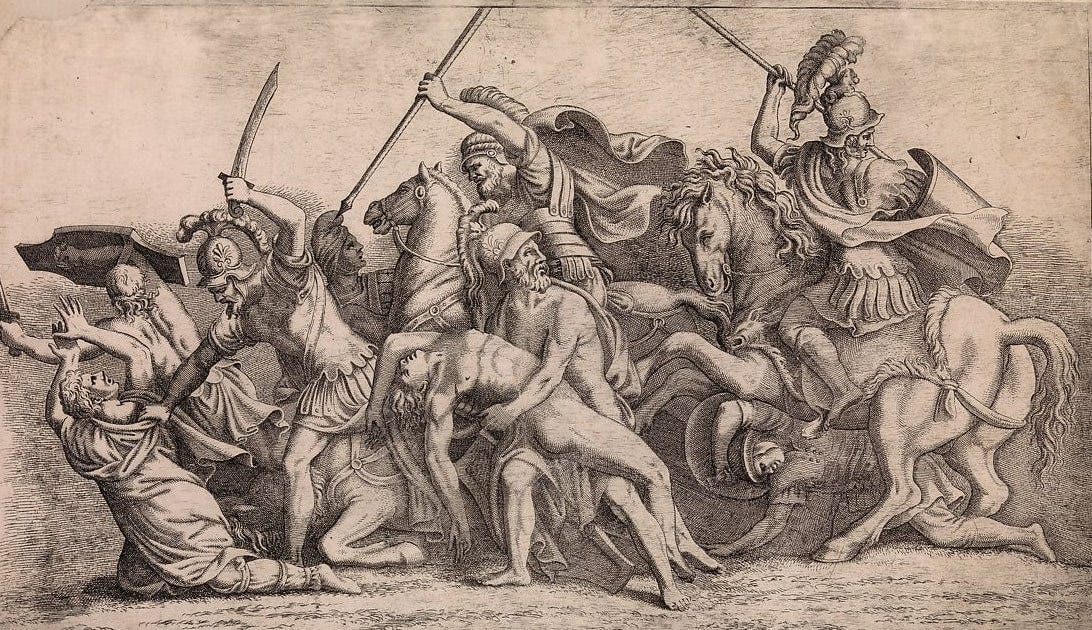
According to Brownmiller, “That some men rape provides a sufficient threat to keep all women in a constant state of intimidation, forever conscious of the knowledge that the biological tool [the penis] must be held in awe for it may turn to weapon with sudden swiftness borne of harmful intent” (p. 209).
Brownmiller argued that all men benefit from the existence of rape because, as she surmised, all men enjoy dominance and seek to profit from women’s fear. No surveys, no psychological studies, no documentary evidence, and not even any sound logic was offered to support this contention. The minority of men who rape simply came to stand in for the majority of men in the world.
If this sounds like a thoroughly ideological proposition based on an anti-male contempt so profound it never occurred to Brownmiller to prove it or test it against alternative hypotheses, that’s because it was. And it is truly shocking that so many reviewers never subjected Brownmiller’s preposterous claims to the interrogation they deserved. Brownmiller’s book was welcomed with glowing reviews and chosen by The New York Times Book Review as one of the Outstanding Books of the Year. In 1976, Brownmiller was featured on the cover of Time magazine as one of 12 “Women of the Year.”
Few took public issue with Brownmiller’s many unsupported assertions and tendentious conclusions.
In her first chapter, Brownmiller declared that from the beginning of recorded history, men had had trouble taking rape seriously as a crime against a woman’s person. She admitted that from 1275 onward, rape was dealt with harshly, punishable in England according to the Second Statute of Westminster by death. But this fact hardly lessened her expressed certainty that the law did not care about women’s injuries. Lawmakers’ understandable worry about the possibility of a man being wrongly put to death she took as clear proof of male scorn for “victims.”
Two chapters on rape in war supported Brownmiller’s claim that “War provides men with the perfect psychologic backdrop to give vent to their contempt for women” (p. 32). In other words, war allowed men to do what they always wanted but normally could not. The fact that rape was made illegal and punishable by death or imprisonment under Article 120 of the American Code of Military Justice was a mere technicality for her.
That war is about men killing other men—and often torturing and mutilating their bodies, including raping them—did not weaken Brownmiller’s belief that it is exclusively women’s bodily integrity that men choose (or are forced) to violate during war.
From this point on in the book, it is difficult not to notice how Brownmiller’s rage overshadows her ability to reason, as every element of human history is marshalled to prove her damning conclusion.
For example, Brownmiller included a substantial section on wartime propaganda during the First World War in which she made much of the fact that Belgium was represented in British war propaganda as a woman raped by the armies of Germany.
She didn’t seem to care, or notice, that the propaganda provided evidence to oppose her thesis. It wasn’t that most men had contempt for women, but that many men were in fact willing to risk their lives in war, and to die if necessary by the hundreds of thousands, in an attempt to save women.
Expressions of public horror at the use of rape in war, and even the metaphorization of rape as a symbol of the worst possible atrocity, as in the phrase “The Rape of Nanking” (p. 57) were mentioned by Brownmiller as if they supported her contention that rape was a casually accepted and at times even glorified practice.
Moreover, the horrific brutalization of men in war and the enormous psychological toll on men of war conditions were never once mentioned as factors requiring serious consideration in any study of wartime rape. In Brownmiller’s so-simplistic view, men were always perpetrators of harm, never self-sacrificing protectors or suffering agents deserving of empathy.
**
Brownmiller wrote as a declared leftist who had broken with her Communist mentors on the issue of rape.
She mentioned her intellectual debt to the American Marxist historian Dr. Herbert Aptheker, from whom she had taken classes in American history. As a young Communist, she had been taught to see rape accusations by white women against black men as a weapon of racism; she had even believed that as a white woman, she should not object to black men’s sexualized behavior, believing she must “bear the white man’s burden of making amends for Southern racism” (p. 248). But no longer.
In a chapter on interracial rape, Brownmiller resolved the tension between her Communist-inspired empathy for black men and her feminist-inspired defense of white female rape accusers by shifting the burden of guilt from white women who accused black men to the white men who allegedly coerced white women to lie and/or created the conditions by which black men felt compelled to rape. “We white women did not dangle ourselves yet everything the black man has been exposed to would lead him to this conclusion, and then to action, in imitation of the white man who raped ‘his’ woman” (p. 253).
White women really were raped by black men, Brownmiller asserted, but they were raped because white men had raped black women, and had inspired justified though misdirected rage in black men. In Brownmiller’s convoluted rationalizations, we see clearly the strained negotiations necessary at the intersection of race and gender ideologies—and the inevitable preference to blame white men whenever possible. Brownmiller ultimately called for solidarity between blacks and white women in recognition of their alleged mutual victimization by the white male enemy. “Rape is to women as lynching was to blacks” (p. 254), she remarked, claiming that “The mythified spectre of the black man as rapist […] must be understood as a control mechanism against the freedom, mobility and aspirations of all women, white and black” (p. 255).
In other words, white men created a bogey-man of the black rapist in order to maintain white male power.
A chapter on prison rape amplified the glaring biases in Brownmiller’s intersectional feminist ideology. Having just discussed interracial rape, she went on to report that the vast majority of men raped in a Philadelphia prison, according to a recent study, were white men raped by black men, but she did not allow this fact to complicate her anti-white male perspective.
Though recognizing the frequency and brutality of prison rape, she doggedly continued to see rape exclusively as an act of contempt against women only. And even after admitting the existence of female-on-female sexual assaults in prisons and other institutional settings, Brownmiller refused to alter her male-perpetrator paradigm. She did not consider female-on-male sexual assaults as deserving of sustained attention.
**
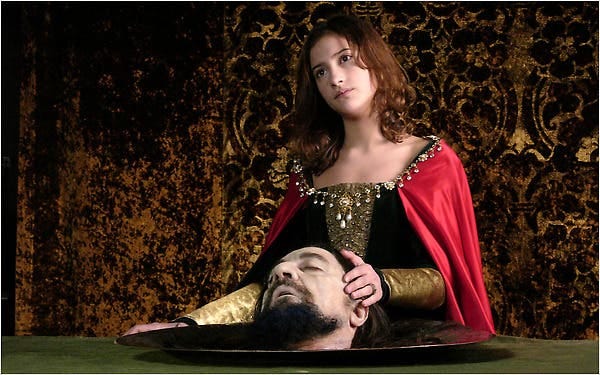
Perhaps the best example of blinkered ideological certainty occurs when Brownmiller discussed the mythologizing of rapists in history. She explained that the original Bluebeard, the French nobleman Gilles de Rais, was infamous in his time for abducting, raping and murdering between forty and one hundred male youths (p. 292). As she noted, Bluebeard is known today as a man who killed seven wives, not as a sex-murderer of boys. The fact that we associate cruelty with the sex-murder of women rather than of boys does not strike Brownmiller as significant.
She also mentioned American serial killer Dean Allen Corll who, with two disciples in the early 1970s, abducted at least twenty-eight teenaged boys who were then tortured, raped, and murdered. Corll’s name, she noted, has been essentially purged from popular memory.
So committed was Brownmiller to her theory of rape as an expression of male sexualized contempt for women that she speculated that the public forgetting of the sex-murders of boys occurred because ordinary men like to identify with rapists of women—that they get a sexual thrill from it—and cannot identify with a man who raped, tortured, and murdered boys. Here are her words:
“Corll raped and killed his own kind, and what heterosexual man with a rich, imaginative, socially acceptable fantasy life could safely identify with Corll without at the height of his fantasy slipping a little and becoming for one dread instant that cringing, whimpering naked lad manacled wrist and foot to the makeshift wooden torture board? What a turnoff that would be! What a short circuit of the power lines!” (293).
The naked hatred for male being could not be clearer.
The simpler explanation for lack of public interest in boys’ sexual torture and death would be that few people care much about harms to boys, but this never seemed to occur to Brownmiller. In true misandrist style, she herself seemed immediately to forget the stories she reported of male vulnerability and suffering, always returning to her thesis about the abuse of women. Just a few pages after the discussion of serial killer Dean Corll, she stated once again that “To talk about rape, even with nervous laughter, is to acknowledge a woman’s special victim status. We hear the whispers when we are children: girls get raped. Not boys” (p. 309).
**
For Brownmiller, in the tried-and-true tradition of feminist theorizing, women were without stain, men without redeeming qualities. Women played no active role in the history she recounted, and one day—when at last men’s power is overthrown—a new dawn will bring an end to all rape, all abuse, and all injustice.
At one point in the book, Brownmiller admitted that women do harbor well-documented and much-discussed fantasies of sexual masochism, including rape fantasies, but she insisted that this was so because men had forced such fantasies onto women (p. 316-317). She was confident that when women at last held power, they would develop better “sexual daydreams” (p. 323), as she called them, ones that would be “non-exploitative, non-sadomasochistic, non-power-driven” (p. 324)—in other words, not perhaps very sexy at all.
Women, according to Brownmiller, never wanted to “humiliate and degrade” (p. 379). Only the male psyche seeks the degradation of the other.

Of all the repellant and defamatory theories feminists have promulgated about men over the years, Brownmiller’s may well be the worst, contaminating at the root the male-female pair bond and charging every man with complicity in rape.
Because she refused to accept in theory—even while admitting in fact!—that men could be victims and women perpetrators, Brownmiller decisively set the terms for all that is most unjust and demonizing in the feminist construct of male sexual guilt.
With her call for “an overhaul of present laws and a fresh approach to sexual assault legislation” (p. 386), she paved the way for radical changes to law and policy, in which society and police must “believe women,” in which a mere accusation can lead to severe punishment, and in which men’s avenues of legal defense are continually reduced.
Against Our Will: Men, Women, and Rape is a collection of anti-male libels designed to permanently stigmatize men at the deep heart of their masculinity. The only thing more shocking than Brownmiller’s ridiculous claims was the credulity of the intellectuals and pundits who accepted, praised, and promoted them.
Source: The Fiamengo Files


Comments
Post a Comment