Financiers, Fabians and Fascists
In my April 2025 article ‘The Big Plan and the Great Gaslighting’, I took a look at Political and Economic Planning (PEP), a think tank pushing “modernisation” in Britain in the 1930s. [1]
President of PEP from its foundation was Israel Moses Sieff (“Baron” Sieff), a Zionist businessman behind high street retailer Marks & Spencer (now known as M&S).
Thanks to the blogger Escapekey, I have now been able to peruse a 1933 document issued in Sieff’s name which, as my fellow researcher notes, is very hard to track down. [2]
The version that I am referencing was included in the US congressional record at the behest of Louis Thomas McFadden, a Republican member of the United States House of Representatives from 1915 to 1935.
McFadden was certainly an interesting character. A banker by trade, he saw from the inside the corruption taking place in the world of finance and became an outspoken critic of the Federal Reserve System.
He noticed that this “was created and operated by Jewish banking interests who conspired to economically control the United States” – which, of course, in the warped world of Wikipedia amounts to “antisemitic conspiracy theories”. [3]
In today’s upside-down society, pointing out a criminal conspiracy involving Jewish people, or a criminal genocide carried out by the Zionist state, is automatically deemed to be “anti-semitic”.
The truth behind the accusation is not even considered relevant and the moral reality of the situation is inverted so as to present the criminal as the victim and the revealer of the crime as the villain.
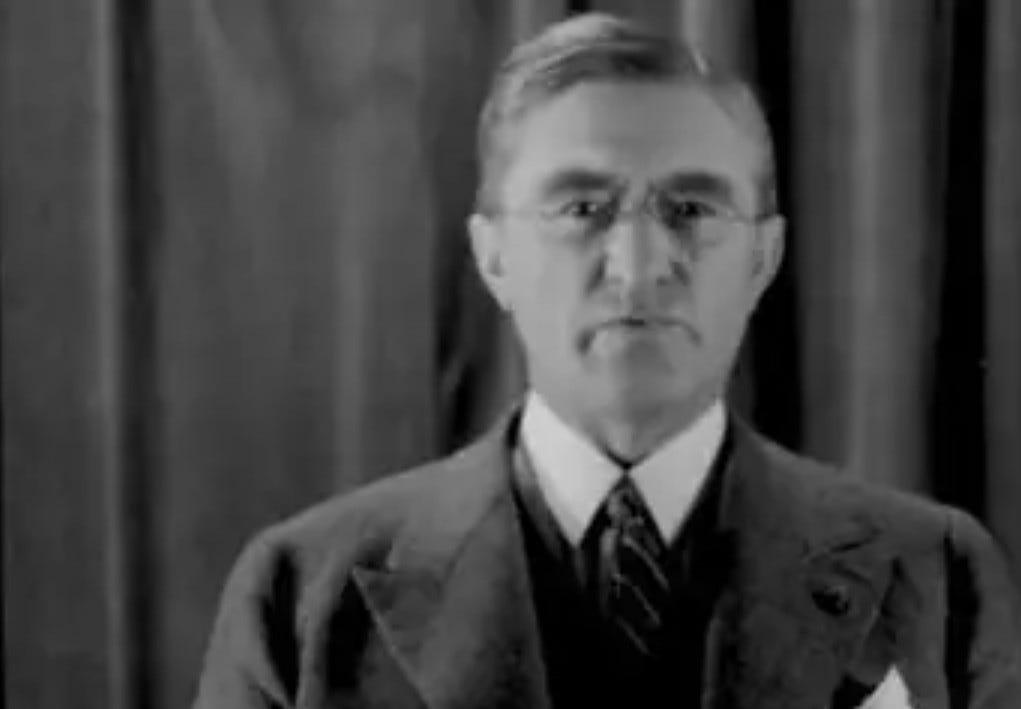
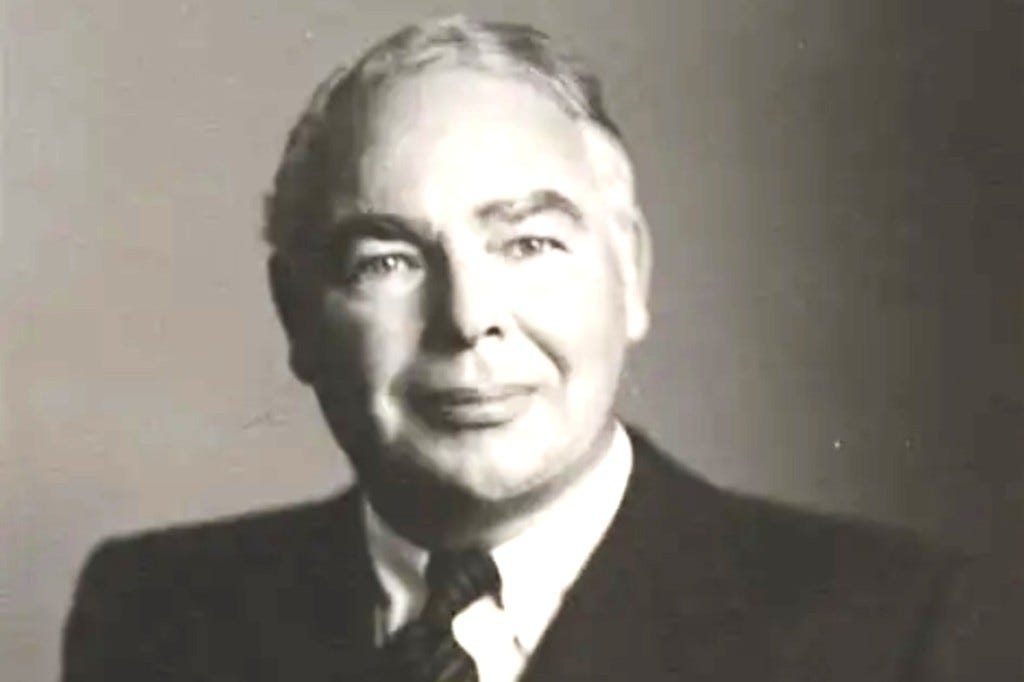
Declared “disgraced”, McFadden (pictured) lost his place to a Democrat in a 1934 election and died of “coronary thrombosis” while visiting New York City two years later, at the age of 60. [4]
In presenting Sieff’s document to US Congress on June 8 1934, McFadden warned of a “well-organized plan for world control… a hellish conspiracy to enslave and dominate the free peoples of the earth”. [5]
He said: “We are on the threshold of a modern and Machiavellian feudal system devised and controlled by a group of international usurpers”.
McFadden drew Congress’s attention, in particular, to the role of Bernard M. Baruch (1870-1965), a “Jewish-American financier, stock market speculator, statesman, and presidential advisor”. [6]
Baruch was a leading player in the zio-satanic imperialist mafia, ZIM and, I see, was a friend of Winston Churchill and of at least one member of the Rothschild family. [7]
Said McFadden: “There has not been an administration since our advent into the great World War in which Bernard M. Baruch has not been a chief political, economic, and financial adviser, and every administration that has listened to him has carried us deeper and deeper into financial chaos, and today we are operating on his greatest experiment – a planned economy and industrial and agricultural control”.
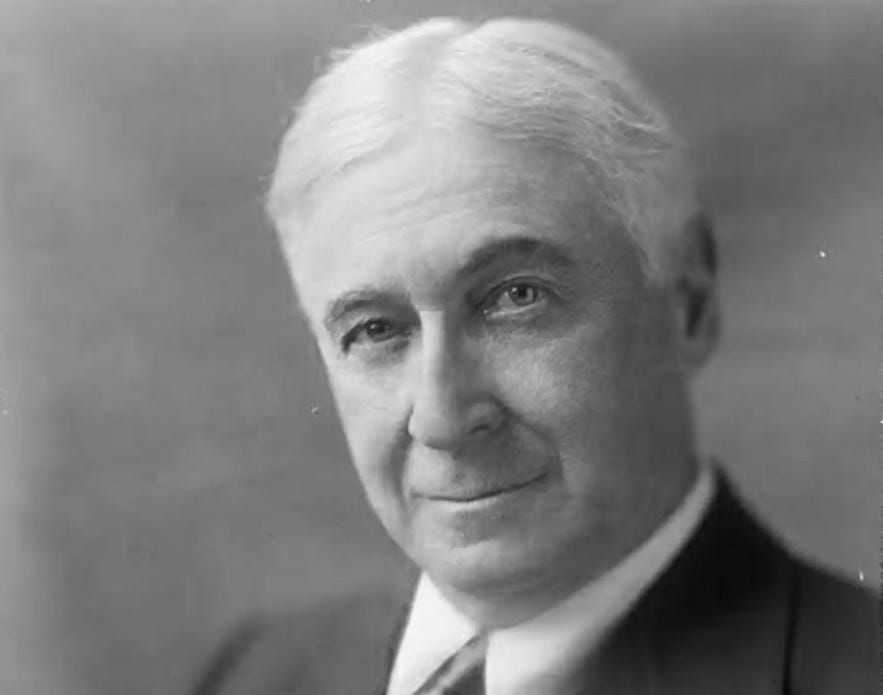
He added that immediately after WWI, Baruch (pictured) had appeared before a select congressional committee “and there testified to the fact that he virtually had complete control of the resources of the American Nation during the war”.
Baruch himself told the committee: “I probably had more power than perhaps any other man did in the war; doubtless that is true”.
Referring to the 1933 National Industrial Recovery Act, part of President Franklin D. Roosevelt’s so-called “New Deal”, McFadden said: “It required 15 years of hard effort on the part of Mr. Baruch and his associates to foist this act upon the American people, and it was only through the sufferings over a period of great stress that he was enabled to do it”.
“In the promulgation of the various codes affecting industry and agriculture throughout the country they have sought to compel, browbeat, and bulldoze the business interests of this country to engage in private contract so that they would have the power to require the business interests of the Nation to do their wishes regardless of the Constitution.
“The new-deal lawyers now have no hesitancy in appearing in court and asserting that private citizens can contract away their constitutional rights.
“It has been through this method that they have broken down State lines and invaded the most private affairs of our citizens.
“It will be through this method, for instance, that the little retailer of the country will be driven out of business and chain-store-system control by them put into operation, just as they are attempting in England”.
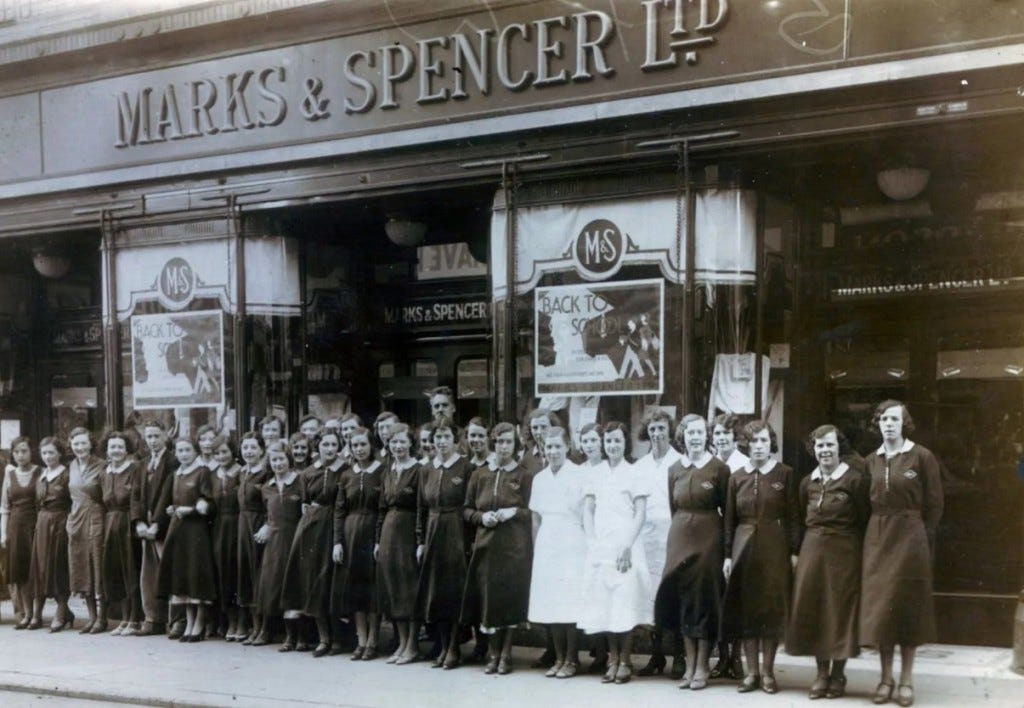
Explaining to his fellow representatives that Sieff was a director of chain-store business Marks & Spencer, McFadden added: “This enterprise declared a 40-percent dividend during 1933 and was enabled to do so by the fact that it had handled almost exclusively all imports from Soviet Russia, thus being able to undersell established British competitors”.
He described Sieff’s PEP as “a branch of the Fabian Society” and said: “An interesting bit of information has come to me in this connection to the effect that this Fabian group has close connections with the foreign-policy association in New York City.
“This foreign policy association was largely sponsored by the late Paul M. Warburg and has received the close attention and support of Bernard M. Baruch and Felix M. Frankfurter”.
“About 3 months after the passage of the National Recovery Act of the United States, when Israel Moses Sieff was urged by members of his committee to show more activity, he said: ‘Let us go slowly for a while and wait until we see how our plan carries out in America’.
“During the past several months Bernard M. Baruch, Felix Frankfurter, and the New York Jewish lawyer, Samuel T. Untermyer, have made several visits to Europe and spent considerable time there.
“There is justification for the belief that they have contacted with members of the British Fabian group and are familiar with their plans.
“The same system, in a somewhat adapted form, has been placed upon the statute books in the United States, and the iron hand of world control is fast being closed upon American agriculture, labor, and industry”.
So what exactly was said in the document, Freedom and Planning, bearing Sieff’s name?
It boasted, in the best industrial-capitalist style, of “greater and greater triumphs over nature”, claiming that “these triumphs have been won by an ever-wider and even bolder application of the principle of division of labour”. [8]
But Sieff (or his ghostwriter) also warned, referring to the economic depression of the time: “World disorganization, famine, pestilence, and the submergence of our civilization are visible on the horizon”.
He deduced from the “exasperating frustration of our best efforts” that “for the moment human intelligence seems bankrupt”.
In the face of this, he said, “a large-scale plan of national reorganization” was required.
And this was not to be some kind of minor reform: “It is idle to deny that some, at least, of the changes required when conscious forward planning extends into the field of production are of a revolutionary character”.
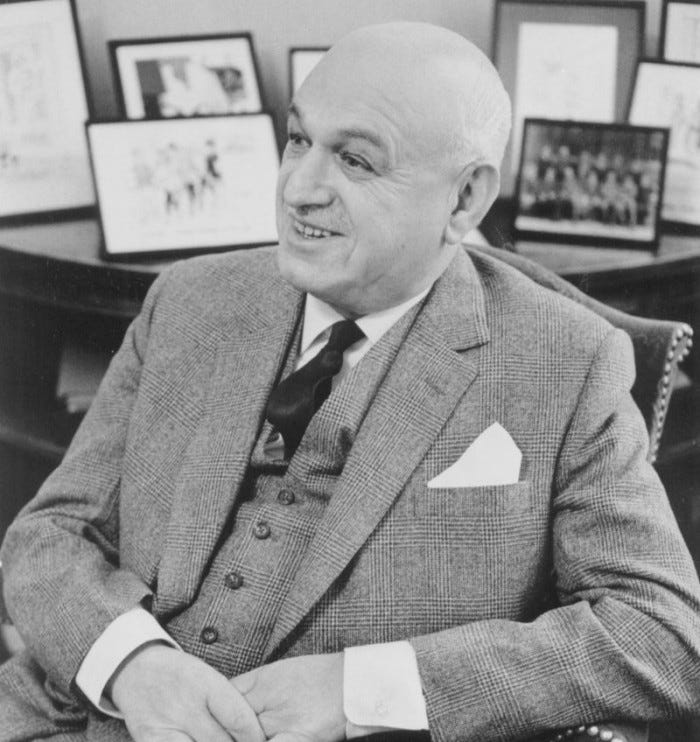
What Sieff (pictured) had in mind was nothing less than “a complete reconstruction of our national life on lines fitted for the new needs of the twentieth century”.
Proposing a reconstruction (“building back better”) reminiscent of the methods used by the USSR, the entity with which he had so profitably traded, he called for “a national planning commission”.
This would be backed up with “a national council for agriculture, a national council for industry, a national council for coal mining, a national council for transport, and so on, all statutory bodies with considerable powers of self-government, including powers of compulsion within the province with which they are concerned”.
As is always the case with the “modernisation” programme being perpetually rolled out by our industrial-financial overlords, traditional ways and freedoms would have to be swept away.
Sieff warned: “The development of an organized grid system for the distribution of milk must, it is certain, lead to a profound modification of the traditional individualism of outlook of the dairy farmer. And so it will be in other producing industries…”
The Marks and Spencer man added: “Methods of retailing cannot indeed be left entirely unchanged in the face of twentieth-century needs.
“The multiple shop and the chain store are already bringing about notable modifications. The waste involved in the 500,000 or more retailed shops – 1 shop for every 20 households – cannot be allowed to continue to block the flow of goods from producer to consumer”.

Sieff did not hide the ultimate goal of this centralisation plan.
He wrote: “Though organized on public-utility lines with monopolistic privileges, the great chartered industrial corporations will find ample room for energy and initiative in performing their primary task of combining maximum output with minimum costs of production”.
Combining maximum output with minimum costs of production. What a noble vision!
No surprise, then, that in a section entitled “The profit-making motive” he insisted: “It is no part of our plan to enshrine equalitarian doctrines”.
His plan was not confined to Britain, either, with a beady eye cast on other lands.
Sieff wrote: “The United Kingdom by itself is far too small to provide an adequate economic unit for planning. A planned economy for Britain implies as the next step a planned imperial economic family”.
A family, yes, of course. No colonial exploitation to be seen here!
He added: “The stabilization of the purchasing power of money calls for action not only in the Empire but also in such countries as Argentina and Scandinavia, which belongs to ‘sterlingaria’, the area where British sterling is indisputably the medium of exchange”.
I have long been pointing out that the British Empire, rebranded the Commonwealth, was the original basis of ZIM’s push for global government.
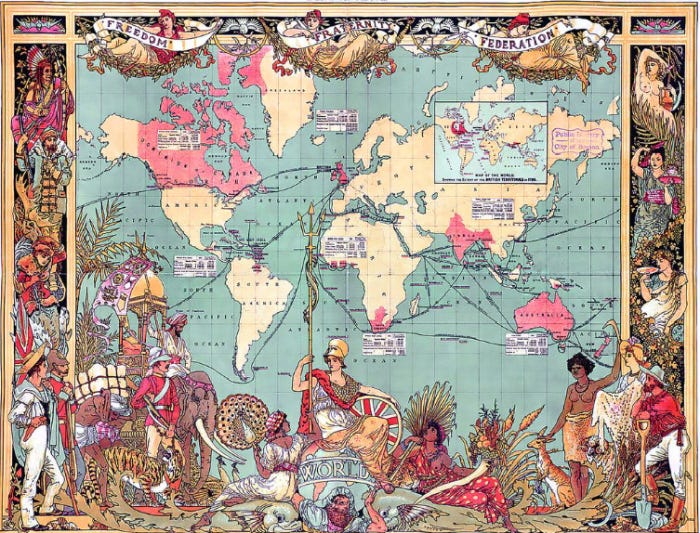
Confirming this, Sieff stressed: “The goal of world-wide international cooperation must never be lost from sight, and advantage must be taken of every opportunity for bringing it nearer”.
“The constitutional development of the British Empire may indeed provide a model more suitable for adaptation to the needs of world cooperation than any at present in existence”.
“The only rival world political and economic system which puts forward a comparable claim is that of the Union of Soviet Republics”.
Hmmm…
A massive land grab was also on Sieff’s agenda.
He wrote: “The conclusion seems unescapable that whether in the field of town-and-country planning or in that of agriculture (or rural) planning or in the organization of industry, it is not possible to make reasonable progress without drastic powers to buy out individual owners of land”.
He foresaw the “transfer of ownership of large blocks of land, not necessarily of all the land in the country, but certainly of a large proportion of it, into the hands of the proposed statutory corporations and public-utility bodies, and of land trusts”.
Sieff also thought that the British individual should not be in control of his or her own money – “there are real difficulties in leaving him entirely free to invest his savings in any way he chooses”.
He envisaged control exerted through the “extension of the system of insurance” and the centralisation of the banking system.
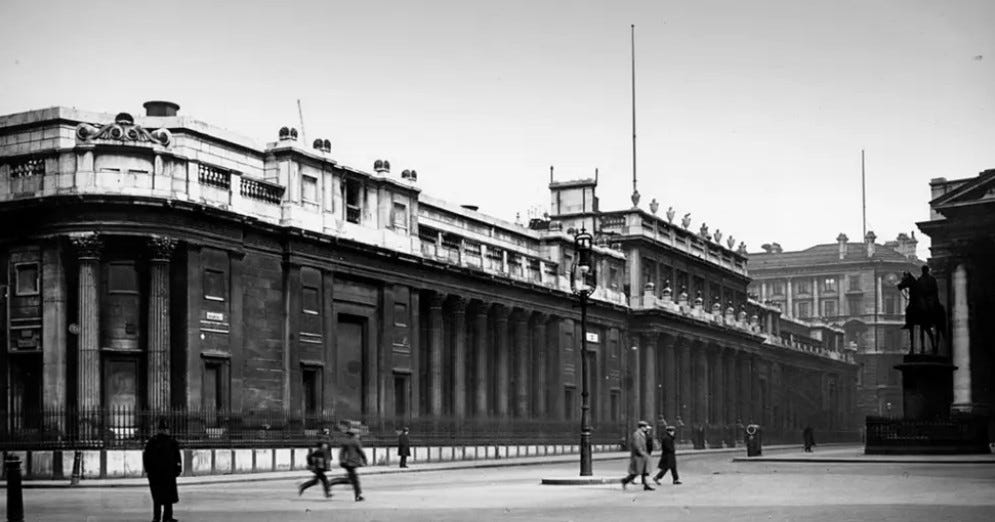
Sieff hailed the Bank of England as “a leading example of a public-utility corporation devoted to rendering public service”.
And he argued: “The logical completion of the process of amalgamation which has reduced the number of the major joint-stock banks to five would clearly be to merge them all in one and to give them some monopolistic privileges in return for converting themselves into a real public-utility corporation”.
Democratic structures could not be allowed to impede the top-down functioning of what ZIM’s Klaus Schwab has more recently termed “agile governance”. [9]
Sieff wrote: “Big consequent changes will follow in the machinery of government”. “Devolution of powers to statutory bodies will be an important feature of the new order”. “Parliament and the Cabinet will be relieved of some part of their present duties”.
All of this would obviously have added up to a massive assault on the freedom of the British people, a reality that was half-admitted and half-denied by Sieff’s weaselly wording.
He asked: “Is it true that what we need is more government and a great encroachment on liberty?”
But while this was clearly what he really wanted, he deployed the usual inversion technique to suggest that it would be a “drifting” reluctance on the part of the British people to jump on board his authoritarian plan that would constitute the real threat to their freedom!
“We know in our hearts that we are in imminent danger of losing both our freedom and our material well-being if we go on drifting”.

Sieff actually acknowledged the similarity of his project to those of totalitarian regimes: “For all their difference, bolshevism and fascism have two outstanding features in common. Both stress the primary need for conscious forward planning on a national scale”.
But he then wrote: “Whether we like it or not – and many will dislike it intensely – the individualist manufacturer and farmer will be forced by events to submit to far-reaching changes in outlook and methods.
“The danger is that in resisting them because he regards them as encroachments on what he calls his freedom, he will make things worse for himself and for the community.
“Resistance is likely to play into the hands of those who say that tinkering is useless and that fullblooded socialism and communism are the only cure. Or he may be tempted to flirt with Fascist ideas.
“In either case he loses his cherished freedom, and it is only too probable that fascism and communism alike would be but short stages on the road to barbarism”.
So Sieff’s argument here was that resisting authoritarianism and defending freedom – or what we “call” freedom in his terms – would somehow lead to communism, fascism and “barbarism”!
It sounds to me like a threat – if the British people would not willingly go along with ZIM’s centralisation and dispossession plan, then they would have to be subjected to the brutal discipline of an openly totalitarian regime.
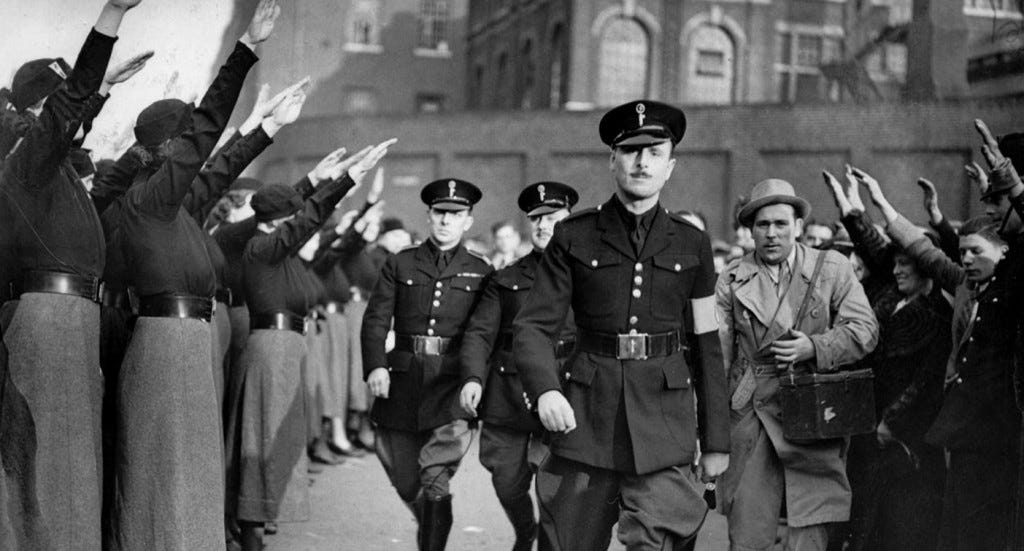
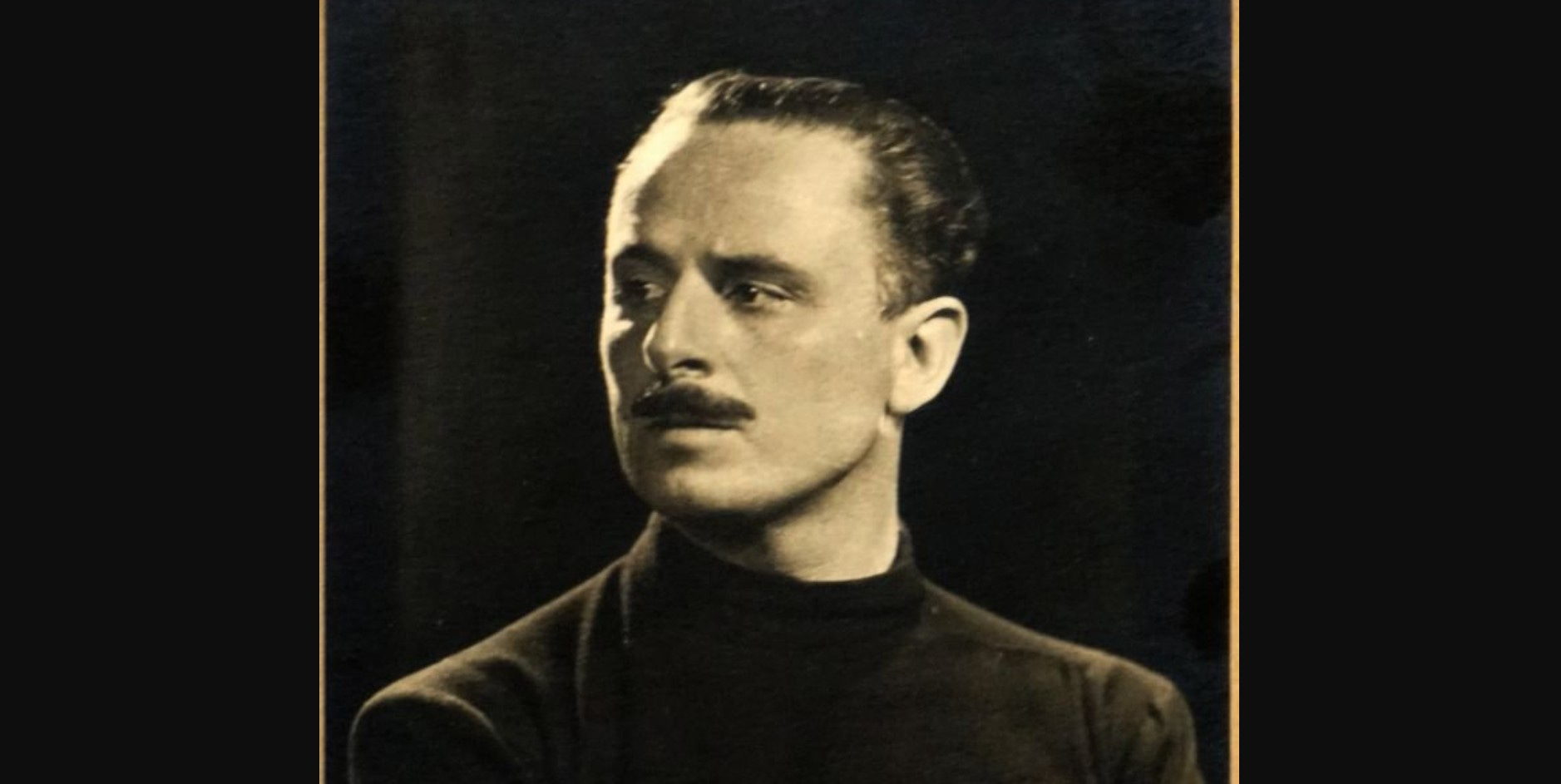
This brings me to a fascinating nugget of information relayed to the US Congress by McFadden in 1934, namely that in late 1932 one of the latest recruits to Sieff’s PEP was none other than “Sir” Oswald Mosley (pictured), “the head of the new British Union of Fascists”.
I see from Wikipedia that former Labour Party politician Mosley and his wife Cynthia “were committed Fabians in the 1920s and at the start of the 1930s” – this would explain his route into PEP. [10]
It may seem peculiar to some readers that a fascist leader known for his anti-Jewish rhetoric should have joined a think tank headed by a Zionist.
But a look at Mosley’s agenda reveals that it was strangely similar to Sieff’s.
In a 1997 book published by Oxford University Press, academic Daniel Ritschel explains how “Mosley’s campaign for his self-styled policy of ‘national planning’, first within the Labour party in 1930 and then on the platform of his New Party in 1931, was the first attempt to place planning on the national agenda”. [11]
Mosley even specifically pre-empted Sieff’s 1933 use of the words “drift” and “drastic” when he warned in 1930 of the need to “secure some agreement among the many who view with increasing anxiety the slow drift of the nation to disaster and are prepared for drastic measures to meet the danger”. [12]
Two years before Sieff’s Planning and Freedom was published, Mosley launched his New Party with the publication of A National Policy.
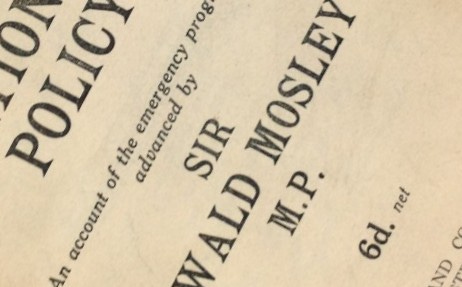
Its preface called for a programme of “national effort to meet the emergency with which we are faced”, and expressed the hope that it would “evoke a response that will impart a new impetus to British politics”. [13]
Ritschel explains that Mosley’s modernisation message had first been set out as the “Birmingham Proposals” at the 1925 Independent Labour Party (ILP) conference and read by him as the pamphlet Revolution by Reason to the ILP summer school later in the same year. [14]
The very title “Revolution by Reason” reminds me of the scientific thinking first promoted by the Invisible College in the 1600s and the disastrous industrial-imperialist “change” agenda that ensued. [15]
Indeed, in 1929 Mosley himself boasted of his “scientific and severely practical creed” which was based on the “scientific intervention of the State”. [16]
By July 1931 Mosley was calling for a systematic planning organisation to be channelled through a new structure of “Commodity Boards” in all major industrial sectors which would reorganize each industry into what he called a “great highly centralised organisation”. [17]
Again, very much the same plan that his PEP president Sieff was shortly to advance.
Ritschel notes that Mosley’s proposed National Economic Planning Organisation “unmistakably implied a centrally controlled economy, run under the direct authority of the state”. [18]

Planning, development and modernisation are the unholy trinity of industrial imperialism.
Says Ritschel: “Mosley depicted planning as both a solution to the economic crisis and a broad basis for political agreement among the ‘modern minds’ in the country”. [19]
Like Sieff, Mosley was looking further afield than Britain, and in 1930 was taking the position “that the combination of British and imperial markets could furnish a viable basis for a closed and self-sufficient economic unit”. [20]
I was intrigued to note that in the ILP’s journal New Leader in 1930, Mosley was said to be demanding “a British equivalent of the Russian ‘Gosplan'”, chiming perfectly with Sieff’s admiration for ZIM’s Soviet regime. [21]
Gosplan, the State Planning Committee, was the agency responsible for central economic planning in the USSR, with its main task being the creation and administration of the notorious production-boosting five-year plans. [22]
But in the same pages, Mosley had praised American industry, with its “amazing feats of mass production”. [23]
As with Sieff, the bottom line was all that mattered.
As Mosley’s ILP colleagues were urged by him to forget “ultimate Issues” and to focus on “realism”, [24] more and more woke up to the fact that “whatever the superficial parallels with socialist policies, Mosley aimed merely to ‘stabilise’ or ‘bolster up’ capitalism”. [25]
The common ground shared by the Soviet system and that proposed by Mosley and Sieff – might we nickname them M&S? – is well captured by Harold Nicolson’s description of the platform of the New Party as “State capitalism”. [26]
John Strachey described how he and others initially failed to grasp what his political colleague meant by “the Corporate State”.
“But the more Mosley talked about it, the more it seemed to be remarkably like Capitalism: or rather it seemed to be Capitalism minus all the things which the workers had won during the last century of struggle. Our doubts grew and grew”. [27]
Strachey went on to write that the “planning” pseudo-ethic was nothing but a trick: “an elegant intellectual disguise” for “monopoly capitalism”. [28]
Pesky democratic structures could not be allowed to get in the way of the rule of the Corporate State, for Mosley any more than for Sieff or Schwab.
His New Party manifesto called for the creation of an “Emergency Cabinet” of five ministers, invested with “the powers to carry through the emergency policy”. [29]
Mosley viewed Parliament as an “obstructionist’s paradise”, whose “antiquated and cumbrous” legislative procedure appeared to have been designed “for the express purpose of preventing things being done”. [30]
The aim was to turn Parliament from a “talking shop into a business assembly”. [31]
In other words he wanted a totalitarian Corporate State spurning democracy and serving the interests of big business and finance.
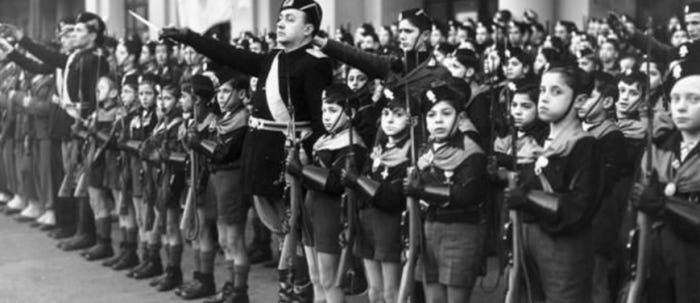
This line of thought was soon to lead Mosley to openly embrace fascism, which Ritschel describes as “the epitome of modern authoritarianism”. [32]
The author explains: “In the October [1931] general election the New Party campaigned on the platform of its ‘New Plan’ and the Corporate State.
“To the question ‘Are We Fascists?’, [its journal] Action replied that they were ‘perfectly prepared to study the methods and ideals’ of this ‘modern movement’. Two months later the answer was ‘frankly “yes”’”. [33]
Mosley launched the British Union of Fascists in October 1932 and published its programme in The Greater Britain in the same month. [34]
This was very much the same vision that Sieff was to present in Freedom and Planning the following year.
The BUF’s “national planning” proposals involved “a representative structure of Industrial Corporations under the jurisdiction of a central National Corporation”, explains Ritschel. [35]
“A ‘Corporate Parliament’, elected on the basis of occupational franchise, was to reflect directly the economic interests of the community, thereby enabling Westminster to become a truly ‘functional’ representative of the planned society”. [36]
“However, the fascist government was to be given ‘absolute power to act’”. [37]

I have not done enough research into Mosley to be able to state categorically that he was working for ZIM.
But it would not surprise me, given that we know that Benito Mussolini and Adolf Hitler were both funded by ZIM’s Wall Street fronts and that, as Jim Macgregor and John O’Dowd have proved, the latter was actually groomed and placed in power by ZIM. [38]
I note the brief mention in the diaries of former MI5 chief Guy Liddell of the £40,000 allegedly paid to Mosley by the Rothschilds in 1937 for arranging the release of one of their family members somewhere “on the continent” – possibly Belgium, since the “Rexists” were involved. [39]
I also cannot help noticing that Mosley’s post-war agenda with his Union Movement, calling for a united Europe fuelled by the imperial exploitation of Africa, was, perhaps coincidentally, very much aligned with that of the Rothschilds. [40]
Mosley was always too close to the British Establishment (Zionist in orientation for a long time now) for somebody who postured as its greatest opponent.
His political manoeuvring around 1930 attracted the interest of David Lloyd George, that notorious participant in ZIM’s monstrous scheme to manufacture and prolong the First World War [41] and also of Winston Churchill, that friend of Baruch, who played a similar role in the Second World War. [41]
Mosley received support from Jewish politician Leslie Hore-Belisha (pictured), a Liberal cabinet minster who went on to be “highly successful in modernising the British road system”. [42]
Another early fan was Henry Mond (“Baron” Melchett), a politician, industrialist and financier who was a director of Imperial Chemical Industries (ICI), the Mond Nickel Company and Barclays Bank.
Mond was “a champion of Zionism” who “advocated the evacuation of Jews from Germany to Palestine”, chaired the Jewish Agency for Palestine and “took an interest in the Maccabi Jewish youth organisation”. [43]
Ritschel adds that press barons Lords Beaverbrook and Rothermere also offered their backing to Mosley, “proposing a joint committee with their Empire Party”. [44]
Mosley died in 1980, after 30 years of self-imposed exile in France, at a time when the British media were united in their condemnation of political groups like the National Front, often stigmatised as “fascist” rather than as merely nationalist.
But the obituaries which they published of a real self-described fascist were gushing with admiration for this “dynamic and handsome” leader, so “compassionate and humane” – as cited in a song on the satirical TV show Not the Nine O’clock News which older readers may well remember. [45]
And what on earth are we to make of the fact that the fascist leader’s grandson Louis Mosley is today UK boss of Palantir, the Israel-linked global tech giant poised to take over the NHS and turn Britain into a digital prison camp with the enthusiastic collaboration of Fabian Society member and Rothschild lackey Keir Starmer? [46]

[1] Paul Cudenec, ‘The Big Plan and the Great Gaslighting’, https://winteroak.org.uk/2025/04/09/the-big-plan-and-the-great-gaslighting/
[2]

[3] https://en.wikipedia.org/wiki/Louis_T._McFadden
[4] https://en.wikipedia.org/wiki/Charles_E._Dietrich
[5] https://www.congress.gov/73/crecb/1934/06/08/GPO-CRECB-1934-pt10-v78-6-2.pdf
[6] https://en-academic.com/dic.nsf/enwiki/36549#
[7] https://winstonchurchill.hillsdale.edu/great-contemporaries-bernard-baruch/
https://www.jta.org/archive/baruch-and-rothschild-sail
[8] Ibid.
[9] Klaus Schwab with Nicholas Davis, Shaping the Future of the Fourth Industrial Revolution: A Guide to Building a Better World (Geneva: WEF, 2018), e-book, 82%, cit. Paul Cudenec, Fascism rebranded: exposing the Great Reset (2021), p. 226. https://winteroak.org.uk/wp-content/uploads/2023/09/fascism-rebranded23web.pdf
Paul Cudenec, The Global Gang Running Our World and Ruining Our Lives (2025), pp. 321-29
https://winteroak.org.uk/wp-content/uploads/2025/03/the-global-gang-web.pdf
[10] https://en.wikipedia.org/wiki/Oswald_Mosley
[11] https://academic.oup.com/book/11683/chapter-abstract/160629924
[12] The Times, December 8, 1930, cit. Daniel Ritschel, The Politics of Planning: The Debate on Economic Planning in Britain in the 1930s (Oxford: Oxford University Press, 1997), p. 2.
https://vdoc.pub/documents/the-politics-of-planning-the-debate-on-economic-planning-in-britain-in-the-1930s-1vsbbmefq68g
[13] A National Policy: An Account of the Emergency Programme Advanced by Sir Oswald Mosley (1931), cit. Ritschel, p. 2.
[13] A National Policy: An Account of the Emergency Programme Advanced by Sir Oswald Mosley (1931), cit. Ritschel, p. 2.
[14] Ritschel, p. 9.
[15] Paul Cudenec, ‘The Invisible College and the plan for our enslavement’. https://winteroak.org.uk/2025/08/11/the-invisible-college-and-the-plan-for-our-enslavement/
[16] ‘We Socialists and Our Creed’, Daily Express, (February 19 1929), cit. Ritschel, p. 16.
[17] Ritschel, p. 15.
[18] Ritschel, p. 15.
[19] Oswald Mosley, ‘Why We Left the Old Parties’ (1931), p. 3, Ritschel, p. 18.
[20] Ritschel, p. 12.
[21] Ritschel p. 21.
[22] https://en.wikipedia.org/wiki/Gosplan
[23] Mosley, ‘Is America a Capitalist Triumph?’, New Leader (April 2 1926), p. 3, cit. Ritschel, p. 10.
[24] Oswald Mosley, Revolution by Reason, p. 28; Ealing Gazette, (April 14 1923), cited in Skidelsky, Oswald Mosley (1975) p. 126, cit. Ritschel, p. 16.
[25] Birmingham Town Crier (July 10 1925), cit. Ritschel, p. 16.
[26] Nicolson Diary, September 27 1931, cit. Ritschel, p. 17.
[27] John Strachey, The Menace of Fascism (1933), p. 163, cit. Ritschel, p. 37.
[28] John Strachey, The Coming Struggle for Power (New York, 1935), pp. 242–47, cit. Ritschel, p. 38.
[29] A National Policy, pp. 19–22, cit. Ritschel, p. 15.
[30] A National Policy, pp. 45–47, cit. Ritschel, p. 22.
[31] Report of the 30th Annual Conference of the Labour Party (1930), p. 202, cit. Ritschel, p. 22.
[32] Ritschel, p. 22.
[33] ‘Action Looks at Life’, Action (October 8 1931), p. 4. Mosley, ‘Have we a Policy?’, Action (December 24 1931), pp. 1-2, cit. Ritschel, p. 38.
[34] Ritschel, p. 38.
[35] Ritschel, p. 39.
[36] Oswald Mosley, The Greater Britain, pp. 32–35, cit. Ritschel, p. 39.
[37] Ibid, p. 21, cit. Ritschel, p. 39.
[38] See Fascism Rebranded and Paul Cudenec, ‘Adolf Hitler and the zio-imperialist mafia’, https://winteroak.org.uk/2025/05/08/adolf-hitler-and-the-zio-imperialist-mafia/
[39] The Guy Liddell Diaries Volume I: 1939-1942: 1939-1942: MI5’s Director of Counter-Espionage in World War II, entry for April 8 1942, p. 242.
[39] The Guy Liddell Diaries Volume I: 1939-1942: 1939-1942: MI5’s Director of Counter-Espionage in World War II, entry for April 8 1942, p. 242.
[40] https://en.wikipedia.org/wiki/Union_Movement
Paul Cudenec, Enemies of the People, https://winteroak.org.uk/wp-content/uploads/2024/09/enemiesofthepeopleol.pdf
[41] Ritschel, p. 6. Paul Cudenec, ‘A crime against humanity’, https://winteroak.org.uk/2022/10/14/a-crime-against-humanity-the-great-reset-of-1914-1918/
[42] Ritschel, p. 6.
https://en.wikipedia.org/wiki/Leslie_Hore-Belisha
[43] Ritschel, p. 6. https://en.wikipedia.org/wiki/Henry_Mond,_2nd_Baron_Melchett
[44] Ritschel, p. 6.
[45] https://archive.org/details/not-the-nine-o-clock-news-s-3x-e-7-8-december-1980
[46] https://corporatewatch.org/palantir-in-the-uk/
https://www.politicshome.com/news/article/palantir-boss-interview-keir-starmer-gets-ai
See Cudenec, The Global Gang Running Our World and Ruining Our Lives.
Source: Paul Cudenec


Comments
Post a Comment