The (Female) Elephant in the Room
The (Female) Elephant in the Room
Will we continue to pretend that female power does not lead to civilizational disaster?
Janice Fiamengo

Multiple surveys (see, for example, with thanks to James Nuzzo, here, here, here, here, here and here) suggest that when women hold power, they pursue typically feminine preferences and policies. Female-led institutions become more oriented to social justice than objective truth. Feelings matter above facts, context above law, and victimhood above expertise.
Protecting and promoting the allegedly vulnerable—through censorship, shaming, coercion, or lawbreaking/lawfare—becomes a greater priority than excellence or impartiality. Truth-tellers find themselves cancelled, Nobel prize winners reduced to tears, laws and policies applied unequally, white men accused and vilified, criminals cossetted, mental illnesses affirmed, and destructive policies embraced. No one who has paid attention over the past 20 years can be surprised by the findings.

Moreover, our ability to discuss this feminine revolution in values is hampered by the very logic of the revolution, as I will show. Both women and men, deeply disinclined to “harm” women, fail to confront the problem adequately.
Two discussions of the subject—an essay by two social psychologists at Quillette and, more recently, a conference speech by a feisty conservative woman—draw a line under the seeming inevitability of the west’s collapse. Even faced with that alarming prospect, most pundits cannot bear to imagine an alternative to the female-led assault on our core institutions.
**
Cheering on Women’s Empowerment
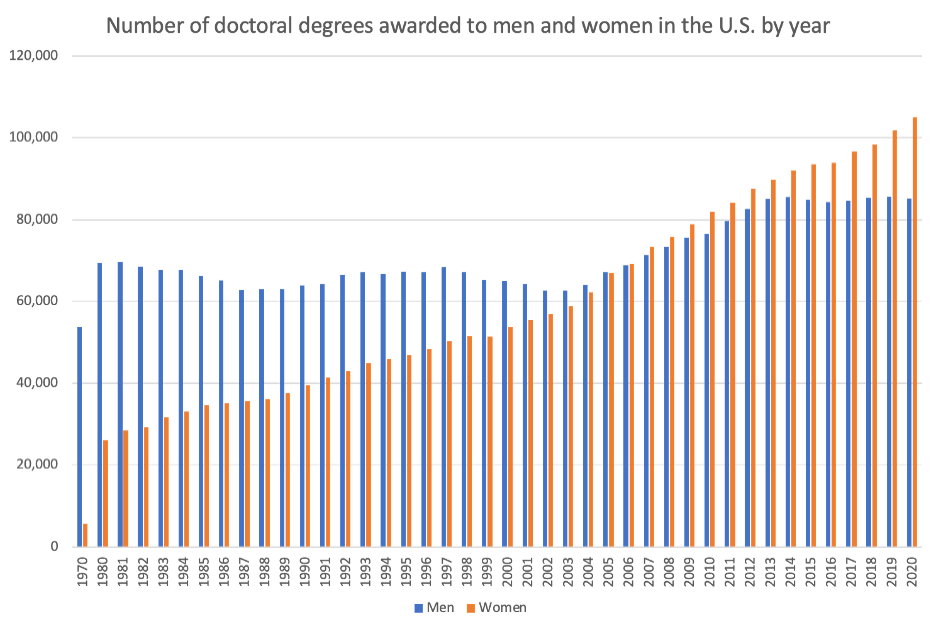
A 2022 article in Quillette, “Sex and the Academy,” provides a stark illustration of my thesis. The subtitle rules out the very conclusion the data supports, with the authors emphasizing that “The inclusion of women in higher education is a great achievement for Western liberal societies. How is this changing academic culture?”
The “great achievement,” as it turns out, will almost certainly be a lethal one.
The article was written by two academics, Cory Clark and Bo Winegard, both PhDs in social psychology. Winegard, a male scholar, had an unfortunate run-in with academic orthodoxy that led to his loss of employment; Clark, a female scholar, has a secure academic position. Both authors express enthusiasm for the takeover of academia by women even as they point out its damaging consequences. Neither one advocates any form of resistance, no matter how mild, to feminine academia’s assault on truth.

Summarizing the results of many surveys, Clark and Winegard demonstrate that while a majority of men favor free speech and the advancement of knowledge over emotional comfort, a majority of women prefer conformity, safety, and the protection of victim groups’ feelings. Not all women are indifferent to the traditional underpinnings of western civilization (and not all men support those underpinnings), but the general trends are clear.
Women are significantly more likely than men to support the cancellation of controversial speakers or the suppression of controversial research.
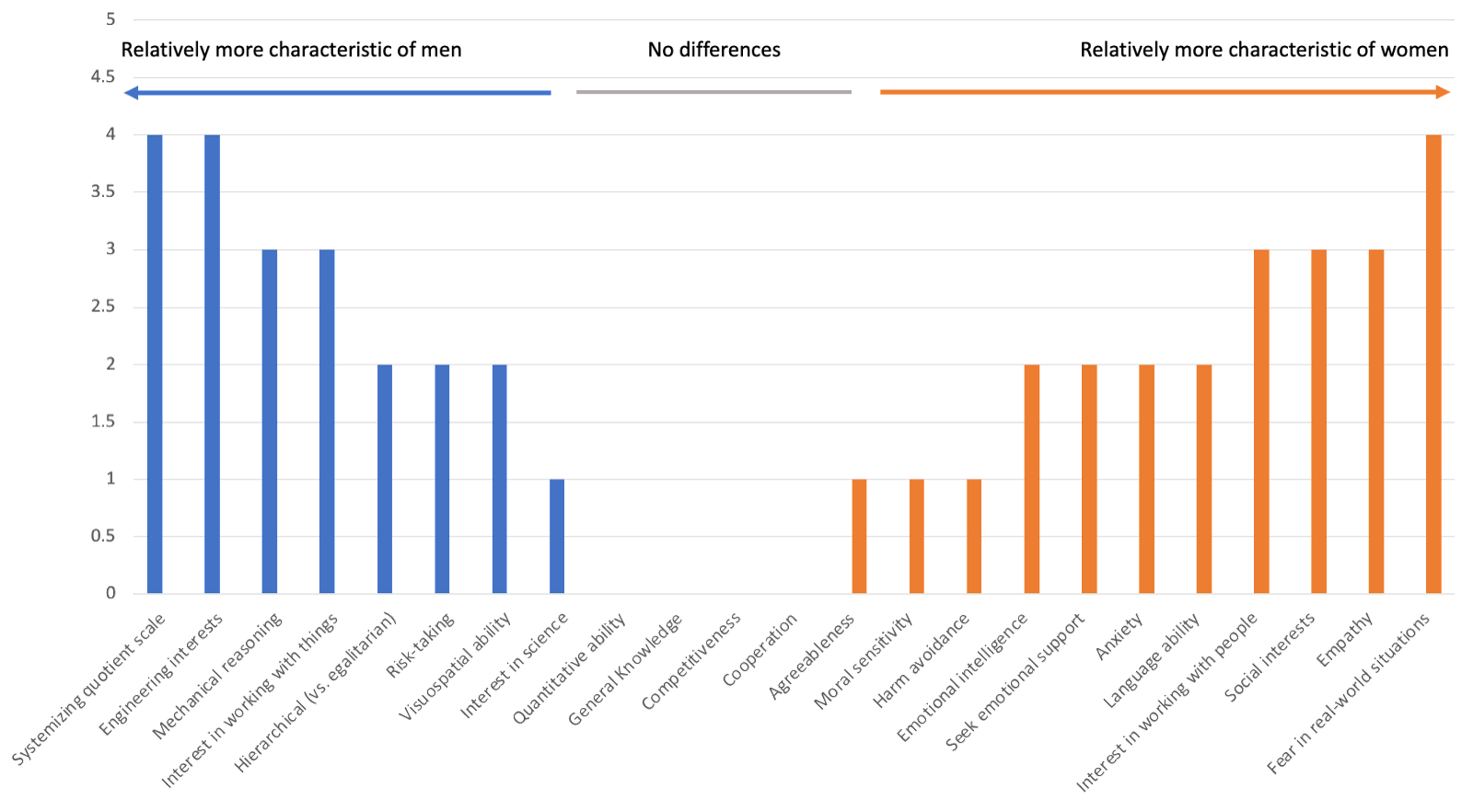
Women also tend to favor the existence of snitch lines to report people who cause offence. Women are more supportive than men of diversity quotas that exclude white men from consideration for prizes, positions, and promotions. (It would be interesting to know how many white women support diversity quotas that exclude white women from consideration for prizes, positions, and promotions.)
But rather than summon readers to the barricades over such findings, the Quillette authors fail to express even moderate misgivings; instead, they present a genial overview that emphasizes female moral commitment.
“The overall theme of these differences,” they write, “is that men are more committed than women to the pursuit of truth as the raison d’être of science, while women are more committed to various moral goals, such as equity, inclusion, and the protection of vulnerable groups. Consequently, men are more tolerant of controversial and potentially offensive scientific findings being pursued, disseminated, and discussed, and women are more willing to obstruct or suppress science perceived to be potentially harmful or offensive. Put more simply, men are relatively more interested in advancing what is empirically correct, and women are relatively more interested in advancing what is morally desirable.”
Asserting that both sides are pursuing worthy goals, the authors downplay the shock value of the findings, which show that women are, overall, less interested in truth and accuracy than men are. Imagine assessing such a finding as anything but catastrophic. Imagine calling the disregard for truth moral.
In place of truth, women value a utopian ideology that they perceive—usually without any consistency or adherence to fact, but nonetheless granted by Clark and Winegard—as “morally desirable.” But morally desirable for whom, and to what end? The use of the phrase, a misnomer, demonstrates how thoroughly the authors themselves are in thrall to the corrosive feminine culture they examine.
There is nothing moral (or generally desirable) about the suppression of truth-seeking research when it conflicts—or is perceived to conflict—with an allegedly emancipatory social goal. There is nothing morally desirable or indeed “protective” about shouting down an academic speaker because of the alleged harm of the speech. Naturally, social justice proponents would be outraged if their speeches were shouted down or their research blocked and censored.
The Quillette authors’ willingness to place truth and morality in opposition to each other, as if men are merely empirical while women are (loftily) moral, concedes illegitimate ground to that which is ruining academia by denying truth.
The pro-feminist perspective of the authors is magnified in their conclusion, in which they vigorously disavow any need to halt or reverse the effects they have chronicled. It would be wrong, they assert, to oppose women’s predominance in academia or elsewhere. Why it would be wrong they decline to say:
“The point here is not to lament or celebrate these changes, but simply to identify and try to understand them, and to note that they will lead to predictable downstream consequences. Institutions are not independent of the people who populate them, and altering the characteristics of those people will inevitably change them. Those who believe that the purpose—the lodestar—of science should be the pursuit of truth might find these trends worrisome. But it would be unethical and futile to attempt to roll back the enormous social gains women have made. The ‘men’s club’ era of academia is over. A new and more female-oriented era is here for the foreseeable future.”
It’s hard to imagine a more timorous, mealy-mouthed ending. If the purpose of scientific research is to pursue truth—which only the insane would deny—then how can it be “unethical” to oppose those who mistakenly (or viciously, cravenly) support untruth? Are women’s “social gains” a genuine benefit when they rest on manipulation, bigotry, illegality, and dishonesty? Academia has not been a so-called men’s club for at least the past 80 years, but it accomplished a great deal when it was male-led. The women’s club of today, in contrast, becomes more academically irrelevant every year.
**
The Great Feminization
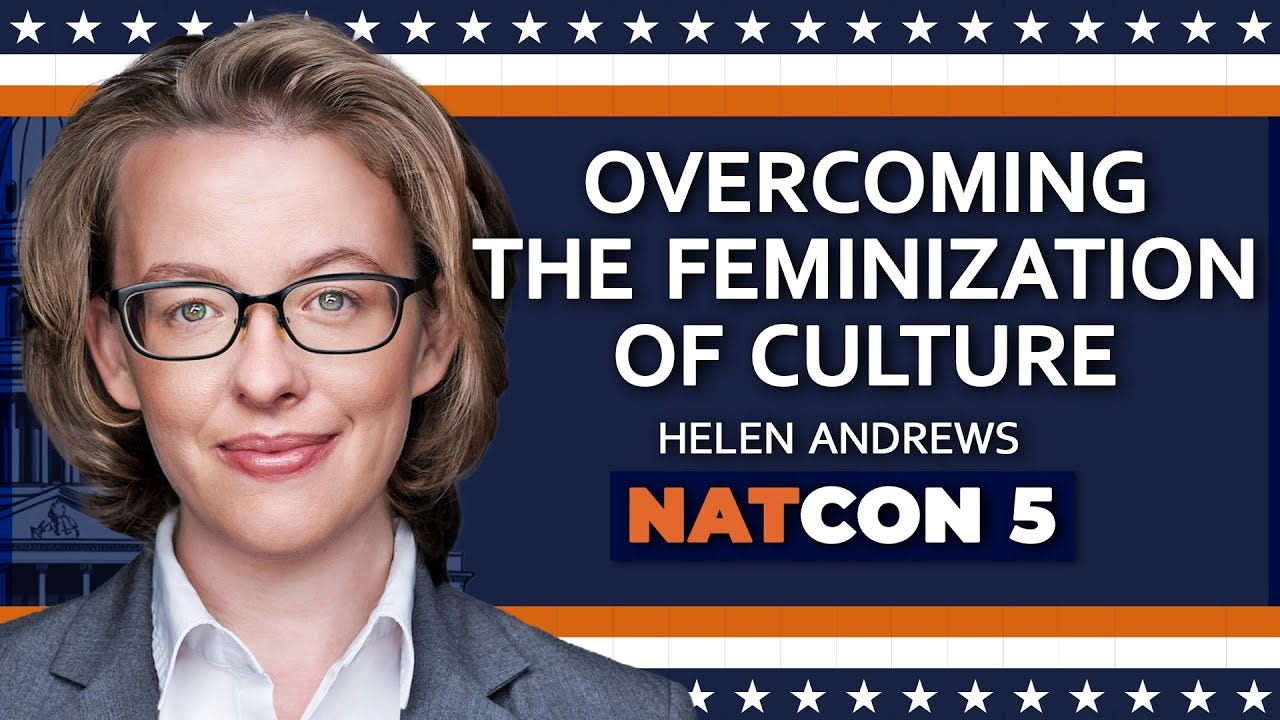
It is refreshing to turn from Quillette’s faint-hearted observations to Helen Andrews’ shibboleth-busting short lecture (well worth watching) at the National Conservatism conference, recently published on YouTube. Unlike Clark and Winegard, commentator and author Andrews does not shy away from proclaiming the civilizational threat embodied by female predominance in many spheres of society, which she dubs, after economist Tyler Cowen, The Great Feminization.
With women now a majority of college faculty, associates at law, and the white-collar workforce generally—not to mention a super-majority in the publishing industry and the field of psychology, among others—feminization is not merely, Andrews argues, an unprecedented new development in human affairs; it is also a profound menace to western societies’ traditions of rationality, competitive excellence, and the rule of law.
“A thoroughly feminized civilization,” Andrews declares, “will set itself on the road to collapse.” Despite the existence of talented and intelligent women who do uphold western values, Andrews does not believe that it is possible to have demographic feminization (an increase in women’s numbers) without substantive feminization (a profound shift in values).
Just when one begins to hope for an uncompromising call to action by the forthright Andrews, however, she disappoints. “I hasten to make clear,” she says at the start of her finale, “that I do not propose to ban women from any field or even to discourage them.”
Why not? The future of the west is in peril—but apparently we must not do anything so “crazy,” as Andrews calls it, as “discourage” women from entering the fields they are destroying!
Andrews does make some reasonable suggestions for restoring our institutions, but they are all, alas, inadequate.
Her primary suggestion is that all forms of equity hiring and affirmative action, all special incentives, programs, and perquisites for women, should be removed. Businesses and institutions must be allowed to hire and fire, promote and distinguish, on the basis of merit alone, with no regard for gender equity and no fear of lawsuits. Unfortunately, Andrews does not indicate how this is to be done. Equity measures are now enshrined in western law and enthusiastically promoted in the very bastions of feminization that are her deepest concern: getting rid of them will be far easier said than done.
But even if equity hiring and the many associated measures to promote and privilege women could, with enormous effort, be halted, the female favoritism and ideological corruption they enable and embody will certainly continue.
As Andrews well knows, feminization has already taken place. Values have been transformed; free inquiry and objectivity are, in many cases, long gone. Female and feminist managers, academics, judges, and lawyers will continue to hire women (and their “marginalized” intersectional allies) because such hiring is their badge of faith. Andrews’ trust in the resilience of our institutions, given what she has already recognized, seems somewhat misplaced. She must know that the enemies of innovation, excellence, and objectivity are already firmly ensconced and will not remove themselves.
So here we are, once again: with a dire warning and no adequate proposed solution.
Is there really, then, NOTHING to be done? Must we simply hope for the best as the worst unfolds? Do these pundits not believe what they are saying, or are they simply too ideologically captured or cautious to follow through?
**
It seems clear that, at the very least, women should be discouraged: for their own good and the good of our societies.
Girls should have it made clear to them from an early age that only the extremely talented and driven should even consider careers in politics, law, high tech, or academia. They should be warned about the moral character, inner strength, and self-discipline needed to occupy positions of public responsibility. The sacrifices required should be vividly outlined. The civilization-damaging realities of feminine propensities should be widely discussed, and female ingratitude, over-confidence, narcissism, vengefulness, and vainglory should be exposed, criticized, and damped down by teachers, mentors, and supervisors.
I would go further to say that women should be hindered, by law or at least by popular consensus, from leadership roles in key cultural domains. True, such an action would be discriminatory. It would mean that the talents of some able and public-minded women would not reach their full flourishing (though I would not bar women from lesser positions, operating under male leadership). It would mean frustration and a justified sense of injury for a few truly worthy women. But that would be a price well worth paying to reduce further feminization and to restore crucial bulwarks of our civilization.
This is all fantasy, of course: it’s not at all likely, in the foreseeable future, that any legislator anywhere will act even on Andrews’ extremely moderate (and entirely inadequate) proposals. No one is going to do anything to roll back the dramatic expansion of women’s political power, and it is not at all likely that women on their own initiative will exempt themselves or develop more traditionally-masculine values. Men themselves are also becoming more feminine, more feminist, and more ideologically fantastical, too often embracing paralyzing guilt, victimhood, resentment, and utopian radicalism.
Regardless, any serious plan to reinvigorate civilizational values will need to consider a strategy of de-feminization that has some teeth. When survey after survey shows that female predominance contributes to institutional and cultural decay, I can’t think of any rationale for not acting.


Comments
Post a Comment