MGM’s New Robin Hood: Blatant Anti-Christian, Anti-History Propaganda

The Frustration Begins
I sat down the other night to watch the new Robin Hood series from MGM. I thought it would be an easy family evening. A bit of medieval drama, some bows and arrows, a sheriff to boo at, something simple, and of course to see how Sean Bean dies in it. Within a minute I found myself pointing out historical nonsense like a man possessed. My daughter, who has been away from home for some time, burst out laughing. She had forgotten what it is like to watch anything vaguely historical with me.
The frustration was not about costumes or swords or accents. If it was just a 19th century dog or a Victorian Cockney accent wandering around the 12th century, I could let it slide. Countless shows get things wrong. What drove me mad was something very different. This new Robin Hood is not just sloppy. It is not just stupid. It is ideological. It rewrites the entire religious and cultural history of England to teach the audience a lesson that is fashionable today, not a lesson that is true.
A History That Never Existed
The show presents a twelfth century where the Saxons are still pagans, praying to woodland deities, holding candlelit fertility weddings in the forest and whispering prayers to a goddess called Godda. A Saxon village elder pagan handfasting in the woods in the 1180’s is modern neo-pagan fantasy projected backwards, not history. In the show the Normans arrive as foreign Christian occupiers and force Christianity on the poor native Saxons, who long for the old ways of the forest. Paganism becomes the lost native soul of England, and Christianity becomes the ideology of the invader.
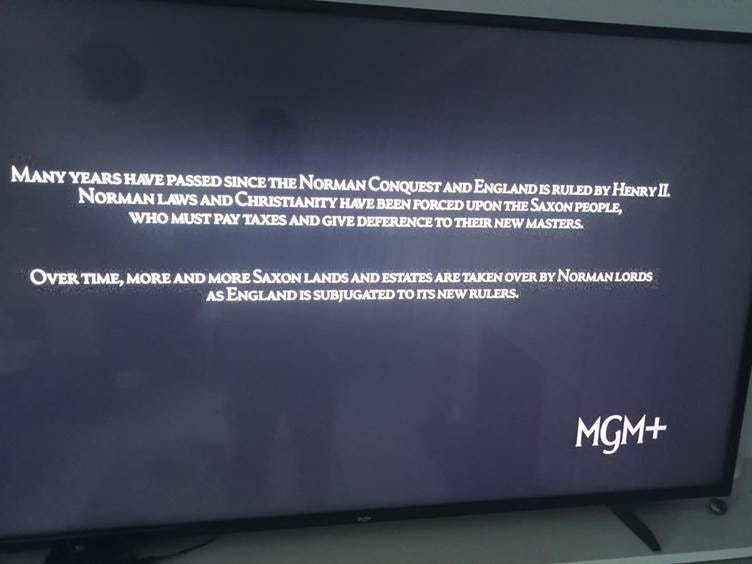
It is the opposite of what actually happened.
The Anglo Saxons became Christian voluntarily five centuries before the events of the show. Not reluctantly, not by the sword, and certainly not by Norman pressure. They converted in the seventh century, long before the Normans even existed as a power. They converted because they found that the new faith brought learning, law, stability and a moral framework that the old beliefs did not provide. By the year 700 every Saxon kingdom was Christian. The old gods were not beaten out of the Saxons. They were forgotten without violence. The irony is of course that Britain was already mostly Christian by the time the Saxons invaded it, and we have foreign invaders (the Saxons) bringing foreign gods to what would become England, and persecuting Christians as they did so. The Normans did not convert England, they reorganised the already-Christian Church and replaced Anglo-Saxon bishops with Norman ones for political control.
Before the Normans arrived, the English Church still carried the flavour of its earlier Celtic and insular roots. It was more local, more monastic, more community shaped, and far less centralised than the Church on the continent. It felt closer in spirit to the old Irish missions and even, in some ways, to Eastern Christianity, where authority was spread rather than concentrated and where bishops did not behave like aristocrats. After 1066 the Normans ripped out almost every English bishop and abbot and replaced them with men loyal to Rome. Overnight the Church became more hierarchical, more continental, more Latin and more tightly controlled from outside the island, it became less indigenous and more Roman.
Turning Real English History into Fairy Myth
There is even an entirely new pagan myth inserted into the story. A legendary Saxon hero called Eadric, in the show, marries a naked fairy woman called Godda, is transformed into a stag and becomes the guardian of the forest. The Saxons in the series gather around fires to tell this story as if it is their ancient spiritual heritage.
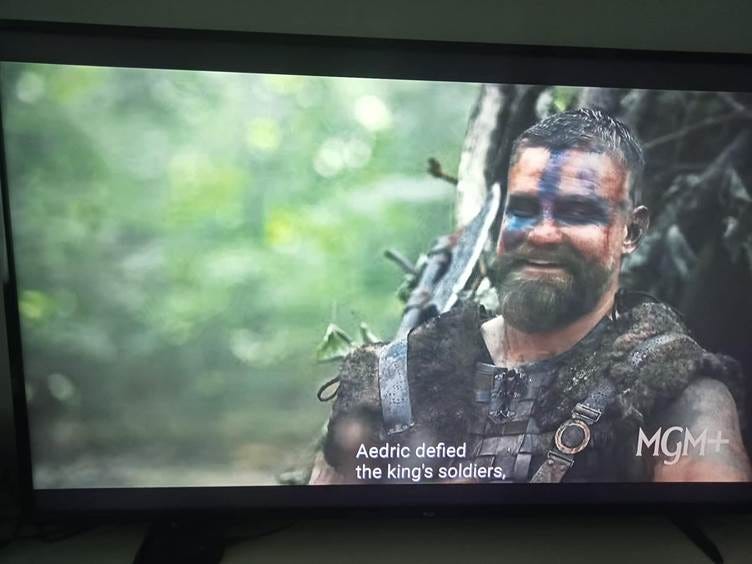
The problem is that Eadric was real, and his story was of course nothing like that. Eadric the Wild was a Christian Anglo Saxon nobleman who resisted the Normans between 1067 and 1070. He fought them because they seized land and destroyed rights, not because they brought Christianity. And the name Godda in old English history is not a goddess. It is a woman’s name meaning “gift of God”. The show has taken a real English resistance fighter and turned him into a pagan fairy myth to erase the actual history.
I am not a defender of the Normans. I have written about their brutality in Britain and Ireland, and as you know, I do not gloss over the medieval Church either, I have fired several salvos at them too. Yet disliking an institution does not entitle me to invent a different past. There is something corrosive about changing history to match your personal preferences or agendas.
And then of course there is the “reimagined” Little John. “Historically” he was an English peasant, a big Derbyshire labourer with a quarterstaff, the sort of man every generation instantly recognised as the archetypal commoner.
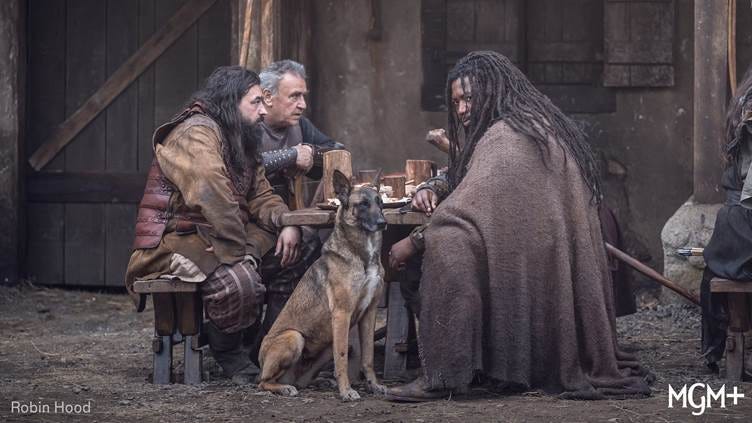
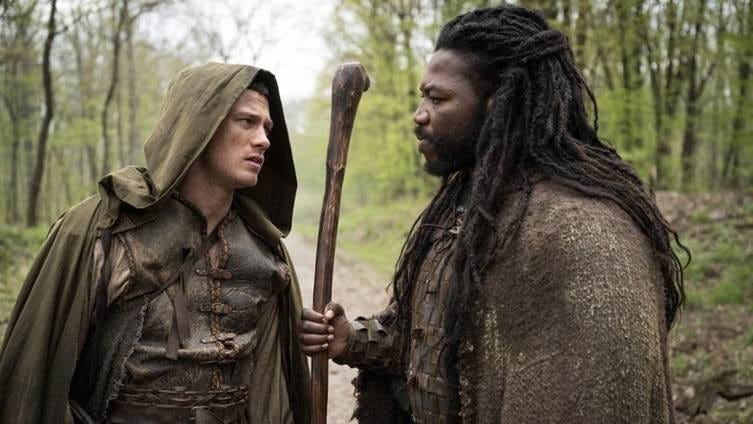
In the new series he has been turned into a dreadlocked “tribal” woodland shaman, complete with a police-dog breed that did not exist until the nineteenth century, and a modern Cockney accent. And yes of course he is black, now a black actor in a fantasy setting may not seem like a big deal. The problem is why the change has been made. Little John has been redesigned to visually erase the English peasant and replace him with an invented pagan, multicultural forest identity that never existed in twelfth century England. His appearance is being used symbolically to teach the audience that “true Englishness” belonged to an ancient (and of course not necessarily white) woodland culture crushed by Christianity. It has nothing to do with so called “representation” and everything to do with historical substitution. The show needs the viewer to believe in a pagan “indigenous” England so badly that it has rewritten one of the most recognisable English figures in folklore to sell the idea.
What the Modern Retelling Is Trying to Hide
Robin Hood is not being rewritten because the writers got the Middle Ages wrong by accident. Robin Hood is being rewritten because the original story teaches a lesson that the modern world does not want anybody to remember.
Robin Hood, at his heart, is a story about resisting corrupt power. It is about standing against unjust authority. It is about the rights of ordinary people and the limits of rulers. It is about the idea that the ruler is not automatically righteous simply because he holds the crown. It is about the idea that law can be wicked and that conscience sometimes has to override it. These ideas came from Christian moral conviction, and from early English common law. You do not need to like Christianity to recognise that the moral logic of the Robin Hood legends is grounded in it.
That is the lesson that terrifies modern elites. A public that remembers Robin Hood as a man who resisted corrupt authority might start asking difficult questions about our own age. What happens when modern officials lie? What happens when the legal system protects the powerful and grinds down the powerless? What happens when tax is used to enrich elites instead of supporting the common good? What happens when people who are supposed to be serving the public begin ruling them instead?
Why the Legend Had to Be Defanged
The original story teaches that authority is conditional. Power can be challenged. The people are not livestock. Law does not get to call itself moral simply because it exists.
A story like that is a problem for any regime, no matter the period or the ideology. So the legend has to be rewritten. The hero is no longer a man who stands against tyranny. He becomes a spiritual individual seeking self expression. His enemies are no longer corrupt officials and abusive authorities, they become Christians.
The message is changed. The viewer is told to reject the past rather than examine the present. The enemy becomes religion rather than concentrated power.
The Story That Still Matters
I could not sit quietly on the sofa because the danger is not that viewers will think the wrong dog breed existed in 1180. The danger is that viewers will think that the Multi-racial English were pagans in the twelfth century, that Christianity was forced on them by foreign invaders and that the fight for justice is a matter of rejecting the past rather than confronting injustice in the present.
Robin Hood survived for centuries because he gave ordinary people a mirror. He told them that the strong can be resisted. He told them that power can be held to account. He told them that the poor, and the powerless matter. The new version tells them something very different. It tells them to express their individuality while leaving the modern power structures untouched.
History is not there to trap us in the past, it is there to remind us who we are allowed to be. The Robin Hood story survived because it whispered to ordinary people that justice belongs to them too, that the powerful are not gods, that the law can be answered with conscience, and that courage in the face of tyranny is never wasted. When Hollywood strips that lesson out and replaces it with harmless pagan cosplay, it is because a public that believes in fairy weddings is no threat to anyone, but a public that remembers the dignity and agency of free men and women is impossible to govern like cattle. That is why the real legend matters now more than ever. If we remember that our ancestors once stood up to corrupt power, then we can stand up too. And once a people remember that they are not owned, they cannot be owned again.
I only lasted for a few episodes, so perhaps the show gets better, but my blood pressure just couldn’t take anymore.
Source: Thoughts From The Shire


Comments
Post a Comment