The cry the algorithm cannot hear: “It matters to me”, the sentiment that will prevail over the annihilation of the future
The cry the algorithm cannot hear: “It matters to me”, the sentiment that will prevail over the annihilation of the future
"You don’t obey, you kill": the prophetic relevance of Barbiana in the face of algorithmic drones.
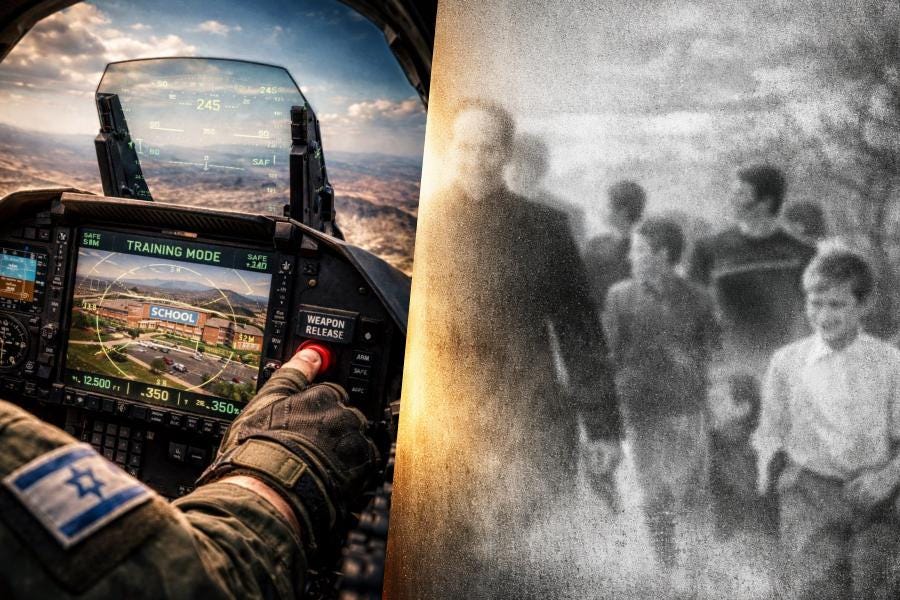
Every armed conflict is, in its most tragic and true essence, an act of senseless barbarity. War does not resolve any dispute: it merely transforms human suffering into rubble, leaving behind only a silence of a grave where life once flourished. Its most heinous crime is not the destruction of buildings, but the violent tearing apart of the very fabric of humanity.
Let us consider what is destroyed first and foremost: the future. In a just and harmonious world, an expectant mother should be able to caress her belly with the tender confidence of one preparing a nest of love. She should be able to dream of horizons of peace, serene discoveries and safe play for her unborn child. Once children are born, they should grow up fulfilling the expectations of those who brought them into the world: gazing wide-eyed in wonder, not closing their eyes in terror.
All this is brutally denied by war. Pregnancy becomes a time of anguish, childbirth an act of desperate resistance, childhood an obstacle course amidst rubble and bombs. And this universal rupture is not caused by fate, but is willed, planned and carried out by a few individuals. Leaders, generals, politicians driven solely by a boundless ego, who regard geopolitical maps and their own pride as infinitely superior to the beating of an innocent heart. It is these few who destroy the future of many, denying the world that natural harmony which is the right of every human being born.
Today, however, this boundless ego has found its most perfect and ruthless instrument. It no longer hides merely behind uniforms or bellicose rhetoric, but masks itself behind the coldness of a computer code. There is a name that makes the skin crawl, more than any pointed weapon. It is called “Where’s Daddy?”.
It is not the question of a frightened child, but the name of a tracking programme used by the Israeli armed forces. Its task is ruthless and precise: it locates a suspect and does not strike when he is out in the open. It waits. It waits for him to return home. It waits for him to sit down at the table, to hug his children, to lie down beside his wife in the dead of night. And then the order is given. According to investigative reports such as those by +972 Magazine and The Guardian, the entire cycle of the killing can take the human operator as little as 20 seconds: the time it takes to “click” and approve the bombing of an entire house, knowing that there are dozens of innocent people inside. This is the true, unacceptable rupture of our time. Death is no longer delegated to a soldier with a rifle at the ready, but to a sinister duo of Artificial Intelligence: Lavender and Where’s Daddy?
Lavender is the algorithm that acts as the “judge”. It analyses metadata, contacts and movements, and assigns a score from 1 to 100 to tens of thousands of Palestinians, labelling them as targets to be eliminated. A system which, as revealed by the soldiers themselves, operates with a known error rate (estimated at around 10%), but which has nonetheless authorised the killing of thousands of people, whose only “crimes” were to have crossed paths with a suspect or to have a phone similar to his.
Where’s Daddy? is the algorithm that acts as the “executioner”. It takes Lavender’s list and identifies the exact moment when the target reunites with their family, to maximise the damage.
We are not talking about “collateral damage”. When the Israeli army sets quotas for acceptable “collateral damage” – going so far as to tolerate the deaths of 15, 20 or more civilians in order to eliminate a single low-to-mid-ranking suspect, often using unguided bombs (“dumb bombs”) on entire buildings – there is no software glitch.
There is a deliberate strategy to eradicate a historical identity. Homes are deliberately targeted at night, along with the mothers, wives and children who are sleeping. Children are targeted because they are the future, the continuity of a people, the bearers of tomorrow’s memory. Women are targeted because they are the creators, the womb that gives life, the roots that pass on language, culture and affection. Killing women and children is not a mere hiccup: it is an attempt to radically erase the future, programming death through a computer code.
Stolen joy: the man who loved the outcast children
This is why the figures that Don Lorenzo Milani1 brought to light were not, for him, a cold academic exercise. To understand the fury with which he condemned war, one must remember where his voice came from.
In Barbiana, Don Milani had taken in children abandoned by the indifference of the State and a school system that had cast them out, the children of poor farmers considered “slow” or “worthless” . He had never looked upon them with pity, nor had he ever used charity to humiliate them. He had raised them with joy. He had shared his bread with them, welcomed them into his bed when it was cold, lit the lamp at night to teach them to read and think, filling them with the dignity that the world denied them. For a man who had dedicated his life to nurturing the future of children forgotten by all, the idea that a machine could legitimise the extermination of other people’s children was not a geopolitical abstraction, but an intolerable abomination, a personal wound.
The figures Milani had already seen: the end of the “just war”
And it was to protect that fragility that, in 1965, in his “Letter to Military Chaplains” [link], using data from Nobel laureate Max Born2, he and the boys of Barbiana laid bare the true nature of modern warfare:
First World War: 5% civilians – 95% military.
Second World War: 48% civilians – 52% military.
Korean War (1950–1953): 84% civilians – 16% military.
Faced with this escalation, Milani highlighted the end of any distinction: as early as 1965, the percentage of civilians killed was so high that, paradoxically, it made the military the “incidental” victims. Faced with such a mortality rate – which left behind a trail of defenceless people, orphans and widows – obedience to orders could no longer be considered a virtue.
As recalled in the book “Obedience is no longer a virtue”3, his condemnation was total: in the face of instruments that massacre populations, the only acceptable weapons remain those of non-violence, strike action and the vote.
The war of the “comfortable” and the abyss of distance
Today, that 84% of the Korean War has been superseded by algorithmic logic. The final frontier of modern warfare is absolute distance. Whilst in Gaza, Lebanon and Iran entire generations die beneath the constant hum of drones guided by a computer score, those who manage those algorithms live in the privilege of invulnerability.
It is the war of the “comfortable”: people are killed between one coffee and the next, at an airbase or in an office thousands of kilometres away, protected by bulletproof walls. For the operator sitting in front of the screen, there is no acrid smell of gunpowder, no screams beneath the rubble of a collapsed building.
There is only a heat signature that fades away. But this physical distance does not absolve one of moral responsibility. Don Milani, in his Letter to the Judges [PDF in Italian], was relentless in his criticism of those who justify themselves by saying they were following orders:
“We must have the courage to tell young people that they are all sovereign, so that obedience is no longer a virtue, but the most insidious of temptations; let them not believe they can use it as a shield, neither before men nor before God.”
Today this justification hides behind the excuse of technology. The programmer says: “I only wrote the code”. The general says: “I merely approved the list”. The drone operator says: “I merely followed protocol”. They pass responsibility back and forth like a burning burden, hoping the machine will absorb their guilt. But the human conscience cannot be divided. Behind that algorithm there is always the hand of a human being.
Whoever knows that behind that pixel lies a creator of life and her child, and still presses the button in 20 seconds, will one day or another have to reckon with the echo of that silence that follows the click of the mouse. Obedience to the machine does not free us from anguish: it buries it deep within, making us slaves to a system that deprives us of our very humanity.
Minab and the absence of mercy
If anyone doubts the true nature of this technique applied on a large scale, look to Minab. Do not view it on a sterile digital map, but imagine it for what it is: a city in southern Iran, in the province of Hormozgan, nestled amongst the arid mountains and a few kilometres from the warm waters of the Strait of Hormuz. It is a land of wind and history, a crossroads of peoples where mothers raise their children with the same hope and love as those in any other part of the world.
In Minab, there were no military bases that could in any way justify an attack, nor any imminent danger posed by that defenceless population. And yet, in April [sic - it was actually the 28th of February] 2026, right there, a Tomahawk missile turned a primary school into a hellish inferno4. 156 lives lost. 120 children. The algorithm did not err: it simply applied a ruthless logic in which the lives of 120 future generations, born on that very strip of land, are an acceptable statistical cost.
Behind those numbers lie the bloodstained schoolbags in the dust of Hormozgan, but above all there is yet another, unequivocal attempt to strike at the very identity of a community.
The antidote of compassion: “It matters to me” as an act of rebellion
Against the sterile hum of drones slicing through the sky, political condemnation is not enough. It takes the courage to reactivate what technology seeks to suppress. It is here that Don Milani’s “It matters to me” ceases to be a school motto and becomes an act of rebellion. “I care”, “I am interested”, is the exact opposite of the detachment required of a drone operator. To say “It matters to me” today means:
Rejecting the technological alibi: It is not the algorithm that kills; it is the person who agrees to delegate their conscience to a machine and to an acceptable death toll. Artificial intelligence does not erase our moral responsibility; it merely makes it more insidious.
Breaking the chain of indifference: Taking back responsibility for every single victim, even if reduced to a score on a computer-generated list. Spilled blood does not become digital simply because the finger is on a joystick.
Choosing humanity, here and now: Countering the silence of military commands with the courage of one’s own choices. There are people who are rebelling against this mechanism of death. In Israel, where conscription is compulsory and refusal means prison and permanent marginalisation, young Refuseniks refuse to enlist. In the United States, applications for conscientious objection have risen by 1000% [i.e. by 10 times!] in the last year. These people choose to give up their own freedom so as not to become complicit in the extermination. They do not obey the algorithm; they do not obey the ego of the powerful: they obey their own conscience.
This solitary courage, however, lays bare a far greater and institutionalised guilt. Don Milani admonished his pupils by reminding them that the Italian Republic was founded on an unshakeable pillar, Article 11 of the [Italian] Constitution [link], which states categorically: “Italy repudiates war as an instrument of aggression or of the settlement of disputes”. Yet, for decades, successive Italian governments – through the supply of weapons to theatres of conflict, participation in military missions under false pretences, and participation in and/or political acquiescence to aggressive military alliances – have systematically ignored, trampled upon and rendered this repudiation meaningless.
When the State betrays its own Constitution to do business with death, it is the individual citizen who must defend it. Today, the conscientious objector is not an outlaw: they are the only one truly upholding the Constitution.
If technology is used to render the erasure of women and children invisible, and if governments betray their own oaths, our empathy must become a shield. Let us reject the final form of slavery: that of obedience to the machine. Let us reclaim our sovereignty, the sovereignty that makes us feel the world’s pain and renders us, despite everything, profoundly human. And to anyone, sitting behind a sterile screen or behind a government desk, who still seeks shelter behind the cold execution of a protocol or in compliance with “international agreements”, Don Milani’s verdict hangs over them forever:
“You were not obeying at all: you were killing.” Just as no superior order relieves the soldier of individual responsibility, for the act of killing remains a personal choice.
But there is one final, terrifying point we must grasp, if we do not want the blood of Minab and Gaza to become the prelude to our own enslavement: that artificial intelligence which, in a matter of seconds, turns a family into a heat-seeking target is not a monster born solely for the front line; it is the testing ground for a logic that is already bearing down on citizens “at peace”.
The very same companies and the very same technology – such as Palantir’s systems – that label a human being with a score from 1 to 100 to decide whether to blow them up, are already mapping our lives. As the New York Times [link] has also unequivocally documented, this is not science fiction: in the United States, the Immigration and Customs Enforcement (ICE) agency already uses Palantir’s databases to cross-reference the data of millions of innocent people, predicting their movements and determining who should be arrested or deported. Algorithmic warfare abroad and domestic surveillance are merely two sides of the same control infrastructure
The creators of the “Palantir” system, Peter Thiel and Alex Karp, chose this very name from Tolkien’s work [“The Lord of the Rings”] because it evokes the mythical stones that allow one to see great distances, but which ultimately deceive and subjugate the will of those who use them (as happens to Saruman and Denethor).
If we have accepted, or silently tolerated, that a human being can be reduced to a mere “node” in a database, we have already signed the death warrant for our free will.
We forget that this freedom is not a concession from the State or a forfeitable right, but the highest and most sublime gift that God, in His infinite goodness, has bestowed upon us to make us free and responsible.
The machine that slaughters children abroad to “protect” a geopolitical interest promises us “security” at home by archiving our traces, stealing our choices, and predicting and blocking our actions.
Leaders with boundless egos do not merely wish to subjugate enemy peoples with drones; they wish to usurp the place of the Creator, subjecting their own peoples to total control that humiliates our very nature.
Algorithmic warfare waged with bombs and the surveillance of citizens at home are one and the same beast. Those who have delegated their conscience to code in order to kill from a distance are ready to delegate their own freedom to code in order to live.
The warning we must draw from this age of extermination and surveillance is that none of us is outside the perimeter: if we do not rebel today against the idea that human life can be measured and disposed of by an algorithm, tomorrow it will be our heartbeat, our movements, our thoughts that are classified as a “problem” to be solved.
True resistance is not merely defending the right to life of mothers and children beyond our borders, but preventing the algorithmic cage that has slaughtered them from becoming our normal daily reality.
Obedience to the machine, whether it comes from a military base or our smartphone, is the most blasphemous betrayal: it means renouncing that free will which God has given us to love one another and choose the good.
But just when the logic of power seems unstoppable, we must remember that one truth which the algorithm can never decode: the freedom that God has instilled in our hearts is not software that can be uninstalled by Palantir; it is an inalienable metaphysical spark.
Control systems may chain the body, restrict finances, predict movements, but they will never be able to calculate the soul.
Let us not obey. Let us say “I care”, before the deathly silence left by the drones becomes the silence of our own conscience.
NOTES AND REFERENCES
Forbes Italia: https://forbes.it/2024/11/18/fondatori-palantir-miliardari-azioni-societa
Azienda Wired: https://www.wired.it/article/citta-ascolta-fibra-ottica-dati-migliori-senza-trasformarsi-sorveglianza/
The New York Times: Titolo “Inside Palantir, the Silicon Valley Company Powering the U.S. Immigration Crackdown: https://www.youtube.com/watch?v=pqgRYWdBd0I
L’obbedienza non è più una virtù – Documenti del processo di Don Milani : https://cleliabartoli.wordpress.com/wp-content/uploads/2015/09/lobbedienza-non-c3a8-pic3b9-una-virtc3b9.pdf
La protezione dei minori nei conflitti – Save the children: https://s3-www.savethechildren.it/public/files/Conflitti.pdf
Nazioni Unite:https://www.ohchr.org/es/press-releases/2026/04/palestinians-across-gaza-unsafe-six-months-ceasefire-announcement-says-turk
Il Fatto quotidiano: https://www.ilfattoquotidiano.it/2025/12/12/obiettori-israeliani-refusenik-palestina-gaza-notizie/8224420/
Cybersecurity Italia: https://www.cybersecitalia.it/lintelligenza-artificiale-nelle-operazioni-militari-di-israele-come-funzionano-i-programmi-lavender-e-wheres-daddy/41569/
Update on the Human Rights Situation in Lebanon: https://www.ohchr.org/sites/default/files/documents/countries/lebanon/update-on-the-human-rights-situation-in-lebanon-23-04-2026.pdf
Italian Catholic priest known for his dedication to educating poor children and advocating for conscientious objection - Wikipedia
German–British theoretical physicist who was instrumental in the development of quantum mechanics - Wikipedia
Original title in Italian “L’obbedienza non è più una virtù” - link to Amazon for the book in English. The original version in Italian can be found in PDF format here or here
See this translation and my coverage of the first day of the Ramadan War here.
Source: GeoPolitiQ


Comments
Post a Comment