So It Goes, Zuckerberg
So It Goes, Zuckerberg
A Tralfamadorian day at sea
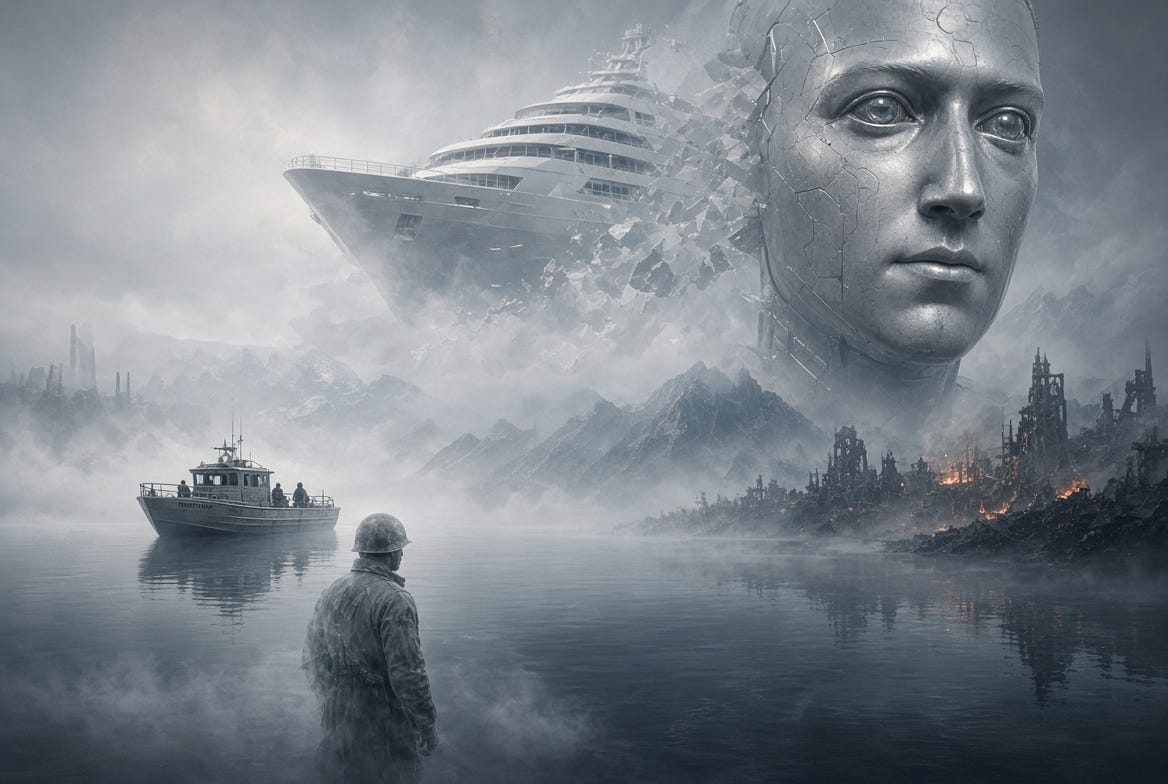
In the first days of August 2026, a strange scene unfolded off the coast of Alaska. Mark Zuckerberg’s yacht Launchpad was moving through Farragut Bay when a six-meter Hewescraft ran out of fuel nearby. Two women, a child, and a dog sat helpless in the small boat while the cold grey sea stretched around them. The contrast might have come fromKurt Vonnegut’s Slaughterhouse-Five: one group sealed inside comfort and machinery, another exposed to chance, with both occupying the same moment but almost different worlds.
The Coast Guard sent repeated calls for assistance over the emergency frequency. Vessel tracking showed that Launchpad was close to the stranded boat. The yacht slowed near the mouth of the bay, equipped with radar, helicopters, small boats, and every device money could buy. Yet the distance between wealth and need remained greater than the few hundred meters of water between the two boats. In Slaughterhouse-Five, Billy Pilgrim learns that distance is not always measured in miles. People can stand beside suffering and still inhabit another universe.
Help came instead from the smaller cruise vessel Wilderness Legacy. Its captain changed course, took the Hewescraft in tow, and brought its passengers to safety. When those aboard the Wilderness Legacy learned that the great yacht had remained nearby while the smaller boat drifted without fuel, they booed the Launchpad, their voices carrying across the water toward the gleaming hull. Slaughterhouse-Five repeatedly sets human suffering beside machines, institutions, and men of great power that seem strangely detached from it. Dresden burns while officials speak in orderly language; prisoners are moved according to schedules; Billy Pilgrim passes through catastrophes beneath the fatalistic refrain “so it goes.” The humor is black because the machinery continues to function even when the human purpose behind it has disappeared. Something similar seemed to happen in Farragut Bay. The larger vessel possessed everything, yet the actual rescue came from the humbler ship that simply changed course and helped. The boos from the Wilderness Legacy thus became something like one of Vonnegut’s bitter punch lines: all the wealth and technology in the world had been gathered in one place, while the elementary act of helping another human being came from somewhere else.
When different news media reported the incident, a spokesman said that Zuckerberg had not been aboard the yacht. The crew, he said, had been listening to another radio channel and therefore missed the Coast Guard calls. Only after Wilderness Legacy had completed the rescue did the operators of Launchpad switch to the emergency frequency and learn what had happened. It is the sort of explanation that fits easily into Slaughterhouse-Five, where terrible or absurd events are followed by explanations that change nothing about the event itself. The moment has already happened. So it goes.
Questions remained about that account. Large vessels are expected to keep watch on the international distress frequency, while modern communications equipment can receive digital emergency alerts automatically. If those systems were operating as intended, the distress message should not have vanished into silence. Slaughterhouse-Five repeatedly returns to this gap between what men are supposed to do and what they actually do. Rules exist, machines function, orders are given, and yet someone is still left outside in the cold.
The episode also offered an image of modern power. A floating palace crossed the same water as a small disabled boat. The powerful possess machines that can see farther, travel faster, and communicate across the planet, but none of those machines can force a man to care. Slaughterhouse-Five gives this kind of indifference a simpler form when Billy Pilgrim and the other American prisoners are packed into freight cars and carried across Germany. Men grow sick, collapse, and die inside the train, but the railway continues to move them toward its destination as though they were cargo rather than human beings. Vonnegut’s point is not that the machinery fails. The machinery works. What fails is the recognition of the person caught inside it. Farragut Bay presented that same contrast on a smaller and less terrible scale: Launchpad had the equipment to detect distress and the means to answer it within minutes, yet the stranded family remained somebody else’s problem until another ship turned toward them.
Billy Pilgrim survives by withdrawing from the logic of ordinary time. He sees Dresden burn, watches people die, and comes to regard each event as something fixed forever in the structure of the universe. The scene in Farragut Bay invites the same cold phrase that follows death throughout Slaughterhouse-Five: so it goes. The small boat drifted. The great yacht remained nearby. Another vessel came. The passengers were saved. Each fact sits beside the next, and the moral judgment is left to whoever is still capable of making one.
Then Launchpad continued on its way, and the Hewescraft reached shore under the care of others. The old Russian saying about the man whose hut stands at the edge of the village found a modern form on the Alaskan coast: what happens beyond the threshold is somebody else’s affair. The Tralfamadorians of Slaughterhouse-Five would have found nothing surprising in it. Every moment simply exists, they say, fixed forever in its place. Human beings, unlike Tralfamadorians, still have the harder task of deciding whether “so it goes” is an explanation or an excuse.
Source: Eurosiberia


Comments
Post a Comment