Surprising Yemen
Surprising Yemen
Who knew that the “Houthi” parts were so green and lush?
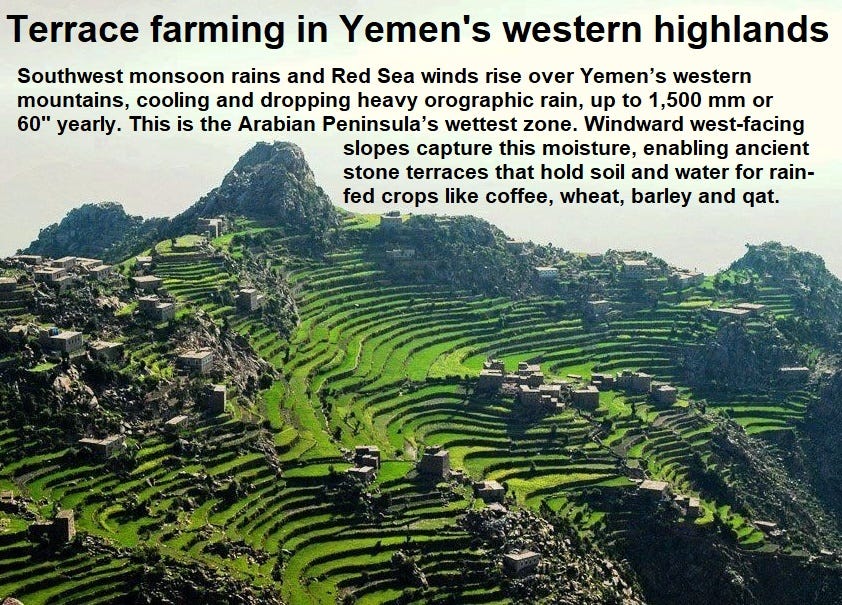
Zoom in on Google Earth, or search Google images, and you will be amazed by the extensive terrace farming across Western Yemen. All these hand-made rock walls, built to trap the rainfall on level terrace fields, took many generations to build. The people who live here feel a connection to the land and to the ancestors who constructed them is immeasurable. Not only are the "Houthis" (aka Ansar Allah) mountain people, they are farmers with a deep commitment to their land and their way of life.
Don’t get me wrong, terrace farming is driven by geology and rainfall patterns, and was developed from China to Peru over millennia. My point is that these terraces form a visible and vital connection between the living farmers who maintain and work them today, and the ancients who first built them. This makes their connection to these lands uniquely powerful.
Please see the photos and links that follow.
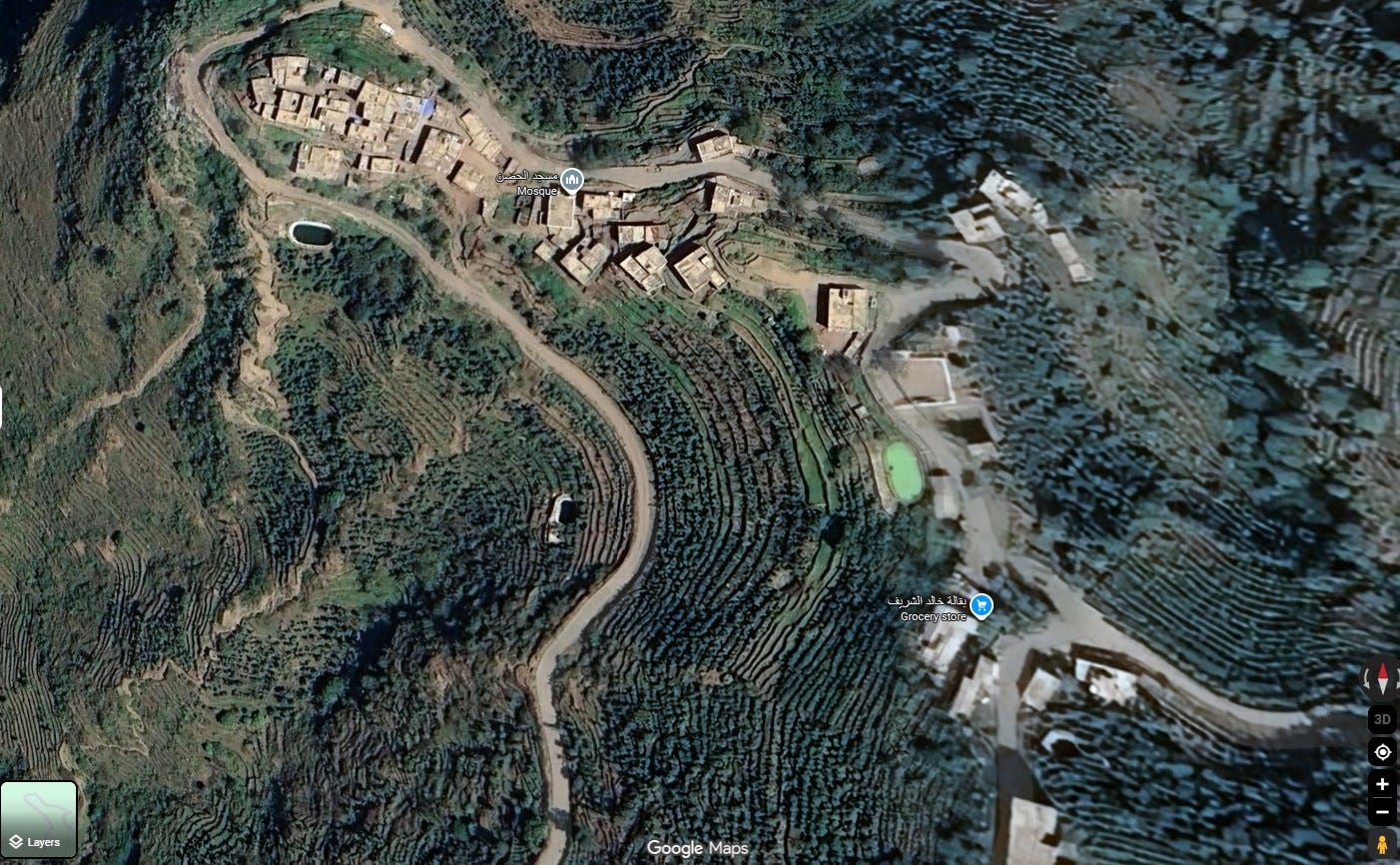
This rich agricultural area is not just some tiny bit of Yemen, it’s a lot of land, and it’s where most of the population is concentrated. Just scroll around on Google Earth to the west and north of Sana’a, the capital of Yemen, and you will see what I mean. This is one screen capture. You will see hundreds of mountains covered with terrace farming like this one. Note the mosque and grocery store.
Google has not gotten around to driving these roads with their camera cars to make street views. It’s probably not the safest project among suspicious mountain folk who have been subjected to decades of a starvation blockade. But Saudi Arabia can’t blockade all these rich and fertile terraces, so the Yemenis can’t be completely starved into submission.
From Grok: "Mocha (Al-Mukha) was the historic Red Sea port that exported Yemeni Arabica coffee from the 15th–17th centuries, giving the beans their name. Traditional Mocha coffee has no added chocolate; its natural dark-chocolate notes come from the beans and dry processing. Modern café mochas add chocolate made from cacao, a crop native to the Americas."
[Ansar Allah recently captured / liberated the port city of Mocha]
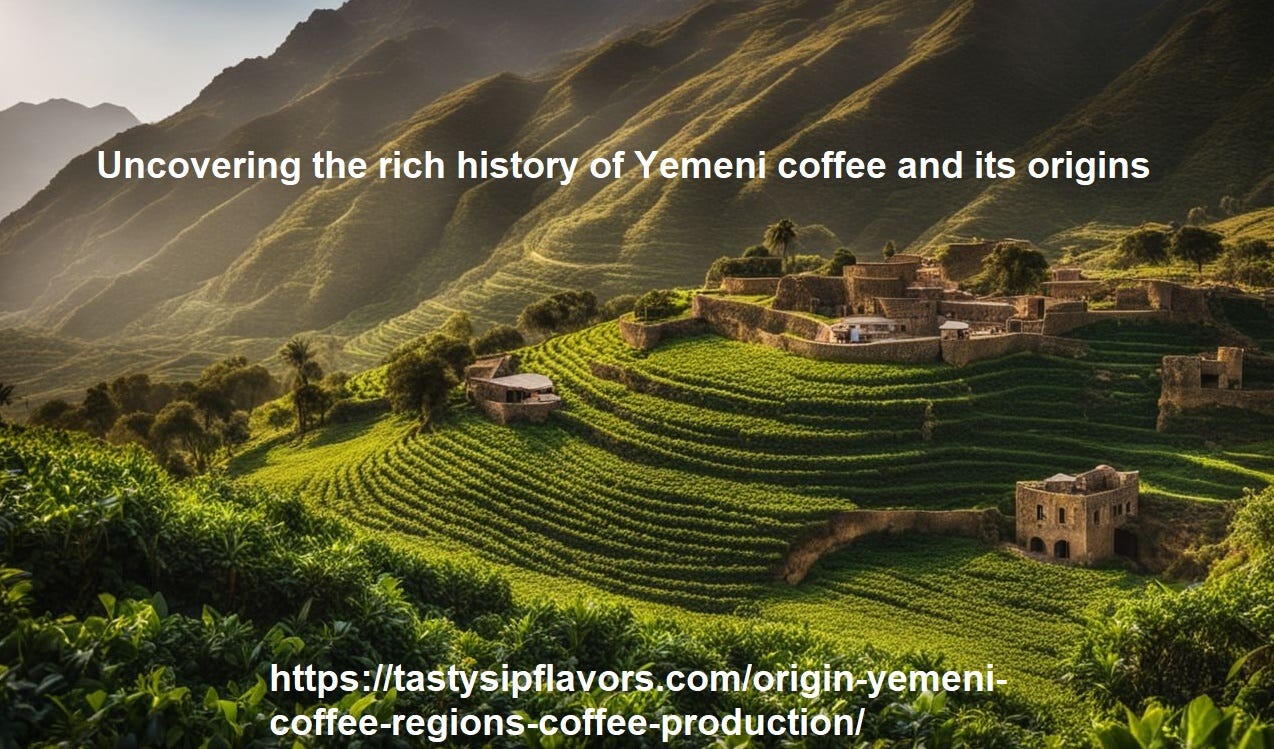
There is an outstanding article here, it’s where I found the above image.
The Ultimate Guide to Yemeni Coffee: Origins and Growing Regions
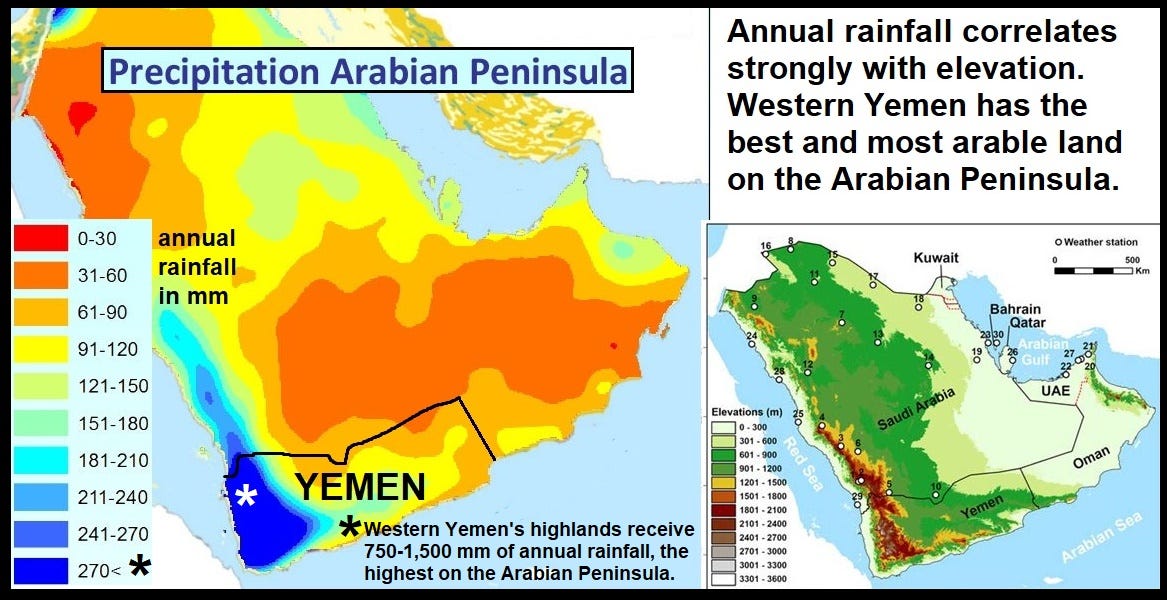
When you think of the Arabian Peninsula, you picture Lawrence of Arabia and sandy deserts. But there is some prime real estate, and it's mostly in western Yemen. And also the part of Saudi Arabia that the House of Saud annexed from Yemen in 1934, with British “help,” so there is a grudge match here going back a century. (Think of Britain, Ireland, and Northern Ireland, with cultural and religious overlays, but on the Arabian Peninsula.)
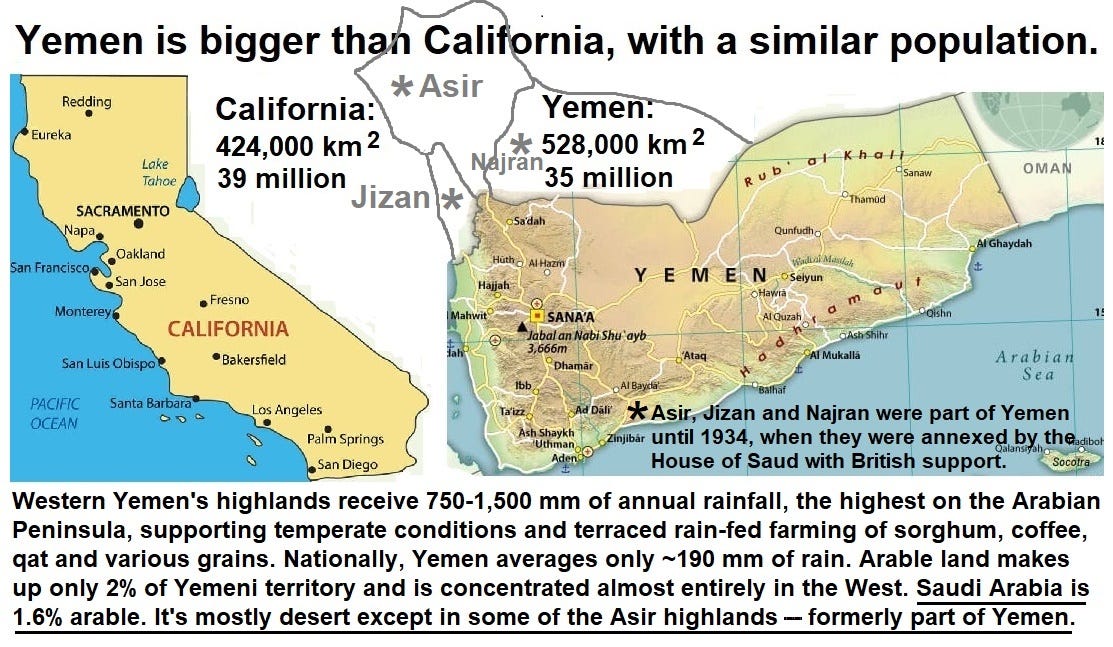
Monsoon rains sweeping across the Red Sea are caught on the steep west-facing mountains, that's why all these agricultural terraces were built, by hand, by Yemenis, over many centuries. These mountains rise up to 12,000 feet, or 3,660 meters. Without constant attention and manual-labor upkeep, these ancient walled terraces would erode and collapse during heavy rain floods, and after repeated freeze cycles. Yemenis are taught about of the sacrifice of their ancestors, and their own generation’s responsibility to maintain these almost sacred terrace field, which feed their families and neighbors. If anybody thinks these Yemeni mountain people are short-term thinkers, much less quitters, they are seriously in error.
The Yemeni tribes that inhabit northwest Yemen are closely related to the tribes in the three Saudi-annexed provinces by dialect, and by their adherence to the Zaydi sect of Shia Islam. The unwelcome 1934 new Saudi border cut straight across the formerly continuous Yemeni highland world.
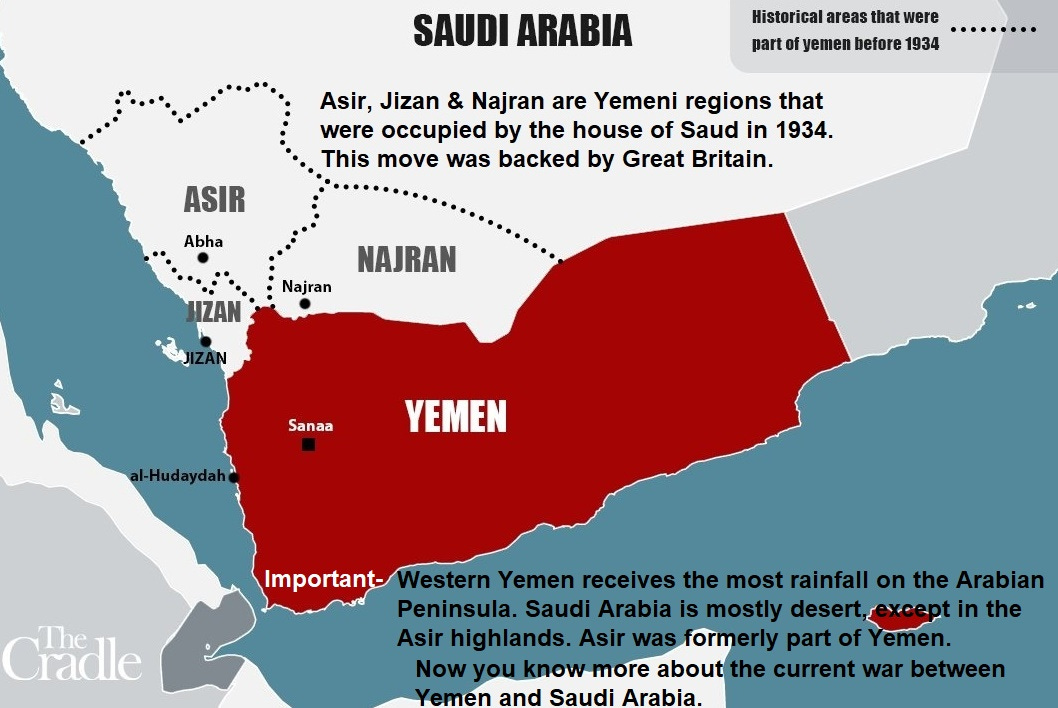
It’s also important to understand just how big Yemen is: it’s 20% larger than California. Its population is nearly the same as Saudi Arabia’s, at around 36 million.
Almost 3/4 of the total Yemeni population is now under Houthi / Ansar Allah control, and they also hold the capital city, Sana’a. So it’s completely absurd to refer to them as “the Houthi Rebels,” and call the Saudi-paid mercenary militias (who only control the ground under their military vehicles) “the official government of Yemen.”
In addition, only 2/3 of the Saudis are citizens, and 1/3 are foreign-born “residents,” of questionable loyalty or fighting spirit.
Another factor to consider: 4 million Yemeni-Saudis live in the three annexed provinces.
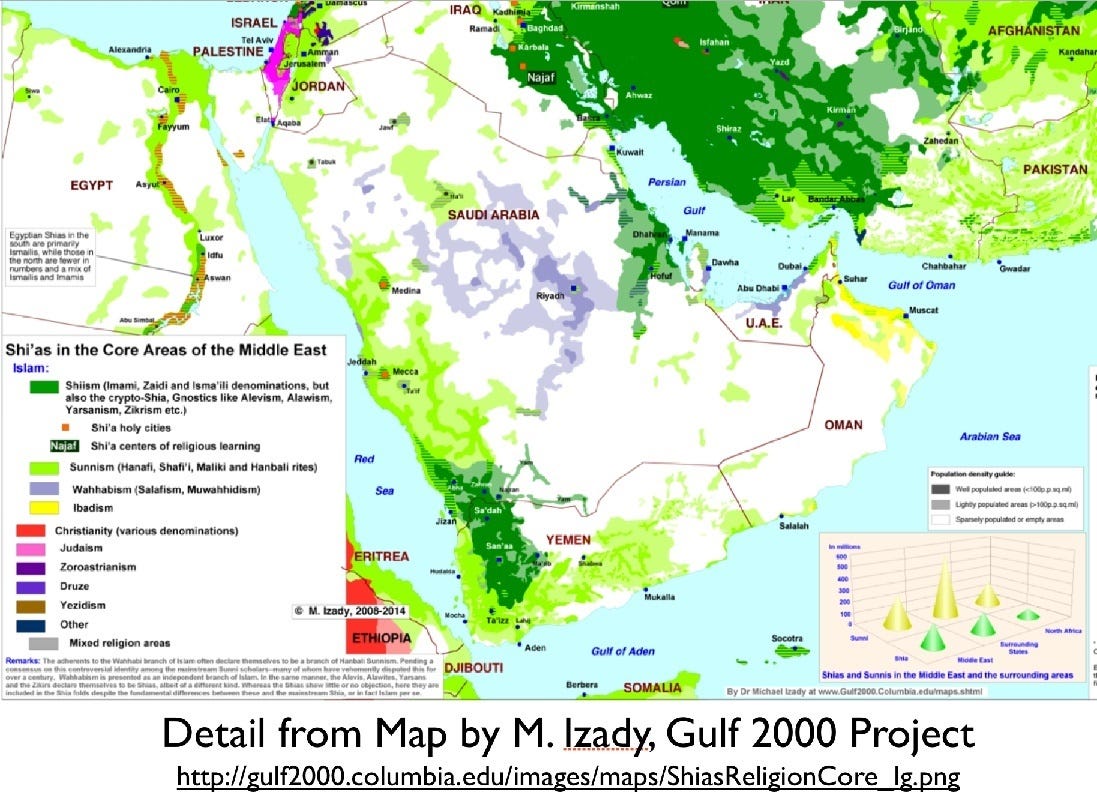
Ansar Allah, aka "The Houthis," are mostly Zaydi Shia Muslims, and these are not quite the same as the Shias of Iran or Iraq. The above map is still useful, though, to understand the religious breakdown of the Arabian Peninsula, the Gulf, and Iran, and why it matters so much in the Saudi-Yemen conflict.
You can see that Iran and part of Iraq are heavily Shia, as are western Yemen and most of the three annexed provinces. But also note the heavy Shia presence along the Saudi Persian Gulf coast, with its vast and vulnerable petroleum infrastructure.
A saying I heard today, I think it’s from Larry Johnson: “The Saudis live in a glass house, and the Yemenis live in a rock house. Who is going to win a rock fight?”
This makes the Saudi royal family extremely paranoid. Not only do they face a war in the south vs. Yemen, but also a war across the gulf with Iran, and an incipient Shia "5th Column" in and among their cash-cow petroleum industries along their Persian Gulf and Red Sea coasts.
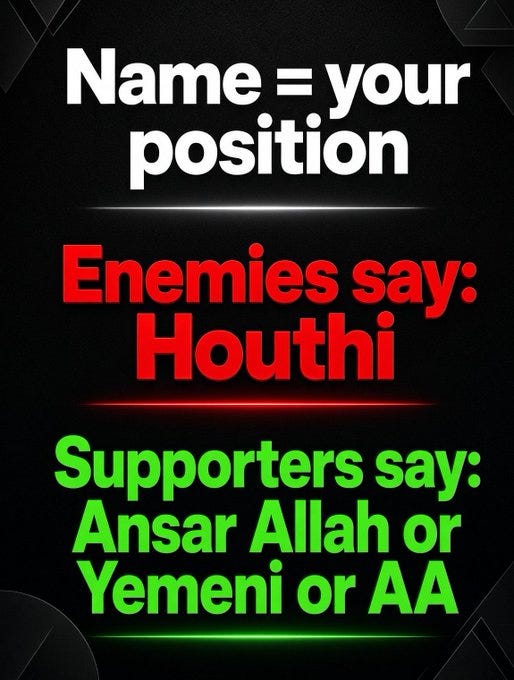
I asked Grok about the whole "Houthis or Ansar Allah?" nomenclature debate. Take it for what it's worth.
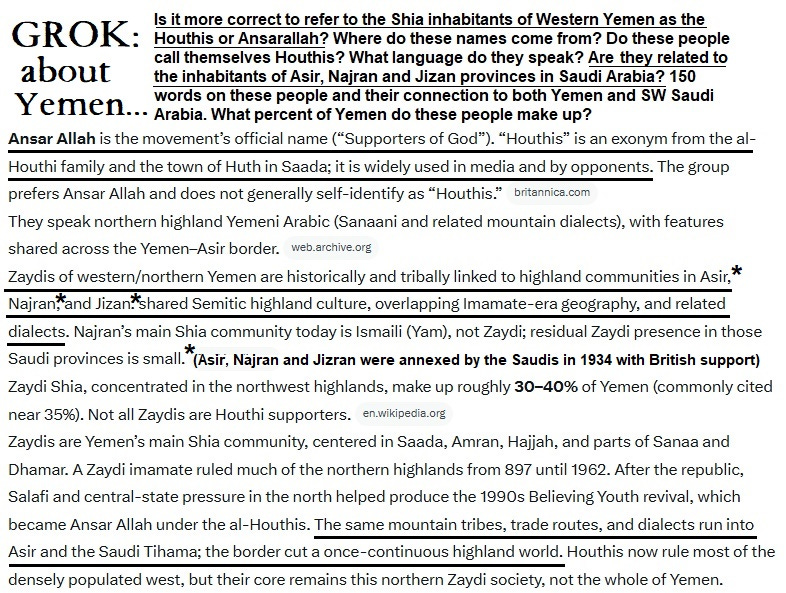
And here is a meme on this point that I saw and grabbed today. Since “The Houthis” aka Ansar Allah now control 3/4 of the population, the capital, the Red Sea coast, and virtually all of the inhabited arable land, maybe it’s time to just call them: YEMENIS. And that is how I will refer to them going forward. Yemenis. They have earned it.
No matter what you think about the USA-Iran war, or the Saudi-Yemen war, you have to admit that the Yemenis are very brave fighters. Here is a representative video showing one soldier’s courage under fire.

/video/1
Napoleon said: “In war, the morale is to the physical as three to one.” This is why the Saudis and their other paid mercenary militias generally quit when facing the extremely brave and motivated Yemenis.
Their obstinate courage is also why they are now forming a strong leg of Iran’s “Axis of Resistance,” as they call it. Only the Yemenis took on Israel and kept firing missiles at “the Zionist project” while Gaza was being bombed into rubble. And it was the Yemenis who took on the US Navy, and drove it out of the Red Sea during this period from the end of 2023 and into 2025. This gives the Yemenis tremendous and enduring “street cred” across the entire Islamic world, and not only the Shia parts of it.
Here in this clip, Ansar Allah Yemenis are are reviewing some of the recently captured American-build Saudi military equipment. Remember what Napoleon said about “the morale to the physical.” Saudi-paid militia mercenaries are not willing to die in this fight, no matter how well paid or equipped they are.

/video/1
Mountain people everywhere are tough and self-reliant. Hard mountain life makes them this way. Some call the west Yemen highlands "Arabia's Appalachia," but the mountains are closer in height to the Rockies, and they are rain-catching, like the California or Oregon coastal ranges. And all those stone terraces, dug and built by hand by their grandfathers going back a thousand years, gives them a spiritual connection to their land that is hard to duplicate.
Here is a Yemeni fighter declaring he will never quit the fight.
"We were born free! We will live free! We will die free! And we will never become slaves!" The audio is obviously “boosted,” but this message is spreading across the Islamic world, both Shia and Sunni, and it’s not only directed at Saudi Arabia. When he says, “To all the tyrants of the earth,” he is looking at us, and at Israel.

/video/1
Do not underestimate their fighting spirit. And courage is contagious: the Yemenis are now boosting the morale and fighting spirit of both Sunni and Shia Muslims across the world, as an example of how brave people can do battle against the Israeli and American “Axis of Evil” (from their point of view) and their paid stooges across the GCC, and notably in Saudi Arabia.
I’m not here to cheerlead for the Yemenis, but we have to face reality. These guys are fighters, and they are motivating a new generation to continue the battle against the Zionist project and American control of the region and West Asia.
Bracken—Out
Source: Matthew's Substack


Comments
Post a Comment