The Hamas Proxy
The Hamas Proxy
* * *
Harakat al-Muqawamah al-Islamiyyah (Hamas) is widely perceived to be a “proxy” of the Iranian government. Three weeks after Hamas’ October 7th attack on the communities and military installations close to the Gaza border, Israeli Prime Minister Benjamin Netanyahu said:
[Hamas are] part of the axis of evil Iran has formed, an axis of terror that works by arming, training and financing Hamas in Gaza, Hezbollah in Lebanon, the Houthis in Yemen and other terror proxies throughout the Middle East and beyond the
Middle East. [. . .] In fighting Hamas and the Iranian axis of terror, Israel is fighting the enemies of civilization itself.
Netanyahu’s depiction of Hamas as simply an extension of the Iranian government was utterly disingenuous. It has been widely reported, and never denied, that Benjamin Netanyahu told a 2019 meeting of his Likud Party:
Anyone who wants to thwart the establishment of a Palestinian state has to support bolstering Hamas and transferring money to Hamas.
Speaking in 2021, IDF Major General Gershon Hacohen added:
Netanyahu’s strategy is to prevent the two-state solution, and that is why he made Hamas his closest partner. In the visible dimension Hamas is an enemy, in the hidden dimension it is an ally.
The evidence demonstrating that Hamas frequently acts as a “proxy” for Israeli strategic interests is compelling. Further evidence suggests that, at times, Hamas also supports US foreign policy objectives.
The influence of Zionism on US politics is currently a contentious issue. Conspicuously led by the American Israel Public Affairs Committee (AIPAC), which has almost total financial control of US politicians’ campaign coffers, US policy, especially foreign policy, is commonly aligned with Israeli interests. It may not be surprising, but there are reasons to believe that Americans’ current focus on Zionist influence is diverting their attention from a more urgent global agenda.
Nonetheless, AIPAC also declares that Hamas is “Iranian-backed” and among the Iranian government’s “terrorist proxies.” AIPAC equally holds Iran jointly responsible for the Hamas attack on October 7th against communities in Southern Israel and has maintained that position. In June 2025 it wrote, “Israel has been at war with Iran and its terrorist proxies for 20 months, following Hamas’ horrific October 7 massacre.”
The evidence indicates that the October 7th attack was an Israeli government-enabled Let It Happen On Purpose (LIHOP) false flag attack. This is not to exonerate Hamas for its part in the operation. Statements from its leaders and video footage it posted on its own channels clearly show that Hamas, or groups who participated in the Hamas-led assault, killed innocent Israeli civilians.
The Israeli government also killed Israeli civilians on October 7th. Consequently, it is not possible to determine relative culpability, though it seems likely that the Israeli government was responsible for a significant number of the killings. The suggestion made by some commentators, however, that Hamas conducted an entirely professional military operation and did not stray into mass murder is just as ridiculous and egregious as Israeli propaganda.
The Israeli government is not the only government to have used the October 7th attack as supposed justification to wage war on Iran. Launching Operation Epic Fury—the US military campaign against Iran—on February 28th, 2026, US President Donald Trump said:
A short time ago, the United States military began major combat operations in Iran. Our objective is to defend the American people by eliminating imminent threats from the Iranian regime. A vicious group of very hard, terrible people. [. . .] [I]t was Iran’s proxy, Hamas, that launched the monstrous Oct. 7 attacks on Israel
Though it issued denials, the Iranian leadership hardly dispelled the impression of its involvement in October 7th when Ayatollah Ali Khamenei—who was apparently assassinated on day one of Operation Epic Fury alongside his family and staff, reportedly including his infant granddaughter—said that Iranians “kiss the hands of those who planned the attack on the Zionist regime”. Khamenei was not necessarily speaking for the people he claimed to rule—Iranians. It is not evident that there is universal support for Hamas in Iran. For example, sections of the crowds at a couple of football matches in Tehran reacted angrily when the Iranian state organised public events promoting Hamas’ cause.ci
Like any government, Hamas has faced vocal opposition from some of the people it purports to represent. For example, in 2019 Palestinians in Gaza protested against the lack of promised economic development. While we should be wary of the potential for organised protests to be manipulated—in Gaza, Iran or anywhere else—nevertheless, the claim that Hamas serves and protects Palestinians in Gaza is no more credible than any of the same claims made by any other government anywhere else.
For example, Hamas fully complied with the global pseudopandemic restrictions. Despite the difficulties Palestinians already faced from Israeli oppressions, Hamas imposed the requisite economy killing lockdowns. Hamas then injected Palestinians with Sputnik V which was seemingly a knock-off of the Astrazeneca “clot-shot” that was later withdrawn globally due to “safety concerns”.
Following October 7, Hamas released a couple of documents titled “Our Narrative”. In the most recent publication, Hamas said that one of the objectives of the October 7th attack was to expose the brutality of the Zionist Israeli government. To this end, Hamas said that “sacrifice is the path to salvation”. It is very difficult to see how the subsequent genocide of the Palestinians by the Israeli government was a “sacrifice” that served and protected the Palestinian people.
While responsibility for the genocide sits squarely with the Israeli government, according to Hamas officials, we are supposed to believe that Hamas was surprised by the scale of the Israelis’ genocidal military reponse. This Hamas claim is nonsensical.
According to figures reported by the United Nations Office for the Coordination of Humanitarian Affairs, between 2006 and 7th October 2023, 5,365 Palestinians were killed and nearly 63,000 injured in Gaza by the Israeli government. To be frank, the Israeli state has never shown any notable restraint when it comes to slaughtering Palestinians in Gaza. It is unfathomable why Hamas was supposedly surprised by the Israeli government’s genocidal reprisals after it led a large-scale assault on southern Israel.
From a propaganda perspective, the Hamas attack primarily served to provide the Israeli government and its international partners a spurious justification to obliterate Gaza and cull Palestinians. Further, it provided a narrative to escalate a regional war with Iran, for which Hamas is reportedly a controlled “proxy”.
Consequently, the best we can say about Hamas’ actions on October 7th is that they were ill-conceived and showed a remarkable lack of foresight. But this conclusion is totally at odds with every other aspect of the official account—from all sides—which maintains that Hamas meticulously planned and prepared for the attack.
It appears that we are asked to accept that Hamas spent years planning their strategy but gave absolutely no thought whatsoever to what their enemy’s response might be. There are, however, other possible explanations, because Hamas isn’t just a proxy for the Iranian government.
The US Central Intelligence Agency (CIA) was seemingly uncertain about the role Iran’s government played in the Hamas attack. The CIA was reportedly under the impression that the Iranian government was also “surprised” by the attack and had little “direct knowledge” of what Hamas was planning. Similarly, Benjamin Netanyahu, though stridently blaming Iran for financing, organising, and directing Hamas—carefully omitting any mention of Israeli funding of Hamas—said that he couldn’t say “for certain” that the Iranian government was directly involved. Then US Secretary of State Antony Blinken was equally unsure.
Since then, nothing has really changed on the intelligence front, but that didn’t stop Trump from claiming that Iran was definitely behind the Hamas attack and was “the world’s number one state sponsor of terror”. Trump’s suggested corollary, that Iran is developing nuclear weapons to spread terror globally, has been, according to many Western analysts and media outlets, an imminent threat for at least the last forty years. The constant refrain that a nuclear Iran would destabilise the Middle East completely ignores Israel’s nuclear threat.
Israel’s own nuclear weapons program is not secret. In 1986, Israeli nuclear engineer Mordechai Vanunu revealed details of Israel’s nuclear weapons development at its Dimona research facility in the Negev Desert. The media widely reported his whistleblower testimony and the evidence he provided. Vanunu was eventually imprisoned for eighteen years in Israel and was released in 2004. To this day, the Israeli government still imposes harsh restrictions on Vanunu. Most Israeli-aligned governments, such as the US government, have adopted a policy of ambiguity when it comes to any official acknowledgement of Israel’s nuclear arsenal.
With regard to the uncertainty about Iranian government involvement in the October 7th attack, such ambiguity was understandable. Hamas has received support and funding from the Iranian government, but it also has a turbulent history of relations with Tehran. At times Hamas has backed Israeli and US initiatives and has actively worked against Iranian interests.
To appreciate this point, it is worth considering events in the Middle East during the US presidency of Barrack Obama. He waged war for more years than any other US president in history. It should be noted that his administrations’ murderous warmongering played out after Obama received the Nobel Peace Prize. To be fair to Obama, he did signal his administration’s interest in proxy warfare in his Nobel acceptance speech:
Terrorism has long been a tactic, but modern technology allows a few small men with outsized rage to murder innocents on a horrific scale. Moreover, wars between nations have increasingly given way to wars within nations. [. . .] I do not bring with me today a definitive solution to the problems of war. [. . .] [I]t will require us to think in new ways about the notions of just war. [. . .] Negotiations cannot convince al Qaeda’s leaders to lay down their arms.
Maybe not “lay down their arms” but al-Qaeda and its myriad of affiliated groups evidently are open to negotiation. They seem willing to consider an offer of a country in exchange for fighting and dying in your “just war.”
In 2011, the Obama administration’s US-led coalition backed an Islamist insurrection against the Syrian government of the democratically elected President Bashar al-Assad. Initially, the US-led coalition relied on groups like its al-Qaeda proxy—Jabhat al-Nusra (the al-Nusra Front)—which later rebranded as the core of Hay’at Tahrir al-Sham (HTS). The Obama administration steadily increased its support for both al-Qaeda and then provided military assistance for ISIS as part of its efforts to use them as proxies to defeat the Syrian Arab Army (SAA) and unseat Assad.
Under Obama’s supposed leadership, the US-backed Islamist terrorist campaign ultimately led to the installation of President Ahmed Hussein al-Sharaa in Syria. A stooge of the US coalition, al-Sharaa was previously the emir of Jabhat al-Nusra, where he fought under the nom de guerre of Abu Mohammad al-Julani. He led al-Nusra to commit numerous atrocities and human rights violations, with the US government evidently providing support through programs like Timber Sycamore.
The rebranding of “al-Qaeda in Syria” (HTS) began in late 2016, following some infighting, al-Qaeda and affiliates joined together to form HTS. This enabled Western propaganda outlets, such as the BBC, to describe al-Sharaa as a “rebel leader” and al-Qaeda in Syria as an “Islamist militant group” and one of the “rebel factions.” The US’ Biden adminstration removed the $10 million bounty off al-Sharaa’s head enabling the Trump adminsitration to take HTS off their list of proscribed terrorist groups before installing al-Sharaa as their terrorist president of Syria.
During the years of insurrection in Syria, Iran backed the Syrian government, while the Israeli government militarily supported the US coalition and their Islamist terrorist proxies. Hamas assisted the US coalition and effectively promoted US and Israeli foreign policy and their covert operations.
As a Sunni Islamist group, Hamas lent tacit support to the so-called “Friends of Syria” coalition. Hamas, consequently, received further support from Qatar and other Syrian friends, including Saudi Arabia and the UAE, who, like the US, backed ISIS. Collectively they formed a Sunni Arab alliance against Syria, which undermined the Iranian Shi’a-led “Axis of Resistance.” By siding with the Sunni alliance, Hamas also essentially aligned with the US coalition and the Israeli government.
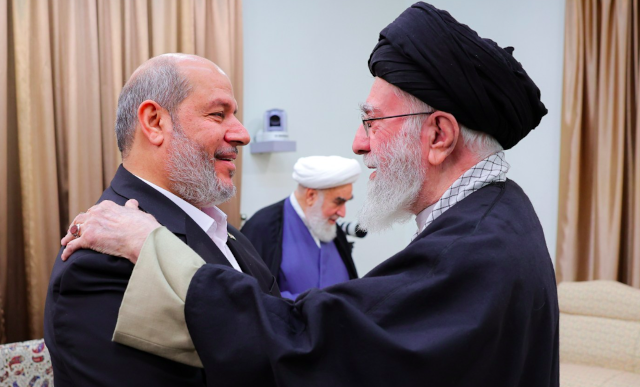
The conflict in Syria put significant strain on the Iranian government’s relationship with Hamas, exacerbating enmities that have been ongoing since 2009. In 2013, Hamas pulled out of Iran’s Syrian headquarters, and the Iranian government withdrew most of its remaining military and financial support from Hamas as a result. Iran remained conditionally willing to support Hamas—for its opposition to Israel—but it wasn’t until 2017 that Iran restarted its cooperation. Hamas took the money and the military assistance but still refused to support Iran’s stance against Saudi Arabia.
During the genocide in Gaza the Saudi and UAE governments effectively backed the Israeli government and called for the disarmament of Hamas. Yet, after Iran was attacked by the US and Israel, leading Iran to strike targets in the UAE and Saudi Arabia, Hamas urged Iran “to avoid targeting neighbouring countries” and suggested that Iran should act “in accordance with international norms.” That is to say, Hamas spoke in defence of the governments that were seeking to effectively remove their authority.
Obviously, the relationship between the Iranian government and Hamas is complex. Even the US Council on Foreign Relations has conceded that Hamas is not simply an Iranian puppet. Hamas’ stated opposition to Israel certainly reflects Iranian foreign policy, but often Hamas appears to serve as a proxy for others, notably some of the Arab states that form the Gulf Cooperation Council (GCC), the US, and Israel.
As I discuss at length in my forthcoming article for Unlimited Hangout, now that Gaza has been almost completely destroyed, the US-led plan is to turn it into an AI-data-driven smart city where the few Palestinians allowed to live there will be subjected to constant surveillance and programmable behavioural control mechanisms. They will have no agency, no means of redress, and will effectively be slave labourers, until no longer required.
Hamas—still the de facto government of what’s left of Gaza—has welcomed the US administration’s so-called miracle city development. If it proceeds as envisaged, the “New Gaza” project effectively ends Hamas’ ability to govern Gaza, yet it has also agreed to disarm itself in order to keep the project on track.
The UN has granted the interim “technocratic committee” a two-year mandate to govern Gaza. Officially named the National Committee for the Management of Gaza (NCAG), Hamas has stated its willingness to dissolve itself to facilitate the work of the NCAG.
The story goes that Hamas is leveraging improving relations with the US administration to put pressure on the Israeli government. In reality, it appears to be doing everything it possibly can to subject Palestinians in Gaza to an oppressive US-led public-private partnership Technocracy.
Whether New Gaza is ever built depends largely upon the outcome of the ongoing horsetrading that is currently underway. Though Hamas has given its commitment to disarm completely, it has made handing over what heavy weapons it possesses pre-conditional on Israel withdrawing from Gaza. Which the Zionist extremists oppose. Itamar Ben-Gvir, the Israeli minister of national security who called for all Palestinians to be starved to death, has therefore decided that US’ New Gaza plan is “unacceptable.” As a result, with elections looming, Netanyahu has to placate the Israeli far-right and has said that “Israel rejects” the proposal.
Netanyahu is under pressure from the Zionist extremists in Israel because they hold his coalition government together. The Israeli government has consequently insisted that Hamas must disarm first.
The gaggle of oligarchs hoping for a miracle Network State in Gaza can take heart, however, because Hamas has already accepted a phased and gradual withdrawal of Israeli forces. This provides the Israeli government with some flexibility and gives Netanyahu an opportunity to satisfy the demands of the Zionist lunatic fringe.
Hamas is funded by and receives support from the Iranian government because it is generally antagonistic to the Israeli government. But Hamas has also received funding and support, via various routes from the Israeli government and its Gulf “partners” because Hamas is also frequently antagonistic to the Palestinian Authority.
Hamas has promoted Iranian interests in the Middle East but also actively opposed them. Hamas has historically aligned with US and Israeli interests, placing a strain on its relationship with Tehran. And it is straining that relationship again today.
Hamas is currently assisting a gaggle of Silicon Valley oligarchs, who control the Trump administration, to establish a smart city surveillance and behavioural control state in what was once Gaza. Whether Hamas expected a genocide of the Palestinians to result or not, its October 7th attack provided Israel, the US, and their private sector partners, an excuse—albeit a baseless one—to murder Palestinians, flatten Gaza, start a regional war with Iran, and advance a global agenda to construct a network of smart city-states.
It seems Hamas is a very useful proxy for numerous public and private sector interests.
Source: Iain Davis


Comments
Post a Comment