People vs. the bankers: battlefront Poland
People vs. the bankers: battlefront Poland
The ongoing battle for Poland have been overshadowed by events elsewhere. However, it is one of the most important political battles today. It could determine whether Poland becomes Ukraine 2.0
In the blizzard of history-altering events that have taken place around the world this month, one of the most important is the ongoing battle for Poland between the nation’s soverigntists and the EU-backed globalists. The EU-backed faction is led by the Prime Minister Donald Tusk, and the sovereigntists by the President, Karol Nawrocki.
Although the crisis has been overshadowed by US mid-term elections, wars in Ukraine and the Middle East and the “Yalta 2” summit in Shenzhen, it merits much greater attention because the nation’s very sovereignty is at stake. If she loses to the Eurocrats, Poland could become a de-facto colony of the EU Reich. In that case, its economy and its military will almost certainly be shaped to become the Western empire’s new bludgeon to wield against Russia - to the last Pole!
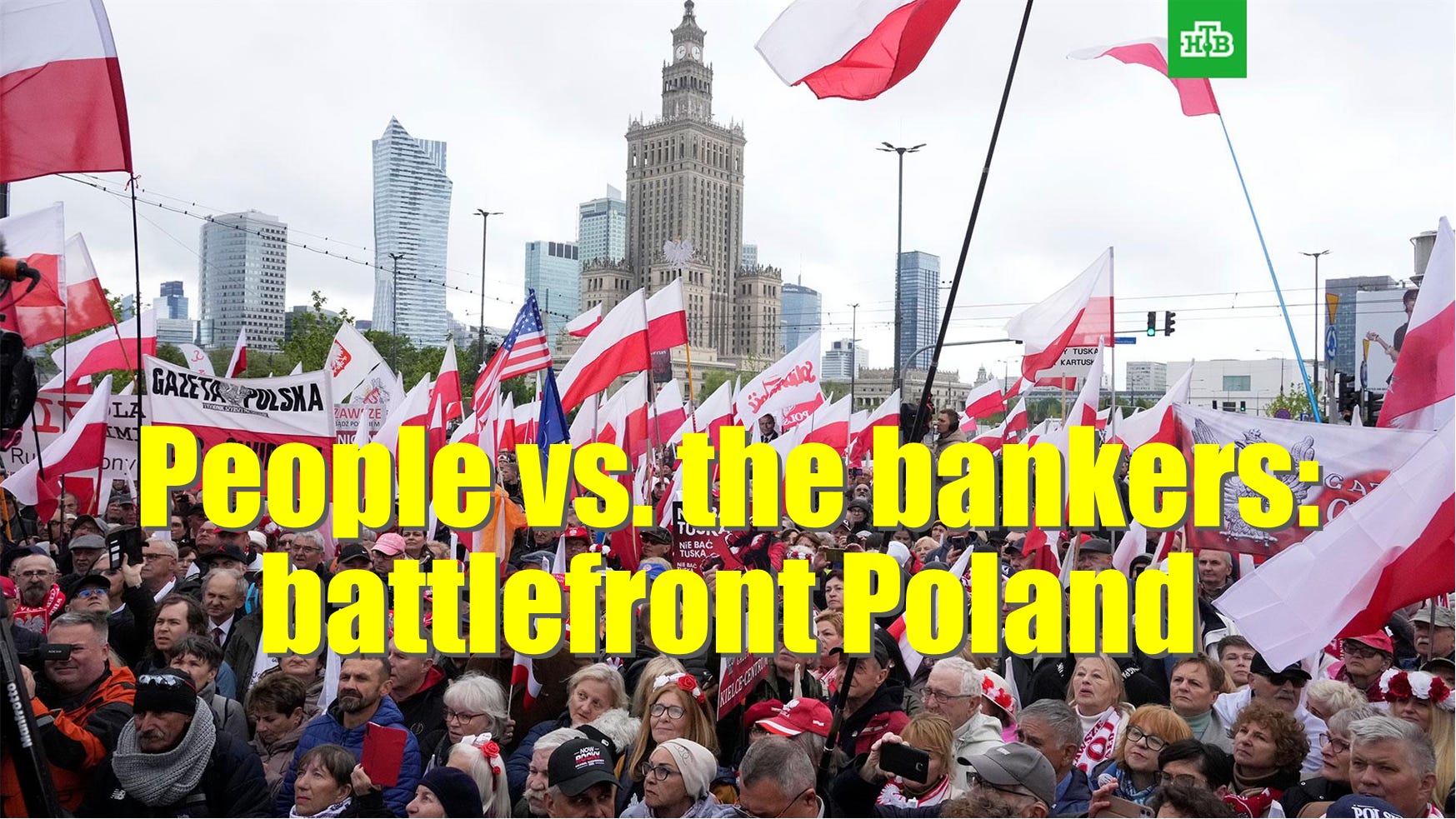
The judicial coup
On Friday, 31 October 2026, after President Karol Nawrocki departed Warsaw for a scheduled trip to Senegal, seven judges elected by the Parliament and led by Anna Korwin-Piotrowska, entered the building of the Constitutional Tribunal. Korwin-Piotrowska, who was not sworn in by president Nawrocki as the Polish Constitution requires, declared herself Chief Justice and proceeded to suspended the sitting Chief Justice Bogdan Święczkowski and his deputy, Bartłomiej Sochański.
At the same time, Poland’s Prosecutor General Waldemar Żurek, who also serves as the Minister of Justice in PM Donald Tusk’s government, ordered the police to isolate the Tribunal, so that when Chief Justice Święczkowski tried to enter the building, he found the gates chained shut and was blocked from entering the premises by the deployed riot police. The Attorney General also stripped the Chief Justice and his deputy of legal immunity from prosecution.
News about the events surrounding the Constitutional Tribunal reached President Nawrocki mid-flight to Senegal and he immediately ordered his plane to turn around. By 1 AM on Saturday morning, he returned to Warsaw and pushed his way through the Police cordon to the Tribunal building, backed by hundreds of people who came out in support of the President and against the government takeover of the Tribunal.
Money strings and weaponized lawfare
To underscore what’s at stake, the Parliament’s Vice-President, Włodzimierz Skalik, commented on the events:
If we allow them to seize the Tribunal by force, tomorrow they will do what they are doing today in Romania. They will annul elections, exclude candidates, and dismantle political parties. They will impose authoritarianism under the clever guise of the rule of law. Today the tribunal, tomorrow a second Romania.
And perhaps a second Ukraine also... Although the forceful seizure of the Constitutional Tribunal failed, the crisis continues and on Monday, 16 November, the National Bank of Poland (NPB) weighed in. Namely, NPB froze the Constitutional Tribunal’s account suspending all payments to and by the Tribunal.
Funds freeze leaves the Tribunal unable to pay judges, staff, or supplies. NPB took this action in spite of its claim that it is not competent to resolve the leadership conflict. Supposedly, freezing the Tribunal’s accounts is merely a precaution. Poland’s Finance Minister Andrzej Domański, correctly characterized this as politicization of the central bank. Indeed, the financial system has been politicized and weaponized against Poland’s sovereignty.
Law of the land over EU “values and norms…”
In July 2020, EU leaders agreed on a €750 billion package to fund Europe’s economic recovery from consequences of the mad countermeasures to the Covid-19 pandemic. Poland’s share in that package was about €36 billion. However, in October 2021 the Eurocrats blocked the approval of those funds to Poland, because they were annoyed by the Constitutional Tribunal’s official affirmation of Polish sovereignty.
In the wake of several verdicts of the EU Court, condemning the actions of the Polish authorities, Poland’s Constitutional Tribunal affirmed the superiority of the Constitution of the Republic over the legislation of the European Union. In effect, the Tribunal pushed against the EU’s introduction of a “conditional mechanism” that would ensure that the recipient states of EU funds adhere to the “values and norms” of the European Union, and that the EU has “tools” to stop such financing in the event of any uppity member states breaking ranks and rejecting their own colonial status.
Traditionally, EU’s “values and norms” included forcing unrestricted immigration and LGBTQ+ nonsense down every member’s throat, but by today it includes also confiscating member nations’ gold, forcing them to give up their sovereign currencies in favor of the euro, and marshalling their military forces to defend democracy and freedom against the, just-about-to-invade, Russian hordes.
“Democracy” under central banks
We may not know exactly why it is so important for the Eurocrats to deprive Poland of her sovereignty or what the ultimate agenda is. We do know, however, that this has been a long-term project and that it wasn’t the first time that the National Bank of Poland intervened in Poland’s “democracy.”
For example, in June 2014, magazine Wprost released a recording of a July 2013 meeting between the Interior Minister Bartolomiej Sienkiewicz and the central bank governor Marek Belka in a Warsaw restaurant. This was about eight months before a general election, and the minister was courting central banker’s support.
The ruling party was concerned that the slow economy and government’s weak budget position could boost public support for the opposition Law and Justice Party.
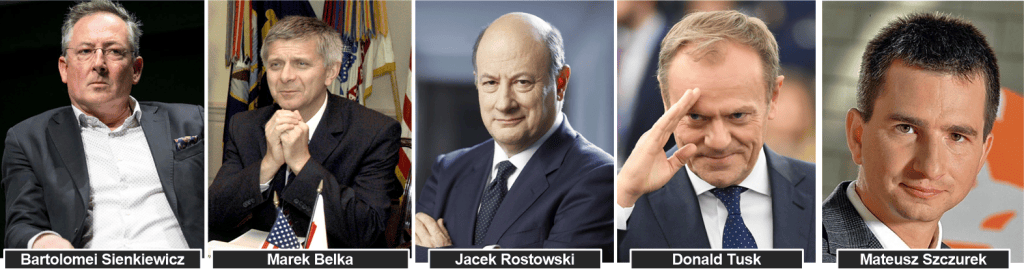
As the former Prime Minister and Finance Minister, Marek Belka was a long-standing political heavy-weight in Poland and was regarded by western interests as a “safe pair of hands” in Poland. In that meeting with Sienkiewicz he discussed “non-standard” support for the government and “very significant change” in the central bank status.
However, the central bank’s support was conditional: the government would have to get rid of their Finance Minister Jacek Rostowski and replace him with a “technical and apolitical minister who would find full support in the central bank.” At the time, ZeroHedge provided a colorful comment:
“Odd: an elected government official being replaced by unelected technocrats who get the blessing of bankers, pardon, central bankers. Where have we seen that before? Oh wait, pretty much in every insolvent European country whose government is merely a group of sock-puppets designed to perpetuate the lie of democracy, and where all the relevant decisions are made by Mario Draghi.”
Indeed, in spite of Mr. Rostowski being named European Finance Minister of the Year by The Banker magazine in 2009 and cited as the third best Finance Minister by the Financial Times in 2012, the government obeyed the central bank’s dictate. Prime Minister Tusk sacked him before the elections and replaced him with the young technocrat Mateusz Szczurek.
Incidentally, the said Mario Draghi himself somehow became the unelected Prime Minister of Italy, proving the export-grade quality democracy that European people are blessed with. Another interesting aspect of this affair is that most of the English language articles about it have been purged since.
Any nation intent on defending its sovereignty should be extremely vigilant about Trojan Horses within its own financial, academic, political and military institutions. If the officialdom, already staffed with obedient technocrats, will ignore the signs of danger and even collaborate with the slow evisceration of their nation’s sovereignty, then the people of such nations should be doubly vigilant so they can recognize the signs of betrayal in time to take corrective action.
This is all the more important today as the empire builders are once more escalating political and military tensions and taking reckless risks that could ultimately lead to another world war.
Wars can errupt suddenly…
How all this could enable certain interests to turn Poland into a new Ukraine and maneuver her into war against Russia may seem abstract and remote today, but we should never be complacent about such risks. Many times in the past, major conflicts escalated suddenly and rapidly past the point of no return.
In 1915, financial journalist W. R. Lawson recalled that, “on the morrow of Sarajevo, not one,” of the political and diplomatic experts showed “the slightest apprehension of the terrible sequel which deluged Europe with blood.” Journalist Hartley Withers wrote that the war “came upon us like a thunderbolt from a clear sky.” Writing in 1925, American historian Alexander Noyes wrote:
“[The] suddenness with which the European War broke out in the middle of 1914, the total absence of popular belief in the possibility of any such event, up to the very week in which it came, are familiar history.”
I can attest to that familiar history also: when the war broke out in the former Yugoslavia in 1991, there was also a nearly “total absence of popular belief in the possibility of any such event…” Tragically however, the war did happen - suddenly and seemingly out of nowhere.
In former Yugoslavia too, the bankers played an important, perhaps decisive role: Slobodan Milošević was a banker who, like Leon Trotsky before him, spent time in New York before he was recruited to the Presidency of the Serbian Communist Party by the grey eminences of the People’s Bank of Yugoslavia, brothers Petar and Ivan Stambolić. Almost as soon as Milošević took power in Belgrade, the cascading events that led to Yugoslavia’s disintegration and wars kicked off.
World War III alert
Today we should pay close attention to the escalating tensions between global powers. For the fault-line nations like Poland, the Baltic states and Ukraine, their people should be weary of being used as a bludgeon in someone else’s imperial project and should regard all foreign meddling with deep suspicion, even if it is dressed up as harmless support for democracy and the rule of law.
They should reject emotional manipulation and demand truth from their media. They should equally demand accountability from their own policymakers. The responsibly to future generations not to repeat the mistakes of the past is today on our shoulders. Let us hope and pray that peace will prevail. But let us also do more than that: each and every one of us must do our part to defend peace and say a clear, resounding NO to the small parasite class who are today clamoring for a new great war.
As I said, we may not know exactly what the agenda discussed by men in smoke-filled rooms is, but we can make an educated guess. Almost exactly 60 years ago, in his 1966 book “Tragedy and Hope,” Carroll Quigley wrote this (p. 278):
“Each central bank… sought to dominate its government by its ability to control Treasury loans, to manipulate foreign exchanges, to influence the level of economic activity in the country, and to influence cooperative politicians by subsequent economic rewards in the business world.”
Poland may be the perfect case in point, connecting the dots in a way that compellingly corroborates Quigley.
Source: Alex Krainer's Substack


Comments
Post a Comment