Paranoia, Industrial Edition
In our last episode, we examined the SAVE and the REAL ID Acts in the United States. Similar legislation is pending or in place in most countries, especially those that are voting members of the United Nations.
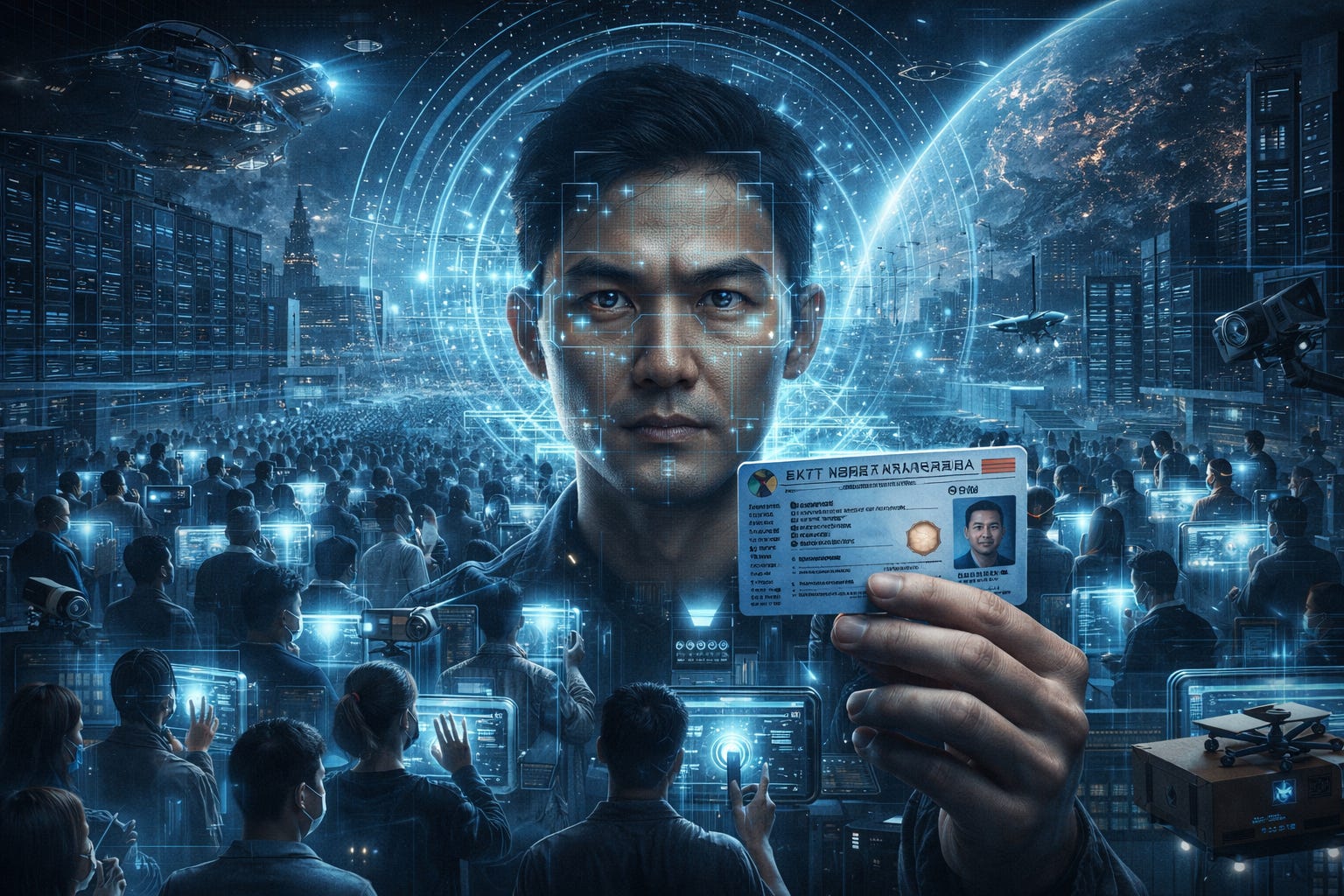
Indonesia already has something functionally broader than REAL ID—and it is actively expanding toward a more integrated digital identity system, with 10 fingerprints, eye and face scans updated every five years. All of this is integrated into a national identity system with each adult (17+) holding an e-KTP card. It does not (yet) have a direct equivalent to the SAVE Act tied explicitly to voting eligibility, but you have to present your e-KTP to register to vote, so it’s functionally the same.
You need an e-KTP to receive a passport, access public buildings or medical facilities, buy land, open bank accounts, on down the line.
To institute a global tokenized identity system, you need to have a “zero point”. This is essentially a global census to capture all existing humans. New tokens start at birth. Us geezers have to be backed into it.
A global census requires everyone to return to their place of residence and sit still long enough to be counted. Enter a global pandemic. You don’t need a real disease, you just need to scare everyone into thinking there is one. The entire vaccine farce is a tagging system, like wearing your “I voted” button. It is also a means to pay off all the layers of bureaucrats that have worked to create and install the system, without calling it a “tax”.
At some point, you need to verify the data collected, and make sure outliers (contrarian folks) are also captured. Enter a global energy crisis that makes it too expensive to travel more than a few miles from one’s place of residence.
If this sounds familiar, it should. We’re in the confirmation cycle now. The “zero point” was 2020, and the confirmation stage runs throughout the 2020s.
The current plan is to have the infrastructure and legal frameworks in place by 2030. By 2040, the system will be online and fully functional in the beta testing phase. By 2050, it will be mandatory, with everything on the planet digitized and tokenized. The year 2050 also marks the point where most humans will never know a world without the system, and the grumpy old geezers who will never comply will mostly be gone.
The policy papers date back to the 1970s. The one currently guiding public policy is Transforming Our World: The 2030 Agenda for Sustainable Development. The never put the plans in a single tidy package, but here’s a general outline up to 2050: The World in 2050 (TWI2050)
Everything you see right now is part of the implementation program. The “Great Reset,” the “Energy Transittion,” the massive data centers, the AI algorithms—it’s all part of an integrated command-and-control system. Everything—including life itself—will be commoditized and traded. All the functions of governance and nation-states will have been subsumed into a global all-encompassing digitized unified robotized network.
If it seems like there’s a big hurry to build out the data centers and power supplies, that’s because there is. According to the plan, there are just four years left to get all the sub-systems operating, and 14 years to integrate and test them. Within 24 years, the system will seem almost invisible to the average human. They will have forgotten that the system exists, or that there was ever another way to live.
Your earnings and income will go directly into your private e-wallet—no banks as we know them. To purchase anything will require nothing more than looking into a camera. You won’t have to go to a store. Just order online, scan your identity, the funds will be automatically deducted, and a drone will deliver the goods within the hour.
By 2050, you likely won’t have to/be allowed to leave your residential closet. If there’s something that requires a physical presence, you’ll simply use Virtual Reality to don a robotic avatar and away you “go”.
To create this world, you would need massive data centers scattered across the globe, or more likely in orbit—exactly what we see happening everywhere we look. Orbit would give you 24/7 sunshine to power the network, -240-degree cooling system for free, and real-time pole-to-pole coverage, much like StarLink.
You would need AI to process and analyze all the data, which we see now. Personal AI agents on your devices predigest your data to take some load off the mother ship. All these “co-pilots” showing up on everything are nothing more than localized pre-processors that minimize the load on central databases.
Indonesia was able to install the system whole cloth, because it’s a “developing” country that did not have a sophisticated legal and technological precedent. In the United States, there’s a long history of distrust of government, as well as an Enlightenment legacy of Natural Rights and rugged individualism, not to mention a century of electrification, telephony and industrialization that must be overcome.
The approaches are vastly different, but they both end in a cradle-to-grave totalitarian nanny state. Indonesia can simply declare it to be so, but the US must assemble the system piece by piece (REAL ID, SAVE, etc.).
Will it work? Probably…for a while, but not for everyone and not forever. Systems never last forever and human nature is to escape cages. One of the oldest concepts in human philosophy was famously expressed by Princess Leia in Star Wars:
“The more you tighten your grip, Tarkin, the more star systems will slip through your fingers.”
Si mundus vult dicipi, ergo dicipitatur.
=====
Our film for make cultural learnings of the day is an old French sci-fi drama by the great Jean-Luc Goddard, called Alphaville (1965). If you’re a fan of French cinema, this is right up your alley, as well as on topic. If not a fan, the pacing and story structure will try your patience. It is, however, an early prediction of the command-and-control society, and the human need to destroy it.
Source: Radio FarSide
Comments
Post a Comment