The PayPal Mafia, the architecture of power and the Rothschild connection
The PayPal Mafia, the architecture of power and the Rothschild connection
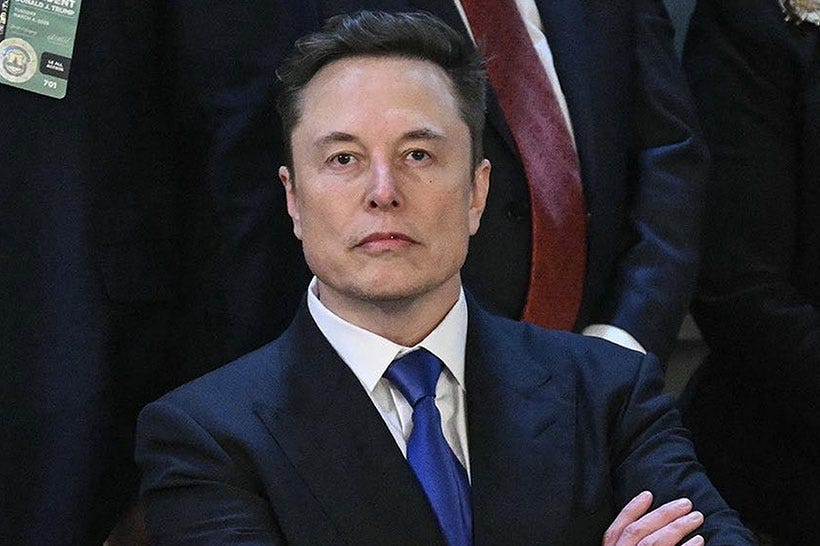
The link between these key figures is no coincidence: it is organic. [Elon] Musk and [Peter] Thiel co-founded PayPal. The network that emerged from this – known as the PayPal Mafia – now holds key positions in the Trump administration: David Sacks is in charge of artificial intelligence and cryptocurrencies; Vice President J.D. Vance’s political career was launched by a $15 million donation from Thiel; Michael Kratsios, Thiel’s former chief of staff, is an adviser to Trump. Thiel also founded, with Vivek Ramaswamy, a financial firm explicitly designed to challenge the responsible investment model promoted by BlackRock.
Documents relating to the Epstein case, made public by the US Congress in 2026, revealed that Thiel’s Valar Ventures fund accepted $40 million from Jeffrey Epstein and that Thiel corresponded with Epstein for five years prior to his death.
The inclusion of the Rothschild dynasty in this investigation is not driven by conspiracy theories. It stems from an analytical necessity. The Rothschilds represent four things simultaneously.
First: the historical model
Rothschild & Co is the institution that invented the model of transnational financial power that BlackRock subsequently industrialised and scaled up to a global level. When, in 1815, Nathan Mayer Rothschild exploited inside information about the Battle of Waterloo to trade on the London Stock Exchange, he established a principle that remains valid today: whoever controls information before others do controls the markets. Palantir does exactly the same thing with digital data. Methodological continuity is the first link.
Second: the current operational presence
Rothschild & Co is not a historical relic. It is an investment bank that describes itself as “the leading advisor to Chinese companies investing in Europe”. The Edmond de Rothschild branch has signed a strategic agreement with the Bank of China. Jennifer Yu, head of Greater China for Rothschild, led the acquisition of Volvo by China’s Geely, responding to her colleagues’ scepticism: “Behind this mouse lies a dragon, and that dragon is China.”
Third: the link with BlackRock
Lord Jacob Rothschild invested through BlackRock funds in the portfolio of his investment firm RIT Capital Partners. E.L. Rothschild, the family’s American branch, sits on the strategic board of FCLTGlobal, the very platform for dialogue on long-term capitalism promoted by BlackRock.
Fourth: the link with Israel
The Rothschild family is historically linked to the founding of the State of Israel. Edmond de Rothschild financed the first Jewish settlements in Palestine. The connection is now operational through the Israeli cyber-security ecosystem: the very same financial intelligence capabilities developed by the Rothschilds in the 19th century—transnational networks, insider information, the ability to influence sovereign decisions through credit—are now encoded in computer programmes and sold as security services by companies such as NSO, Paragon and Cellebrite, all of which originated from Unit 8200 of the Israeli armed forces.
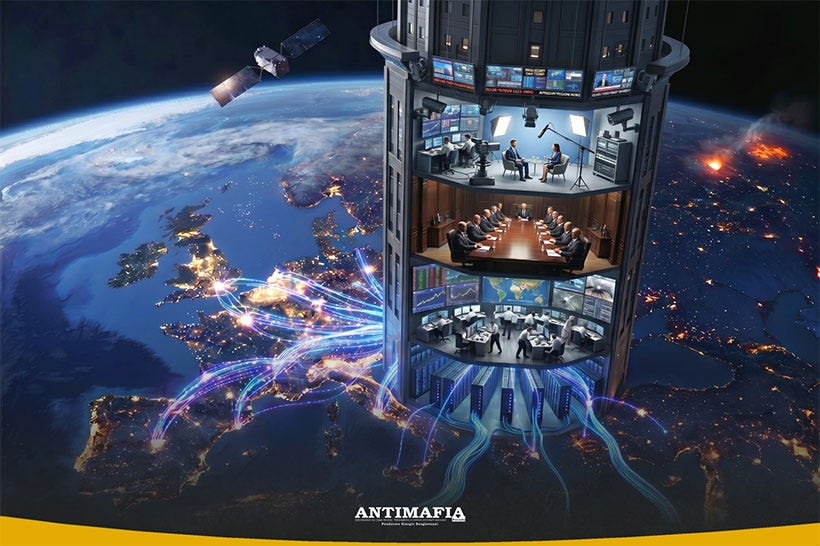
The Rothschilds do not “control the world”. But they represent the source code of the system that BlackRock has industrialised, that Palantir has digitised, and that the Israeli ecosystem has militarised. To ignore them would be like studying a programme without knowing the language in which it is written. To understand the system, we must stop thinking of it as a conspiracy and start thinking of it as an architecture. A four-storey building, where each floor needs the others to stand, where the tenants of one floor are often the owners of another, and where those on the outside—that is, citizens and their elected governments—have no keys to any of the entrances.
The first level is physical: the world’s pipelines
Everything digital requires a physical form. An email, a stock market order, an encrypted communication between an embassy and its home ministry, a satellite image of a military target: all of this exists in the form of electrical impulses travelling through tangible objects. Submarine fibre-optic cables laid on the ocean floor. Satellites orbiting a few hundred kilometres from the Earth’s surface. Semiconductors the size of a fingernail, etched with billions of transistors, without which no computer, no telephone, no weapons system works. Data centres the size of industrial warehouses, filled with servers that consume the energy of a small town to process and store the world’s information. Whoever controls these pipelines controls the first tier of power. And today, there are very few names. Elon Musk controls Starlink, a constellation of over 7,000 low-Earth orbit satellites that is rapidly becoming the planet’s dominant connectivity infrastructure, with plans to reach 42,000 satellites. No government, no company, no international organisation has anything comparable. The European alternative, the IRIS project, will not be operational before 2029, and [Italian Defense] Minister [Guido] Crosetto has admitted that it will take 10–15 years to achieve comparable capacity. In the meantime, anyone needing to communicate securely from space—be it an army at war, an embassy in a crisis zone or a government under cyberattack—must knock on Musk’s door.
TSMC, the Taiwan Semiconductor Manufacturing Company, produces over 90% of the world’s most advanced semiconductors – the ones that power artificial intelligence, next-generation weapons systems and global financial infrastructure. A single company, on an island of 36,000 square kilometres that China claims as its own territory, produces the components without which the digital world grinds to a halt. It is the West’s greatest strategic vulnerability, and also the main reason why Washington cannot afford to lose Taiwan. Finally, data centres are the new oil. Not in the metaphorical sense usually employed: in the sense that whoever owns and powers them controls the physical location where the data of governments, businesses and citizens resides. BlackRock is in talks with ENEL2 to acquire decommissioned power stations and convert them into data centres. Amazon, Microsoft and Google control the vast majority of remote computing services (the so-called “cloud”) relied upon by governments and companies worldwide, including in Italy. The fact is this: Italians’ data, including sensitive information from the public administration, is physically stored in infrastructure owned and managed by American companies, on European soil but under uncertain jurisdiction. The first level of power is therefore this: whoever owns the cables, satellites, chips and data centres owns the body through which everything else moves. Without a body, there is no thought, no money, no narrative. It is the most concrete and least visible level, because the pipes lie underground, in orbit or locked away in anonymous warehouses. But whoever controls them has the power to turn off the tap at any moment. Musk demonstrated this in Ukraine. He can demonstrate it anywhere.
The second level is the brain: those who transform data into decisions
Data, on its own, is useless. A billion phone taps, without a system to read them, compare them and extract meaning from them, is white noise. Millions of satellite images, without an algorithm to identify a military convoy in the middle of a desert, are useless photographs. The movement of billions of Dollars on financial markets, without a model to predict their direction, is just numbers on a screen. The second level of power belongs to those who transform noise into signal, raw data into operational decisions, and the mass of information into military objectives, profiles of suspects, market forecasts and sovereign risk analyses. Today, the two poles of this power are Palantir and the Israeli intelligence ecosystem.
Palantir built its empire starting with the CIA, with funding from the In-Q-Tel fund, and has progressively expanded its presence to dozens of governments, armed forces and intelligence agencies around the world. Its Gotham software is capable of integrating heterogeneous data sources—including wiretaps, satellite imagery, financial records, biometric data and open-source intelligence—and presenting them to analysts via a unified interface that enables the identification of connections, patterns and anomalies invisible to the human eye. The Maven system, designated by the Pentagon on 20th March 2026 as the benchmark standard for battlefield command and control, is the next step: it does not merely analyse data, but suggests actions, simulates scenarios and, in the future, will be able to trigger automatic responses. Those who write the software that interprets reality for generals and intelligence services, in a sense, decide what is real and what is not. They decide who is a target and who is not. They decide which threats exist and which can be ignored.
The Israeli ecosystem operates on the other side of the same cycle. The companies spun off from Unit 8200 of the Israeli armed forces – NSO Group with its Pegasus system, Paragon with Graphite, Cellebrite with its forensic extraction tools for mobile phones, and Cognyte with its mass surveillance platforms – specialise in data collection: penetrating devices, intercepting communications, and extracting information from seized mobile phones. If Palantir is the brain that processes, the Israeli ecosystem is the sensory system that collects. Whoever possesses both possesses the complete intelligence cycle: from collection to analysis, from analysis to decision, from decision to action.
Italy, with its classified defence contracts for Gotham and Israeli platforms in public prosecutors’ offices and intelligence services, is handing over both halves of this cycle to external parties. It controls neither the collection of its own sensitive data nor the analysis carried out on it. In other words: it does not know what those to whom it has entrusted its security know about it. And it has no way of finding out.
The third level is money: who decides where capital goes
If the first level is the body and the second is the brain, the third is the blood that nourishes them. The money that finances the construction of satellites, the development of software, the operation of data centres, the acquisition of strategic companies, and the restructuring of sovereign debt. Here there are three names, known in the world of finance as the “Big Three”: BlackRock with its $14 trillion in assets under management, Vanguard with around $9 trillion, and State Street with nearly $4.5 trillion. Together, these three funds hold significant stakes in almost every major listed company on the planet. According to various academic studies, the “Big Three” are the largest or among the top three shareholders in over 90% of the companies in the S&P 500 index, which comprises the 500 largest US companies. But their holdings do not stop at the United States: they are present in Europe, Asia, Latin America and Africa. In Italy, as we have documented, BlackRock alone holds over €17 billion in stakes in the main listed companies.

These funds do not govern in the sense that a President or Prime Minister governs. They do not issue orders, sign decrees or command armies. Their power is different and, in some ways, more profound: they shape the gravitational field within which all other players operate. When BlackRock decides to overweight a sector in its portfolios, billions of Dollars flow in that direction and the sector grows. When it decides to underweight it, the flow reverses and the sector contracts. When it publishes its sovereign risk index and the assessment of a country is negative, the cost of that country’s debt rises, because the market follows the lead of the world’s largest investor. There is no need to ring ministers. There is no need to bribe anyone. All it takes is to move capital, and the rest follows. The historical template for this model of power is the Rothschild dynasty, which in the nineteenth century invented the fundamental principle of modern finance: whoever controls information before others do controls the markets, and whoever controls the markets influences governments without needing to govern. BlackRock has industrialised that principle and scaled it to a level the Rothschilds could never have imagined. The tokenisation proposed by [Larry] Fink in his 2026 letter—the transformation of every financial security into a digital token tradable 24 hours a day—is the final step in this trajectory: whoever owns and manages the platform on which all the world’s financial transactions take place does not need to own individual companies. It is enough for them to own the market itself.
The fourth level is the narrative: whoever controls what we know and what we think
A system of power, however sophisticated, cannot survive for long if citizens understand how it works and decide to oppose it. This is why the fourth level is, in a sense, the most important of all: it is what protects the other three from the only force that could dismantle them, public awareness. Whoever controls the media and the platforms through which hundreds of millions of people form their opinions controls the scope of what can be said, that is, the boundaries within which public debate can take place. And today, those media outlets and platforms are owned by the very same entities that occupy the first three levels. Elon Musk owns X, the platform that was known as Twitter until 2022 and which remains one of the main spaces where journalists, politicians, financial analysts and the public engage in real-time. Since Musk bought it, the platform has changed its content distribution algorithms, reinstated accounts previously suspended for disinformation, reduced the staff dedicated to content moderation, and systematically amplified political views aligned with those of its owner. When Musk posts a comment on Italy, the war, tariffs or immigration, that comment reaches hundreds of millions of people in a matter of minutes and influences news coverage for days. He is not a columnist: he is the owner of the public square where the debate takes place. Peter Thiel exerts his influence on the narrative in a less visible but no less effective way. The CEO of his company Palantir, Alex Karp, was a member of the supervisory board of Axel Springer, Europe’s largest publishing group, which owns Bild (Germany’s most widely read newspaper), Die Welt, and Politico Europe (the leading portal for European Union politics). Thiel has hired the son of the CEO of Axel Springer as his chief of staff. It is not a matter of directly controlling what journalists write: it is a matter of occupying the positions from which editorial decisions, hiring, and the strategic directions of the groups that shape the opinion of Europe’s ruling classes are influenced.
Finally, BlackRock is a major shareholder in almost all the major publishing and media groups in the Western world. It does not dictate the editorial line of the New York Times or the Corriere della Sera3. But the fact that the largest institutional shareholder of a publishing group is the very same entity that buys the government debt of the very government that group is supposed to act as a watchdog for creates a structural conflict of interest that does not need to translate into explicit orders to have an effect. Self-censorship, caution, and a tendency not to probe too deeply into who pays your dividends are enough. The result is a media system in which the top three levels of power—the infrastructure, the surveillance software, the capital—are also the owners or financiers of the very outlets through which the public is supposed to form an independent judgement on those powers. It is as if the defendant owned the court, paid the judge’s salary and financed the newspaper covering the trial. No one explicitly calls for acquittal: the system is designed so that the demand for conviction is never even raised. That is why this investigation is necessary. Not because the facts are hidden: as the reader will have seen, almost everything written in these pages comes from public sources, official reports, journalistic investigations, US Congressional documents, and letters to shareholders. The facts are there. What is missing is the will to piece them together, to connect them, to call a spade a spade. The fourth estate serves precisely this purpose: to ensure that the facts remain separate, that the dots are not joined, that the bigger picture never emerges.
Source: GeoPolitQ


Comments
Post a Comment